Best Flush Mount MPPT Solar Charge Controllers for Off-Grid Power
Direct answer: Flush-mount MPPT solar charge controllers are ideal for cleanly integrated, wall-mounted solar setups in RVs, boats, cabins, and off-grid dwellings. They simplify installation while providing efficient battery charging and real-time monitoring. This guide highlights five top options, explaining who each product is best for and why it stands out. Use the buying guide to compare features such as mounting design, battery compatibility, and monitoring capabilities to pick the right controller for your system.
Buyer summary at a glance. The table below lists key details for quick comparison.
| Product | Mount Type | Best For | Note | Battery Types |
|---|---|---|---|---|
| LNEX Solar Charge Controller | Flush Mount | RV/off-grid setups needing LCD monitoring | 6-stage PWM with 40A | LiFePO4, AGM, Gel, Flooded |
| Go Power GP-MPPT-PRO-60 | Flush Mount | Users wanting simple SOC display | Remote display option | General 12/24V chemistries |
| Renogy Adventurer 30A | Flush Mount | Seamless RV/off-grid integration | Negative-ground compatibility | Gel/Sealed/Flooded/Lithium |
| Renogy Monitoring Screen (12V 30/50A) | Flush Mount (monitor screen) | Systems needing dual-battery visibility | Dedicated monitoring module | Various, via screen |
| Victron SmartSolar MPPT | Flush Mount (installation) | High-efficiency, flexible energy management | Bluetooth integration | 12/24V options |
LNEX Flush Mount 40A PWM Controller

Product overview and features: The LNEX model is designed to install flush into walls, with a mounting kit included. It offers a 6-stage charging cycle and a backlit LCD display that shows battery voltage, charging current, capacity, and battery temperature. It automatically detects 12V/24V systems and supports lithium, AGM, gel, and flooded batteries. It includes health diagnostics and can revive over-discharged lithium batteries. The memory function recalls prior settings for convenience.
- Best for: Off-grid installations in RVs or cabins where a clean, recessed mount is preferred and real-time LCD monitoring is important.
- Why selected: Combines flush-mount design with multi-stage charging and diagnostic features, aiding battery longevity.
- Limitation: PWM technology generally offers lower efficiency than MPPT in very large or shaded systems.
Go Power GP-MPPT-PRO-60 MPPT Flush-Mount

What to know: The GP-MPPT-PRO-60 uses a flush-mount design and provides a display of current battery charge, voltage, and state of charge. It emphasizes maximum power boost technology to extract more energy during varying light conditions.
- Best for: Users who want a straightforward MPPT setup with a visible charge state directly from the panel.
- Why selected: The flush design makes for a tidy install, while the MPPT boost feature helps optimize output in partial shade.
- Limitation: Fewer detailed battery-type specifications in product notes; verify compatibility for lithium systems in your setup.
Renogy Adventurer 30A Flush Mount Controller

Key details: The Renogy Adventurer 30A is a 12V/24V PWM controller with a flush-mount design and a clear LCD display. It supports gel, sealed, flooded, and lithium batteries and includes a negative-ground option for safe grounding. The kit aims for seamless wall integration and simplified monitoring via a built-in LCD.
- Best for: RV or off-grid systems requiring a compact, wall-embedded controller with broad battery compatibility.
- Why selected: Robust 4-stage charging with a compact form factor and easy wall integration.
- Limitation: PWM technology is generally less efficient than MPPT in high-voltage or long-run system setups.
Renogy Monitoring Screen for 12V System
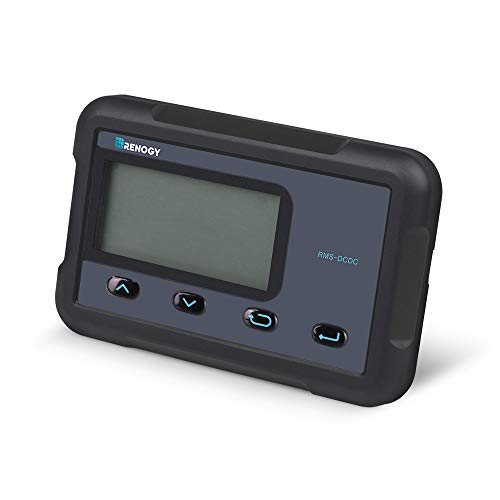
Purpose and use: This product is a monitoring screen that provides dual battery monitoring and adjustable parameters. It connects via RJ45 to a DC-DC and handles real-time data tracking, making it ideal for users who want enhanced visibility into two battery banks and overall system health.
- Best for: Systems requiring enhanced, dual-battery visibility and adjustable charging parameters via a dedicated monitor.
- Why selected: The screen provides direct, easy-to-read data to fine-tune charging performance.
- Limitation: It is a monitoring accessory rather than a full charge controller; ensure compatibility with your controller model.
Victron Energy SmartSolar MPPT 75V/15A

Overview: This Victron MPPT controller emphasizes smart charging with Bluetooth for remote monitoring and configuration. It is designed to maximize power output with fast MPPT, intelligent charge algorithms, and synchronization across multiple controllers for system-wide optimization.
- Best for: Systems seeking high efficiency, Bluetooth monitoring, and scalable multi-controller synchronization.
- Why selected: Victron’s SmartSolar line is known for robust MPPT performance and flexible, future-ready energy management.
- Limitation: Higher feature density may require a learning curve for new users; ensure your system and app ecosystem align with Victron devices.
Renogy Rover 20A MPPT (B01MRWTAB5)

What it brings: The Renogy Rover 20A MPPT controller is designed for 12V/24V systems and supports multiple battery chemistries, including lithium. It targets RV and marine applications with partial shading optimization and a robust 4-stage charging profile.
- Best for: Budget-conscious off-grid setups that still need efficient MPPT charging and broad battery support.
- Why selected: It delivers good multi-chemistry compatibility and strong shading performance at a reasonable size and cost.
- Limitation: The product notes emphasize Bluetooth module compatibility separate from the main unit; confirm any required accessories for full functionality.
Buying Guide: Choosing the Right Flush Mount MPPT Controller
What mounting design matters?
Flush-mount controllers offer a clean, low-profile installation that hides the device behind a wall or panel. They are ideal for compact spaces like RV cabinets, boat interiors, or small off-grid enclosures. Ensure the mounting kit is included and that the wall or panel material is suitable for flush installation.
Which charging method fits your system?
MPPT controllers generally outperform PWM in terms of efficiency, especially when you have longer cable runs or higher panel voltages. If your system uses lithium cells or requires precise voltage control, MPPT is often the better choice. PWM can be adequate for smaller, simpler setups.
Battery compatibility and safety
Check whether the controller supports lithium, lead-acid (gel/sealed/flooded), and any temperature compensation features. Negative-ground compatibility can simplify grounding in some RV or marine installations. Look for protections such as reverse polarity, overcurrent, and surge protection, especially in storm-prone areas.
Monitoring and ease of use
LCD displays, backlit screens, and Bluetooth connectivity make it easier to monitor battery health and adjust charging parameters. If you want remote monitoring, consider modules or apps that sync with the controller. In flush-mount designs, ensure the display remains accessible or that there is an external monitoring option.
System scale and future-proofing
Choose a controller with appropriate amperage for your current solar array. If you anticipate expanding your panel count or upgrading battery chemistries, select a model that can handle higher input or is compatible with lithium reactivation or advanced charging algorithms.
Practical quick-start considerations
- Verify that the controller supports your panel’s voltage and the system’s battery type(s).
- Confirm mounting space and hardware compatibility with a flush installation.
- Plan for monitoring needs: onboard LCD, external display, or Bluetooth/app-based data.
- Prepare grounding and safety steps per your vehicle or building codes.
4 Frequently Asked Questions
- What is a flush-mount MPPT controller?
A flush-mount MPPT controller installs flush with a wall or panel, providing efficient solar charging while maintaining a clean interior aesthetic.
- Why choose MPPT over PWM?
MPPT optimizes energy extraction under varying lighting and higher panel voltages, delivering higher efficiency for most off-grid systems.
- Which battery types are commonly supported?
Most controllers support LiFePO4, AGM, GEL, and flooded lead-acid batteries, with some models offering lithium-specific reactivation or temperature compensation.
- Is Bluetooth monitoring important?
Bluetooth or app-based monitoring helps remote visibility and configuration, but onboard LCDs are often sufficient for direct, at-a-glance status checks.
- Can I use multiple controllers together?
Some models support synchronization of multiple SmartSolar MPPT units, enabling system-wide optimization in larger arrays.