Best Flexible Solar Panels for Marine Use: Bending Power for Boats and Watercraft
Flexible solar panels offer lightweight, curved-surface power solutions for boats, yachts, RVs, and marine vessels. This guide showcases five top options designed to perform on curved roofs, decks, and cabin surfaces, delivering efficient energy generation while resisting harsh marine elements. Below you’ll find quick product highlights, installation notes, and practical buying guidance to help you choose the best panel for your vessel.
Summary of selected products
| Product | Brand | Type | Approx. Output | Key Benefit |
|---|---|---|---|---|
| Renogy 200W Flexible Solar Panel | Renogy | 200W, flexible, 240° bend | 200W nominal | High power with curved-surface compatibility |
| Renogy 100W Flexible Solar Panel | Renogy | 100W, flexible, 240° bend | 100W nominal | Lightweight, versatile for smaller installs |
| DOKIO 100W Flexible Solar Panel | DOKIO | 100W, semi-flexible, 30° bend | 100W nominal | Ultra-light, highly portable for travel kits |
| ALLPOWERS SF200 200W Panel | ALLPOWERS | 200W, ultra-thin, 30° bend | 200W nominal | High efficiency with rugged, waterproof design |
| BougeRV Arch Pro 200W Panel | BougeRV | 200W, N-type, anti-shading | 200W nominal | Stability under partial shading; versatile wiring |
Renogy 200W Flexible Solar Panel for Marine

The Renogy 200W flexible panel is designed for curved surfaces common on boats, RVs, and cabins. It uses half-cut PERC cell technology to boost solar capture and electrical performance, delivering a robust daily output under favorable sun conditions. Weighing about half the weight of rigid panels, it offers an all-black, glare-free appearance and bendability up to 240 degrees, enabling installation on hulls, decks, and curved roofs. Ideal for marine applications where weight, space, and surface flexibility matter.
Renogy 100W Flexible Solar Panel
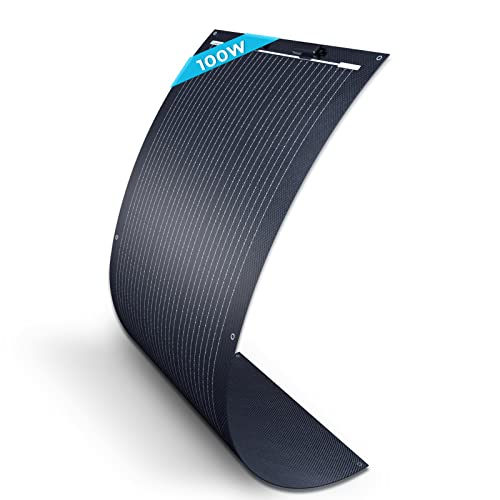
The Renogy 100W option provides a lighter, more compact solution for smaller marine installations or retrofit projects. With a 240° bending capability and a surface that minimizes glare, this panel maintains a discreet profile on curved surfaces while delivering practical energy output. The inclusion of half-cut PERC cells further enhances efficiency, making it a reliable choice for limited roof space or overhead compartments on boats and campers.
DOKIO 100W Flexible Solar Panel

DOKIO’s 100W panel emphasizes portability and ultra-light design. Weighing around 2.3 pounds and just 0.03 inches thick, it’s well-suited for travel kits, RVs, and occasional off-grid marine use. It can bend safely to about 30 degrees to accommodate curved surfaces on vans, boats, and campers. Installation considerations include ventilation to manage heat and avoiding direct mounting on combustible materials. A good fit for temporary setups or seasonal boating scenarios.
ALLPOWERS SF200 200W Flexible Panel

ALLPOWERS offers a 200W flexible panel engineered for high efficiency with ETFE-coated monocrystalline cells. The ultra-thin design (about 3 mm) and weight around 4.1 kg support easy handling and installation on RVs, boats, and camping setups. The panel’s slight bend (up to 30 degrees) suits curved surfaces while maintaining robust weather resistance with an IP68 rating, making it a strong choice for all-weather marine use and off-grid charging needs.
BougeRV Arch Pro 200W Panel

BougeRV’s Arch Pro 200W model emphasizes shading resilience and N-type cell design, using 25% efficiency cells to deliver stable output. Its anti-shading feature helps maintain energy delivery under partial shading, a common scenario on boats with rigging or nearby structures. While wiring configurations can support series connections for higher voltages, it’s important to verify compatibility with your power station to avoid mismatches. This panel blends rugged performance with marine-ready durability.
BougeRV Arch 200W Fiberglass Flexible Panel

This BougeRV model uses a dual fiberglass protection approach to boost impact resistance, making it durable for marine environments. With a maximum flex of up to 270 degrees, it adheres well to curved surfaces and is designed to resist scratches and environmental wear thanks to ETFE cladding. It’s a solid option for tight spaces on decks or curved hatches where traditional rigid panels won’t fit.
Renogy 100W Flexible Solar Panel for Marine

Renogy’s 100W flexible offering targets marine and off-grid applications where weight and surface conformity matter. The panel is marketed for extremely high flexibility, enabling mounting on curved surfaces such as airstream roofs or boat decks. It’s designed to be lightweight and thin, delivering a discreet installation with a minimized silhouette while still providing meaningful daily energy output when paired with a battery system or portable power station.
Callsun 100W Ultra-Thin Flexible Panel
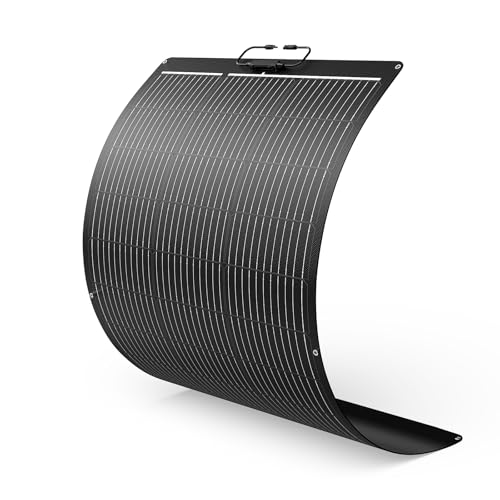
Callsun’s 100W panel is engineered for curves with a 240-degree bend and an ultra-light profile. It uses ETFE coating to resist yellowing and provide saltwater resilience for marine environments. The panel is positioned as a universal partner for solar generators and power stations, suitable for RVs, boats, and trailers. Potential buyers should confirm compatibility with their existing charge controllers and inverters to ensure optimal charging performance.
Buying Guide: Key Considerations When Choosing Flexible Marine Panels
- Surface compatibility: Check the maximum bend angle and the surface curvature of your vessel. Panels rated for 240° or 270° bending are more versatile on hulls, decks, and curved cabins.
- Weight and thickness: Lighter, thinner panels ease handling and installation on boats where weight distribution matters. ETFE-coated panels generally offer better durability than PET alone.
- Efficiency vs. area: Higher efficiency cells (22–25%) deliver more power in limited roof space, but you may still need more area for larger boats or higher energy demand.
- Durability and weather resistance: Look for IP ratings (IP68 is common for marine panels) and robust laminates that withstand salt spray, UV exposure, and temperature swings.
- Cell technology: Half-cut PERC and N-type cells can improve light capture and reduce shading losses, which is valuable on partially shaded decks or rigged boats.
- Installation approach: Decide between permanent mounting, semi-permanent mounts, or portable configurations. Proper ventilation beneath panels helps prevent heat build-up and efficiency loss.
- Electrical compatibility: Verify voltage and open-circuit voltage (VOC) ranges to ensure compatibility with your charge controller, battery bank, and inverter. Some panels’ VOC may exceed what certain power stations tolerate.
- Expansion potential: If you anticipate growing your battery capacity or adding more panels, consider panels that are easy to wire in series or parallel and that share similar electrical characteristics.
- Maintenance: ETFE panels are easier to clean and more resistant to abrasion; plan for periodic cleaning and inspection to maintain performance on the water.
When selecting a flexible marine panel, balance surface fit, weight, and electrical performance against the specific energy needs of your vessel. For boats with curved surfaces, these flexible panels offer practical, space-saving solutions that maintain efficiency even under marine conditions. Pair any panel with a compatible marine-rated charge controller and weatherproof connections to maximize longevity and performance on the water.