Best Flexible Solar Panels for Van Roofs: Ultra-Light, Curved-Surface Power Options
For camper vans and RVs, flexible solar panels offer a lightweight, low-profile way to keep batteries charged on curved or irregular roofs. The following selections are among the most suitable for van builds, emphasizing bendability, weight, efficiency, and compatibility with 12V or 24V systems. The list below highlights five top options with strong performance on curved van roofs, coastal cabins, and other non-traditional mounting surfaces.
| Product | Brand | Wattage / Type | Key Benefit |
|---|---|---|---|
| Renogy 200W Flexible | Renogy | 200W, Flexible | High power output; 240° bendability; half-cut PERC cells |
| Renogy 100W Flexible | Renogy | 100W, Flexible | Compact, lightweight; 240° bendability; PERC tech |
| Renogy 200W N-Type 24V | Renogy | 200W, 24V | Smaller, lighter; 25% efficiency; 24V compatibility |
| Greenmagic 200W | Greenmagic | 200W, Flexible | Ultra-thin, lightweight; high efficiency; curved-surface ready |
| ECO-WORTHY 260W Kit | ECO-WORTHY | 260W, Flexible | Higher total wattage; included controller; off-grid versatility |
Renogy 200W Flexible Solar Panel

This panel delivers strong daily energy, averaging about 1000 Watt-hours under five hours of sun. It’s designed for curved surfaces with a 240° bend range and weighs roughly half that of a rigid panel, offering an all-black, glare-free appearance. It uses half-cut PERC cell technology to enhance light capture and electrical performance, improving overall output efficiency on van roofs or other rounded structures.
Renogy 100W Flexible Solar Panel
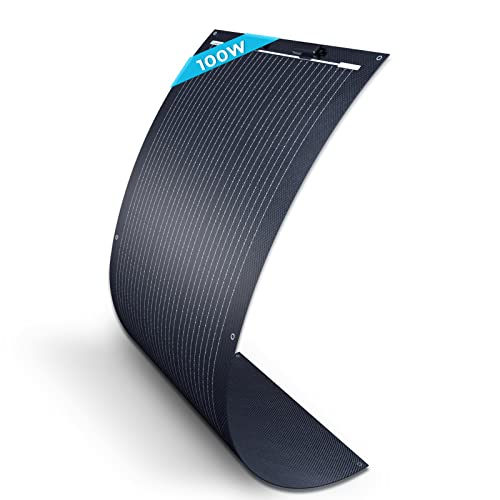
This 100W panel is ideal for smaller van roofs or supplementary charging. It’s bendable within 240°, weighs about one third of a rigid panel, and features an all-black, glare-free surface. The half-cut PERC cell technology boosts efficiency and light capture, helping maximize daily output under varied sun conditions.
Renogy 200W N-Type 24V Panel

Designed for Class B vans and tight spaces, this 200W panel is 7.5% smaller and 11.7% lighter than earlier models. It uses 16BB cells to achieve about 25% efficiency, reducing microcracks and improving performance, particularly in high temperatures. It supports both 12V and 24V battery systems for flexible installation on van roofs or other compact setups.
Greenmagic 200W Flexible Solar Panel

Greenmagic USF-200 offers a thin, ultralight design at about 8.5 pounds with a thickness of 0.11 inches. It features high conversion efficiency, with a 23%–25% range using advanced monocrystalline material and ETFE surface. The MC-4 outputs and included mounting straps support installation on RVs, boats, trailers, or uneven roof surfaces.
ECO-WORTHY 260W Flexible Kit

This kit bundles two 130W panels with a 30A 12V controller and necessary cabling, expanding daily output to about 1040Wh under favorable sunlight. It uses a lightweight polymer construction, making transportation and mounting easier on off-grid vans, boats, or RV roofs. The upgrade from 100W to 130W per panel increases overall power generation by about 30% in good sun.
Buying Guide: Flexible Solar Panels For Van Roofs
- Flexibility and weight: Look for panels with high bend radii (often up to 240°) and low weight to suit curved van roofs without compromising structural integrity.
- Cell technology: Half-cut PERC or mono-crystalline cells improve efficiency and performance in shaded or high-temperature conditions, which is common in uninsulated van roofs.
- Voltage and system compatibility: Choose panels that match your battery bank (12V or 24V) and include or be compatible with suitable controllers or power optimizers for off-grid use.
- Durability and mounting: Consider thin laminates, ETFE or tempered surfaces for weather resistance, along with mounting straps or adhesives designed for curved surfaces.
- Real-world outputs: Daily watt-hours depend on sun exposure; design for your typical climate and altitude. A higher wattage panel can compensate for less-than-ideal sunlight.
- Maintenance and longevity: Assess warranty terms, curb appeal, and ease of cleaning; flexible panels may need careful handling to avoid microcracks during bending.
- Scalability: If you plan to expand, choose panels with compatible mounting patterns and a modular kit approach to add more capacity later.
- Cost vs. benefit: Weigh the initial cost against potential daily energy gains, especially if you rely on solar during extended trips without shore power.
These options provide a spectrum of capabilities—from compact 100W units suitable for minimal setups to 260W kits designed to maximize daily production for larger van systems. Each product emphasizes lightweight construction, curved-surface adaptability, and modern cell technology to optimize performance on van roofs.