Best Flexible Solar Panels for Sailboats: Lightweight Power on the Move
Finding reliable flexible solar panels for sailboats means balancing weight, flexibility, and efficiency on curved hulls or deck surfaces. The following picks are specifically highlighted for marine environments, easy installation, and dependable performance under varying sunlight. The table below summarizes key specs for quick comparison.
| Product | Brand | Peak Power (W) | Notes |
|---|---|---|---|
| Renogy 200W Flexible | Renogy | 200 | High efficiency; 240° bendable; marine ready |
| ECO-WORTHY 260W Kit | ECO-WORTHY | 260 | Two 130W panels; lightweight; curved surfaces |
| Renogy 100W Flexible | Renogy | 100 | Compact; half-cut PERC tech |
| GCUSSZ 1200W Kit | GCUSSZ | 1200 | Two 600W panels; flexible for boats |
| Greenmagic 200W | Greenmagic | 200 | Ultra-thin; high flexibility |
The selections emphasize lightweight construction, compatibility with curved surfaces common on sailboats, and robust performance in marine conditions. Each option brings a different balance of wattage, installation flexibility, and ease of transport, helping sailors tailor a solar solution to cabin power, trolling motors, and onboard electronics.
Renogy 200W Flexible Solar Panel For Marine Use

Renogy’s 200W flexible panel uses half-cut PERC technology to maximize light capture and electrical efficiency, delivering an average daily output around 1000 Wh under typical sun. Its 240° bend radius supports curved hulls and deck surfaces, and its lightweight design reduces load on sails and fittings. This panel is known for an all-black, glare-free appearance that blends with marine aesthetics.
ECO-WORTHY 260W Flexible Kit For Boats

This kit combines two 130W flexible panels designed for uneven surfaces on sailboats. It delivers up to about 1040 Wh per day under favorable sun, with an emphasis on portability and quick installation. Edge-mounted pre-drilled holes allow simple fastening with adhesives, silicone, or Velcro, making it suitable for temporary or semi-permanent marine installations.
Renogy 100W Flexible Solar Panel
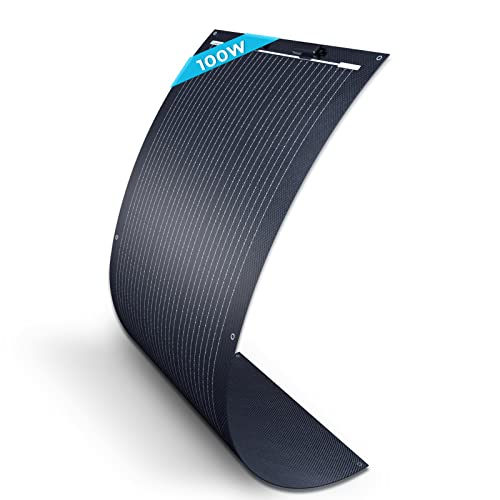
Renogy’s 100W option provides a compact, bendable solution for smaller sailboat surfaces. Half-cut PERC cells support efficient energy capture, while the panel’s lightweight construction reduces draught and handling effort. Suitable for cabin charging, navigation electronics, and small auxiliaries on vessels with tight installation spaces.
GCUSSZ 1200W Flexible Solar Kit

This high-capacity kit features two 600W flexible panels designed for larger sailboats or yachts. It emphasizes high conversion efficiency and reliability under low-light conditions. The flexible construction supports curved deck areas, cabin tops, and hull contours, helping maintain a steady power supply for heavy-use systems during longer cruises.
Greenmagic 200W Ultra-Thin Flexible Panel

Greenmagic offers a compact 200W panel that is exceptionally thin and light, weighing around 8.5 pounds with a 0.11 inch thickness. Its 23–25% conversion efficiency and MC-4 output ports provide versatile integration with marine battery banks and power stations. Curved-surface compatibility makes it a strong choice for sailboats seeking added redundancy without heavy hardware.
Buying Guide
Key considerations when selecting flexible solar panels for sailboats include wiring versatility, weight, and durability against salt spray and wind. Panels that bend easily (up to 240 degrees or more) fit curved deck areas but should also come with robust waterproof cables and MC-4 connectors. Efficiency matters in shaded or mixed sunlight; monocrystalline cells and ETFE surfaces tend to perform better in marine environments. Installation options—adhesive mounting, Velcro, and pre-drilled holes—affect how permanently you secure panels on deck or cabin tops. For larger boats, higher wattage kits can reduce the need for multiple panels, while lighter, compact panels suit smaller craft and portable power stations. Compare output per kilogram to estimate carry-weight impact on vessel performance. Consider a balanced system with a reliable charge controller to prevent battery overcharge and to optimize daily energy harvest in varying sea conditions.