Best Flexible Solar Panels for RVs: Ultra-Light, Curved-Surface Power Solutions
Flexible solar panels offer a versatile, lightweight way to power RVs, boats, campers, and vans on uneven or curved surfaces. This guide highlights five top options and explains how to choose the right kit for off-grid adventures. Each product is evaluated on flexibility, durability, efficiency, and ease of installation so you can compare at a glance and make an informed decision for sustained outdoor energy.
| Product | Power (W) | Key Benefit | Surface Fit |
|---|---|---|---|
| DOKIO 400W Flexible Panels | 400 | Expandable, scalable for 12V/24V | Curved surfaces |
| Topunive 100W Flexible Panel | 100 | Very high flexibility, lightweight | Irregular surfaces |
| Callsun 400W Flexible Panel Set | 400 | 2x200W, cool-running design | Marine and RV decks |
| 1000W Flexible Panel Kit (2x500W) | 1000 | High power, strong on uneven roofs | Curved surfaces |
| Renogy 100W Flexible Panel | 100 | High efficiency, ultra-light | Curve surfaces |
DOKIO 400W Flexible Panels: Expandable For RV Power

The DOKIO 400W set combines four 100W modules into a scalable power solution ideal for expanding 12V or 24V systems on RVs, campers, and trailers. Panels are semi-flexible, bending up to 30°, which helps fit curved roofs while maintaining efficiency. Installation emphasizes ventilation: leave space for heat dissipation and avoid mounting on combustible materials or under cables that trap heat. This kit suits users who want modular capacity and reliable performance in varying conditions.
Topunive 100W Flexible Panel: Ultra-Portable Power

Topunive’s 100W panel uses 9BB monocrystalline cells for high efficiency (up to 23%) in a lightweight 920x590x3mm form. It’s designed for irregular surfaces on trailers, RVs, boats, and cabins. With a minimal thickness and pre-drilled mounting holes, installation is straightforward. Its flexibility and compact weight make it ideal for travelers who seek viable off-grid power without heavy rigid panels.
Callsun 400W Flexible Panel Set: Premium ETFE
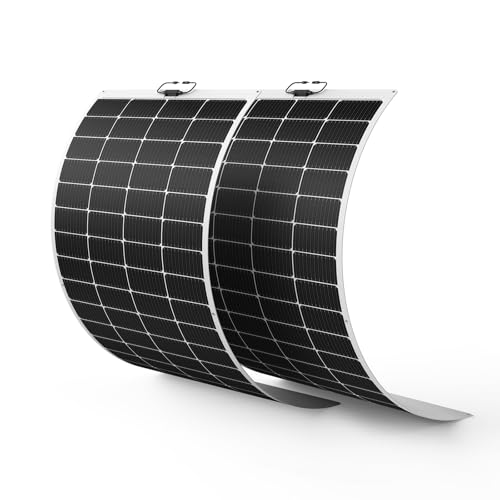
The Callsun set features two 200W panels with a premium ETFE coating for durability against harsh weather. Designed for large RVs, catamarans, and other off-grid installations, the system stays cooler with a white backsheet, reducing heat-related power loss. Its flexible design supports installation on curved decks and roofs while remaining lighter than rigid panels, enhancing handling and setup on the go.
1000W Flexible Panel Kit: 2x500W For RVs

This kit includes two 500W monocrystalline panels with a 30° bend tolerance, enabling installation on uneven RV roofs or boat decks. The ETFE-coated modules offer good weather resistance and durability for extended outdoor use. The configuration suits users needing substantial power for appliances and devices in mobile off-grid settings, while still accommodating curved surfaces through flexible mounting.
Renogy 100W Flexible Panel: Lightweight Efficiency
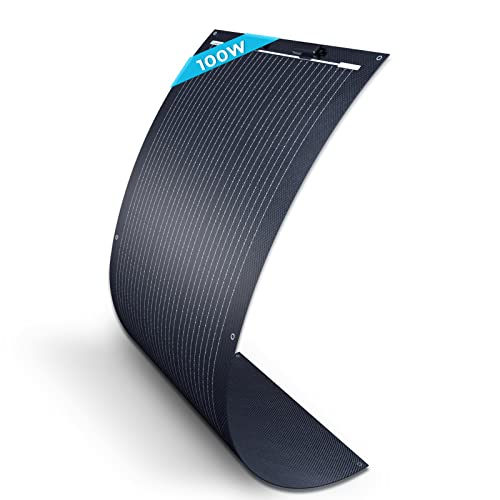
Renogy’s 100W flexible panel delivers high efficiency with half-cut PERC cell technology to maximize sun capture on curved surfaces. Weighing significantly less than rigid options, it’s easy to transport and install on RVs, campers, boats, or cabins. The panel’s 240° bend tolerance allows mounting on complex geometries without compromising electrical performance.
Buying Guide: Choosing The Right Flexible RV Solar Panel System
- Flexibility and bend radius: Match the panel’s curve tolerance to your vehicle’s roof or hull shape. Panels that bend up to 30° are common and work well on most RVs and boats.
- Weight and handling: Lighter panels simplify installation and reduce roof loading. Compare panel thickness and total kit weight to ensure safe mounting.
- Durability: ETFE coatings, reinforced edges, and weather resistance extend lifespan in sun, wind, and rain. Look for UV stability and robust mounting options.
- Power needs and scalability: Start with a base wattage, then add panels if you expand your energy demand. Consider 12V vs 24V configurations and charge controller compatibility.
- Installation method: Pre-drilled holes, adhesive mounting, or Velcro-based setups affect permanence and ease of removal. Ensure proper ventilation to prevent heat buildup under panels.
- Efficiency and cell technology: Monocrystalline cells with higher efficiency (e.g., 23%+) provide better output on partial sun. Half-cut or multi-busbar designs can improve durability and performance.
- Weather resistance and warranties: Look for ETFE or other durable coatings and a solid warranty that covers coating degradation and power output over time.
- Cost vs. benefit: Flexible kits typically offer convenience at a premium. Assess total system cost against expected daily output under typical travel conditions.
When evaluating options for RVs, boats, or campers, prioritize panels with proven durable coatings, reliable efficiency, and flexible mounting that suits your surface. For larger power needs, consider kits that pair multiple panels with a compatible controller and battery setup to maintain steady performance during trips.