Best Fan Coil Line-Voltage Thermostats for Central Heating and Cooling
When shopping for a fan coil line-voltage thermostat, the top pick should match your system type, wiring options, and installation needs. This guide highlights five reliable line-voltage thermostats suitable for electric baseboards, fan coil units, and PTAC setups. It targets buyers seeking simple mechanical controls or programmable options, with clear reasoning for who each model is best for.
| Product | Brand | Best For |
|---|---|---|
| Buachois Adjustable Manual Line Volt Thermostat | Buachois | Simple manual control for central AC/heat with multiple wiring modes |
| Peco TA167-007 3 Speed Non-Programmable | Peco | Line-voltage, three-speed fan control for easy tuning |
| Stelpro Single Pole Line Voltage Thermostat (SWT1F) | Stelpro | Versatile, broad compatibility with many heating products |
| Legacy TH5 Line Voltage Thermostat Assembly | Legacy | Standard 120V setup with heating/cooling switching |
| Peco TB155-046 3 Speed Programmable | Peco | Programmable line-voltage control with multi-speed fan |
Buachois Adjustable Manual Line Volt Thermostat
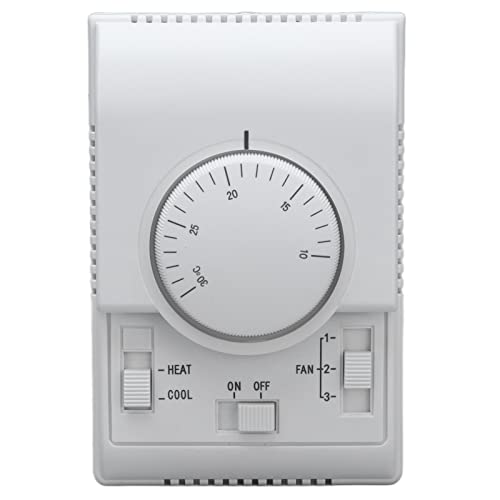
Features include multiple working modes and flexible wiring options. It supports single line or double line configurations, enabling valve and fan control according to installation needs. The device uses a 220V contact rating for durable switching and claims high end-of-life durability for manual operation.
Best for: Homeowners who want straightforward manual control with several wiring choices for central HVAC. Caution: installation details are essential; refer to the included instructions to ensure proper wiring and safety.
Peco TA167-007 3 Speed Non-Programmable

This line-voltage thermostat supports electric, gas, and PTAC systems with a heat-off-cool capability. It emphasizes solid-state precision and dependable operation. Best for: users seeking a simple, robust, non-programmable option with clear speed control and reliable performance. Limitation: lacks programmable scheduling for automatic mode changes.
Stelpro Single Pole Line Voltage Thermostat

Designed for a wide range of heating products, this mechanical dial thermostat enables easy and precise temperature adjustments. Installation is straightforward with a simple two-wire connection, making it suitable for both residential and commercial applications. Best for: users needing a versatile, easy-to-install thermostat for diverse heating equipment. Caution: mechanical dials may require periodic calibration in changing environments.
Legacy TH5 Line Voltage Thermostat Assembly

This thermostat offers standard 120V operation with a simple heating or cooling control scheme via a three-prong plug. It is positioned for easy wiring changes and quick setup. Best for: users who want a basic, ready-to-wire line-voltage solution. Caution: ensure compatibility with your specific AC system and outlet configuration.
Peco TB155-046 3 Speed Programmable

Equipped with on-off control and three fan speeds, this programmable line-voltage thermostat enables scheduling and precise climate management. Best for: homes or offices seeking energy efficiency through programmable control and multi-speed air handling. Caution: programming features may require a short setup time to learn the interface.
Buying Guide: Key Considerations for Line-Voltage Fan Coil Thermostats
- System compatibility: Confirm whether your setup is electric baseboard, fan coil, PTAC, or another line-voltage configuration. Some models support dual line or single line wiring.
- Control type: Choose between mechanical (dial or switch) and programmable options. Mechanical models are typically simpler, while programmable units save energy with scheduled heating and cooling.
- Number of speeds: If you have a multi-speed fan, a thermostat offering 2- or 3-speed control provides better comfort and efficiency.
- Installation requirements: Look at wiring methods, required clearance, and whether a standard 86-type enclosure is supported. Some units are designed for quick, two-wire installations.
- Durability and load: Check voltage and current ratings (e.g., 120V, 220V, or higher; amp capacity) to ensure safe operation with your equipment.
- Safety considerations: For line-voltage devices, proper electrical isolation and adherence to local electrical codes are essential. Consider hiring a professional if unsure.
- Maintenance: Mechanical thermostats may require calibration over time; programmable units may need periodic software-like updates or resets after power interruptions.
FAQ
- What does “line voltage” mean in thermostats?
Line-voltage thermostats control devices powered directly by household electrical circuits (typically 120V or 240V). They switch heating elements or fan motors without low-voltage transformers.
- Are programmable line-voltage thermostats worth it?
Yes, for energy savings and scheduled comfort. Programmable units can adjust temperatures automatically based on time and day, reducing unnecessary heating or cooling.
- Can I install a line-voltage thermostat myself?
Some models support simple two-wire installations, but wiring safety is critical. If unsure, consult a licensed electrician.
- What is the difference between single-pole and double-pole line-voltage thermostats?
Single-pole switches control the hot line; double-pole switches disconnect both hot and neutral, offering safer and more complete isolation in some circuits.
- Which product is best for a small apartment with baseboard heating?
A compact, single-pole line-voltage thermostat with straightforward wiring is often best for compact setups and quick replacement.
- Do line-voltage thermostats affect cooling-only systems?
They can control cooling when connected to compatible HVAC equipment. Ensure the device supports cooling/fan operations in your system configuration.