Best Exterior Wall Flood Lights to Brighten Your Home Exterior
Answering your search for reliable exterior wall flood lights, this guide highlights five top picks that balance brightness, durability, and ease of use. Ideal for homeowners, landscapers, and property managers, these lights suit entryways, driveways, yards, and garages. Each option emphasizes clear nighttime visibility, weather resistance, and simple installation. Below, compare means of brightness, power, and installation style to choose the right fit for your space.
| Product | Best For | Key Benefit | Power / Lumen | Waterproof Rating |
|---|---|---|---|---|
| Onforu 3200LM Flood Lights Outdoor | Small-to-medium homes | Two adjustable heads for flexible coverage | 32W, 3200 lm | IP66 |
| Lithonia HomeGuard 2-Light LED | Yards and driveways needing broad coverage | Elegant design with integrated glare control | 2x LEDs, 2750 lm total | IP65 |
| Onforu 75W Flood Lights Outdoor | Large areas and entryways | Three adjustable heads for wide reach | 75W, 7000 lm | IP65 |
| CINOTON 120W LED Flood Lights | Rural or commercial spaces | High brightness with wide range | 120W, 16800 lm | IP65 |
| LUTEC P6221B 2000 Lumen Dual-Head | Walkways and entrypaths | 360° adjustable heads for precise targeting | 18W, 2000 lm | IP65 |
Onforu 3200LM Flood Lights Outdoor

Two adjustable LED heads provide flexible lighting angles, ideal for highlighting porches and entryways. This model is an energy saver with 32W producing 3200 lm, designed to replace higher-wattage bulbs. It is best for homeowners who want wall-switch controlled lighting with straightforward installation. A limitation is that it lacks motion sensing, so it won’t trigger automatically when you arrive home after dark.
Lithonia Lighting HomeGuard 2-Light LED
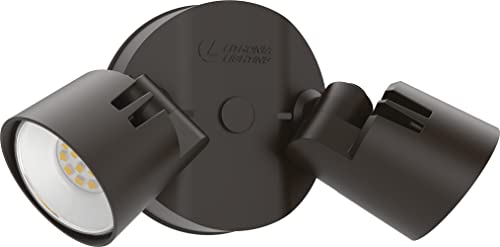
This dual-head fixture offers broad coverage and is well-suited for yards, driveways, and walkways. With 2750 lm of 4000K cool white light and a durable die-cast housing, it pairs practical brightness with robust construction. It includes a glare-minimizing design, making it good for residential settings where comfortable nighttime illumination is desired. Best for those who want a straightforward, stylish exterior light with reliable performance and minimal glare.
Onforu 75W Flood Lights Outdoor

This three-head flood light provides a wide 270° illumination angle, making it a strong option for larger entryways or yards. With 7000 lm brightness and 75W power, it offers substantial coverage while staying energy efficient. It is best for properties needing broad, even lighting across a wide zone. A potential drawback is that it requires a wall switch for operation, with no motion sensor feature.
CINOTON 120W LED Flood Lights

High-brightness 16800 lm with a 180° knuckle mount delivers a wide, powerful beam suitable for barns, garages, or large courtyards. IP65 waterproofing and die-casting aluminum housing support durability in adverse weather. Best for properties needing intense illumination with long lifespan and strong heat dissipation. Limitation: significant upfront wattage relative to smaller residential lights.
LUTEC P6221B 2000 Lumen Dual-Head

Two heads deliver 360° adjustable coverage, ideal for guiding walkways or illuminating entry points. With 2000 lm at 5200K daylight white, it offers bright yet crisp lighting. IP65 rating ensures weather resistance. Choose this if you want flexible aiming for tight pathways or doorways. Limitation: lower total lumen output than high-will models for very large spaces.
Buying Guide: Exterior Flood Light Purchase Considerations
- Brightness needs: Estimate your area in square feet and desired light level (lumens). Higher lumens suit large outdoor spaces; smaller areas may only require a few thousand lumens.
- Power and efficiency: LED flood lights offer energy savings over traditional bulbs. Compare wattage to lumens to judge efficiency.
- Coverage and mounting style: Look for adjustable heads and mounting options (wall, ceiling, knuckle arms) to aim light where needed.
- Weather resistance: IP ratings (IP65 or higher) indicate protection against water and dust. Durable housings extend lifespan in exposed environments.
- Control type: Switch-controlled lights are simple but lack automatic triggering. Motion-sensor or dusk-to-dawn options improve security and energy use.
- Color temperature: 3000K–4000K yields warm to neutral white, while 5000K–6500K provides daylight white for higher visibility. Choose based on ambience and task lighting needs.
- Installation considerations: Ensure electrical compatibility and clearances for wiring. Some units offer tool-less installation, which speeds up setup.
Frequently Asked Questions
- What is the main difference between IP65 and IP66 ratings?
IP65 protects against water jets from all directions and dust; IP66 provides higher protection against powerful water jets, making it more resistant in heavy rain or high-wind areas.
- Do I need a motion sensor for exterior flood lights?
Motion sensors save energy by only lighting when movement is detected, but switch-controlled lights offer simple, immediate control without sensors.
- How many lumens are ideal for a residential entryway?
For a standard entry, 2000–4000 lumens is often sufficient. For larger entrances or driveways, 6000–8000 lumens can improve visibility and security.
- Can outdoor flood lights interfere with neighbors?
Choose lights with good glare control and proper aiming to minimize light spill. Adjustable heads help limit over-illumination onto neighboring properties.
- Are LED flood lights more durable than traditional bulbs?
Yes. LEDs have longer lifespans, lower energy use, and better heat management, which improves reliability in outdoor conditions.
- What is the advantage of a dual-head or triple-head design?
Multiple heads provide wider coverage and flexible aiming, reducing the number of fixtures needed to illuminate large areas.