Best Exhaust Fans With Speed Control for Any Space
Yes, a variable-speed exhaust fan can tailor airflow to your needs, conserve energy, and reduce noise. This guide highlights five top picks with adjustable speed controls, suitable for garages, greenhouses, attics, workshops, and sheds. Each option is described with who it’s best for and practical limits. Use the quick-reference table below to compare core specs at a glance.
| Product | Airflow (CFM) | Speed Control | Typical Use |
|---|---|---|---|
| iLiving ILG8SF12V-ST | 960 | Variable + Thermostat | Large garages, warehouses |
| VEVOR 10″ Exhaust Fan | 900 | Stepless variable | Attics, sheds, workshops |
| addlon 12″ Shutter | 1250 | 8 speeds + remote | Garages, greenhouses, studios |
| HG Power 8″ Exhaust Fan | 567 | Infinity speed controller | Kitchen, bathrooms, attics |
| KEN BROWN 24″ Shutter | 4200 | Speed controller | Large shops, barns, greenhouses |
iLiving 12″ Wall Mounted Shutter Exhaust Fan with Thermostat and Variable Speed

The iLiving ILG8SF12V-ST combines a 12-inch shutter exhaust with a variable-speed controller and thermostat. It delivers up to 960 CFM at 115V and is designed for larger spaces up to about 1,400 square feet. Best for: industrial spaces, warehouses, or sizable workshops where precise temperature-controlled ventilation is key. Limitation: noise stays under 65 dB, but the motor is purpose-built for continuous use, so expect steady operation rather than ultra-quiet performance.
VEVOR 10” Exhaust Fan With Variable Speed Controller

VEVOR’s 10-inch shutter fan offers 900 CFM with stepless, variable-speed control. Built for attic and workshop ventilation, it’s designed to expel heat and odors quickly while maintaining a quieter operation. Best for: year-round ventilation in attics or sheds where you want scalable airflow. Caution: ensure the mounting area supports a 10-inch unit and verify shutter operation in cold environments to avoid stiction in extreme temperatures.
addlon 12″ Shutter Exhaust Fan With Remote and 8 Speeds
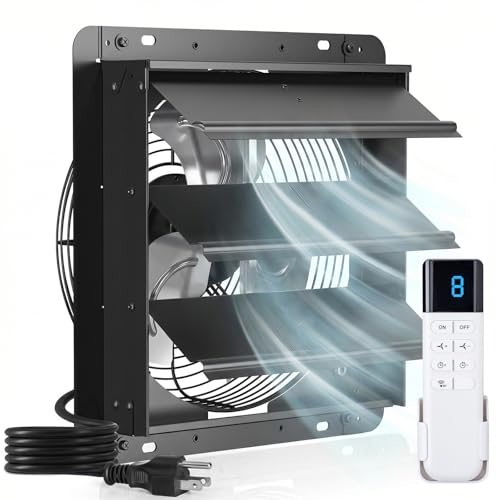
The addlon model features a 12-inch shutter with remote control and eight adjustable speeds, delivering up to 1,250 CFM. Its DC motor is energy-efficient and quiet for a wide range of spaces, including garages and greenhouses. Best for: remote-controlled comfort and energy-conscious ventilation. Limitation: remote operation depends on clear line-of-sight and battery integrity in remote units.
HG Power Upgraded 10 Inch Shutter Exhaust Fan

This HG Power model provides 647 CFM at 1400 RPM with a low 42-watt draw, featuring an adjustable speed control for flexible ventilation. Best for: sheds, greenhouses, or small workshops where a balance of airflow and power draw matters. Caution: higher airflow units may require more robust mounting to minimize vibration and noise transfer.
KEN BROWN 24 Inch Shutter Exhaust Fan With Speed Controller

KEN BROWN’s 24-inch shutter exhaust provides a substantial 4,200 CFM with a built-in speed controller and pre-wired power cord. Best for: large garages, barns, greenhouses, or industrial spaces needing heavy-duty ventilation. Limitation: larger footprint requires substantial wall space and structural support; installation is more involved than smaller units.
Buying Guide: How To Choose A Speed-Controllable Exhaust Fan
Size and airflow matter: measure the space to match CFM with room volume. A rule of thumb is 1 CFM per square foot for typical ventilation, higher in heat-heavy areas. Consider shutter type: automatic shutters prevent backdrafts when the fan is off, helping maintain indoor conditions. Speed control method matters: stepless (continuous) control offers precise adjustments, while fixed-step or multi-speed options can simplify operation. Noise and efficiency are often linked to motor type—look for durable motors designed for continuous operation and corrosion resistance in humid environments.
Key considerations by space
- Garages and workshops: prioritize higher CFM and robust construction; look for thermostats if temperature control is important.
- Greenhouses and green spaces: energy-efficient DC motors can reduce running costs and keep climate stable.
- Attics and sheds: stepless speed control helps when balancing intake and exhaust during varying temperatures.
- Basements and kitchens: noise level matters; select models with quiet operation and durable housings.
Ease of installation and maintenance
- Pre-wired cords and easy-mounted shutters simplify setup.
- Armor and corrosion resistance extend life in humid environments.
- Remote controls add convenience but verify battery replacement frequency and range.
Safety and durability
- Look for UL-listed components and weather-resistant constructions for outdoor or semi-exposed installations.
- Shutters should operate reliably with fan rotation to avoid backdrafts and pests.
FAQ
- What size exhaust fan do I need for a small garage?
- Is a thermostat essential on an exhaust fan?
- What is the benefit of stepless speed control?
- Do shutter exhaust fans require professional installation?
- Can these fans operate in cold environments?
- Are there safety considerations with high-CFM fans?
For a typical small garage, aim for 300–900 CFM depending on space and heat load. A larger unit with speed control lets you adjust airflow as needed.
A thermostat is helpful when you want automatic temperature-based operation, but it’s not required for all setups. It’s most valuable in spaces with fluctuating heat levels.
Stepless control lets you fine-tune airflow continuously, improving comfort and energy use compared to fixed speeds.
Many models are designed for DIY mounting, but larger 24-inch units or high-w airflow fans may need professional mounting to ensure structural support and electrical safety.
Most units are built to handle typical indoor temperatures; check motor and bearing specs for operation in cold climates to prevent stiffness or reduced performance.
High airflow units can generate significant wind inside a space, so secure mounting, guard grills, and proper wiring are essential to prevent injuries.