Best Exhaust Fan Flow Meter Options for HVAC and Airflow Testing
If you need a reliable device to measure airflow, wind speed, and air temperature for exhaust fans, look for a handheld anemometer or hot-wire flow meter that supports CFM/CMM calculations, multiple units, and easy data capture. The top picks below are suited for HVAC technicians, ductwork installers, and drone operators who require accurate airflow data in tight spaces.
Summary of selected products
| Product | Main Use | Key Feature | Best For |
|---|---|---|---|
| BTMETER BT-100 | Multi-function anemometer | Air flow in CFM, dual temp sensors, tripod mount | Drone operators and HVAC installers needing hands-free operation |
| VVV-Group AM-288 | Hot-wire airflow meter | Low-velocity sensitivity, CFM/CMM calculation | Vent balancing and duct testing with low airflow |
| VIVANTECH VA109 | All-in-one wind/airflow meter | CFM/CMM, temperature, max/min | HVAC inspection and environmental monitoring |
| VIVANTECH Hot Wire (Compact) | Hot-wire airflow analysis | Multiple units, max/min tracking | Precise ductwork analysis |
| AIOMEST AI-826A | Pro airflow with USB data | Extended reach, tripod hole, 3 measurement modes | Professional HVAC installations and long-term testing |
Note: All products are listed with their primary use case and why they can fit typical exhaust fan testing scenarios. Consider your budget, space constraints, and data needs when choosing.
BTMETER BT-100 Handheld Anemometer

The BT-100 measures wind speed, wind temperature, and wind chill with a bright backlit LCD. It supports five units (m/s, km/h, ft/min, knots, mph) and includes a wind temperature range from -10 to 60°C. It is suitable for HVAC duct testing and for pilots or drone operators needing stable wind data during flight. Best for technicians who want quick on-site readings and the ability to mount on a tripod for continuous measurements. Caution: readings can drift slightly at very low wind speeds; ensure sensor exposure is unobstructed for accuracy.
Hot Wire Anemometer AM-288

The AM-288 is designed for HVAC airflow diagnostics with a hot-wire sensor that excels in low-velocity environments. It automatically calculates airflow in CFM or CMM after entering the duct area, reducing manual math during testing. Best for technicians balancing ventilation or diagnosing weak airflow. Caution: hot-wire sensors can be sensitive to dust; keep the sensor clean for consistent results.
VIVANTECH VA109 Professional Anemometer

The VA109 offers an all-in-one solution for wind speed, air flow (CFM/CMM), and temperature with a backlit LCD. It features Max/Min readings and a clear display, making it suitable for HVAC maintenance, duct cleaning, and environmental monitoring. Best for users who need a single device that covers multiple air measurements. Caution: broader features may require familiarization to maximize use of the Max/Min functions.
VIVANTECH Hot Wire Anemometer (Slim Probe)

This hot-wire model provides a slim probe suitable for tight spaces. It measures wind speed and air flow with CFM/CMM calculations and is designed for ducts, vents, and clean rooms. Best for precise airflow analysis where space is limited. Caution: slim probes can be more delicate; handle with care during setup and transport.
AOPUTTRIVER Pro HVAC Anemometer
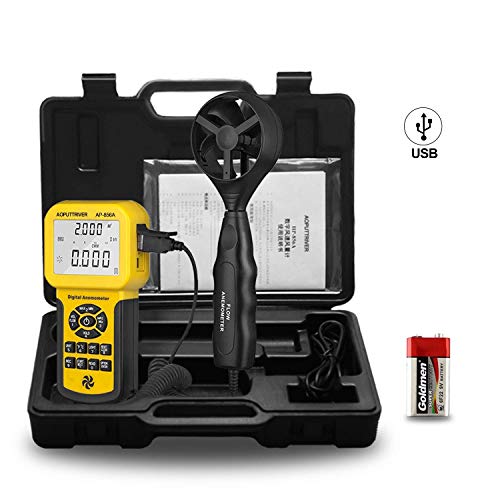
The AP-856A measures wind speed over a wide range (0.001–100 mph) and temperature (32–113°F) with USB data export for PC analysis. It also covers CFM measurements and has data hold for stable readings. Best for professionals who require post-test analysis and long-term data capture. Caution: USB data software may require setup; ensure compatibility with your PC.
Buying Guide
What should you look for in an exhaust fan flow meter?
Key capabilities include measuring wind speed, air temperature, and, when possible, humidity. Look for CFM/CMM output, multiple unit options, backlit displays, and data logging or USB export for later analysis. A tripod mount or long sensor reach helps when mounting near large exhaust ducts or during drone-based testing.
Which type is best for tight ducts?
Hot-wire or ultra-slim probe anemometers excel in tight spaces. They offer better sensitivity for low-velocity air and can measure true airflow without requiring large openings. Be mindful of dust buildup on sensors, which can affect accuracy over time.
Should you choose multi-function vs. specialized devices?
Multi-function meters save space and money when you need wind speed, temperature, and humidity in one device. Specialized hot-wire meters often provide higher accuracy in low-velocity airflow, which is useful for duct balancing and precise HVAC diagnostics.
How important is data export?
USB or PC data export enables trend analysis and reporting. If you regularly document tests, choose a model with straightforward data transfer and compatible software or universal file formats.
What about durability and field use?
Consider rugged construction, backlit displays for low-light environments, and an easy-to-clean sensor. A tripod mount adds stability for long-duration measurements, especially when calibrating large exhaust fans or outdoor testing.
Which buyer types match these products?
- HVAC technicians and installers: prioritize accuracy, CFM calculation, and duct testing features.
- Drone pilots and researchers: value hands-free operation, tripod compatibility, and low-velocity sensitivity.
- Maintenance and facilities teams: seek data logging, USB export, and long-term measurement capabilities.
FAQs
- What is CFM, and why is it important?
CFM stands for cubic feet per minute. It measures airflow volume and helps verify ventilation adequacy and duct performance.
- Do these meters measure humidity?
Most listed models focus on wind speed, temperature, and airflow. Some versions include humidity sensing; check individual features for confirmation.
- Can I use these with drones?
Yes, several models offer tripod mounts or compact form factors suitable for mounting on drones or stabilizing platforms during external testing.
- Is data export necessary for HVAC jobs?
Data export helps compile test reports, verify balancing, and compare results across time or locations.
- What maintenance is required?
Keep sensors clean, calibrate if recommended by the manufacturer, and store in a protected case to prevent damage to delicate probes.