Best Energy Consumption Monitoring Devices for Home Efficiency
Monitoring home energy usage helps identify waste, optimize efficiency, and reduce bills. This article reviews five top energy consumption monitoring devices that integrate with standard electrical panels or outlets, offering real-time data, alerts, and historical reports. Each option supports common US wiring setups and enables solar or net metering tracking where applicable. Readers will find practical guidance on installation, data accuracy, and how to choose the right model for whole-home, circuit-level, or plug-in monitoring. The table below compares key details at a glance.
| Product | Brand | Type | Key Benefit | URL |
|---|---|---|---|---|
| Emporia Vue 3 Home Energy Monitor | EMPORIA | Whole-home meter | UL certified safety with circuit-panel install; solar/net metering | https://www.amazon.com/dp/B0C79PNK84?tag=infinitepower06-20 |
| Eyedro Home Energy Monitor | Eyedro | Whole-home and solar meter | Real-time monitoring with cloud access; robust data history | https://www.amazon.com/dp/B0CD2SZX35?tag=infinitepower06-20 |
| Meross Smart Energy Monitor | meross | Whole-home + circuit | Real-time usage with clear charts; no subscriptions | https://www.amazon.com/dp/B0FSZYR7V4?tag=infinitepower06-20 |
| Watt Meter Plug Monitor (2-Pack) | MECHEER | Plug-in outlet monitor | Multiple display modes; overload protection | https://www.amazon.com/dp/B0DGSMCV7Q?tag=infinitepower06-20 |
| HBN Watt Meter Plug | HBN | Plug-in outlet monitor | Nine data displays; backlit screen for easy reading | https://www.amazon.com/dp/B09MHGK6MT?tag=infinitepower06-20 |
Emporia Vue 3 Home Energy Monitor
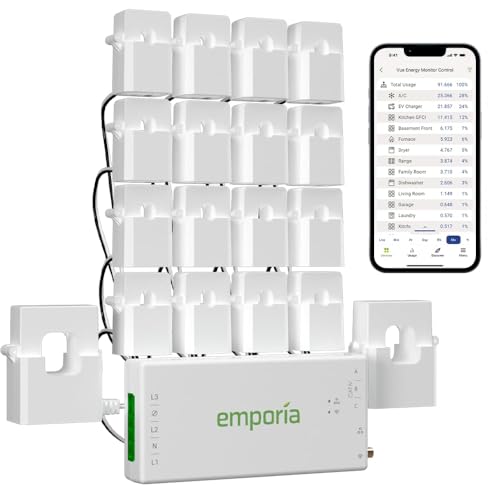
The Emporia Vue 3 is designed for in-panel installation with clamp-on sensors. It supports single-phase, single-split-phase, and 2-wire systems, with 3-wire and 3-phase options using a supplementary 200A sensor (sold separately). The device is UL Listed, ensuring compliance with rigorous U.S. and Canadian safety standards. It provides 24/7 energy management and monitoring, including solar and net metering tracking. A one-year warranty accompanies the unit, and the system is built for continuous home energy automation and efficiency improvements.
Eyedro Home Energy Monitor

Eyedro provides real-time electricity monitoring with two 200A sensors and a MyEyedro cloud service (no subscription required). It supports entire-home and solar/net metering configurations and works with both WiFi and Ethernet connections. The system tracks your power usage in dollars, watts, amps, and volts, offering dashboards and historical reports to help identify waste, compare periods, and optimize energy decisions. It’s designed to meet North American safety standards and is suitable for households seeking actionable energy insights.
Meross Smart Energy Consumption Monitor

Meross offers a UL 61010-compliant, ETL-certified energy monitor suitable for common US power configurations, including single-phase, three-wire, and four-wire Wye systems with grounded neutrals. The device supports 2 main circuits (200A total) plus 16 branch circuits and provides real-time monitoring with alerts and historical charts. The app presents data with minimal latency, and the unit emphasizes privacy by avoiding mandatory subscriptions while exporting data for analysis. It’s an accessible option for households seeking circuit-level insight and smart alerts.
2 Pack Upgraded Watt Meter (MECHEER)

This MECHEER 2-pack monitors power, energy, volts, amps, frequency, power factor, cost, and more. It features an 8-display mode, an upgraded 2.36-inch backlit LCD, and a user-friendly 180-degree viewing angle. An overload protection function warns with flashing indicators and audible alerts, with adjustable settings to prevent nuisance tripping. The meters fit standard US outlets and are designed for manageable, plug-in monitoring of individual devices or small appliances.
HBN Watt Meter Plug

HBN’s watt meter plug features a backlit LCD with a wide 160-degree viewing angle and nine data display modes. It tracks power (W), apparent power (VA), energy (kWh), usage time, frequency (Hz), power factor, voltage, current, and estimated cost. The backlight auto-off helps conserve energy, and the device enables quick insights into consumption patterns, making it suitable for on-the-spot monitoring of specific outlets or devices and for everyday energy awareness.
Buying Guide: Key Considerations For Selecting An Energy Monitoring Device
- Installation scope: Choose whole-home monitors for circuit-wide visibility or plug-in meters for individual outlets. In-panel devices like Emporia Vue 3 provide more comprehensive data, including solar tracking, while plug-in meters offer quick, device-level insights.
- Electrical compatibility: Verify compatibility with your wiring configuration (single-phase vs. 3-phase, Wye vs. Delta, neutral grounding). Most options here support common US configurations, but some require additional sensors for larger setups.
- Data access and integration: Consider whether you want cloud-based dashboards, local data exports, or smart home integration. Eyedro and Meross emphasize accessible dashboards and historical reporting; some devices also offer alerts without ongoing subscriptions.
- Safety and certifications: Look for UL or ETL listings to ensure safety standards. In-panel devices should be installed by qualified personnel, especially when working inside electrical panels.
- Data resolution and history: If you aim for long-term trend analysis, prioritize devices that store years of data or offer easy export (hourly/daily/monthly breakdowns).
- Alerts and automation: Decide if you need real-time alerts for spikes or threshold breaches. Some models include built-in alarms and automatic tips for reducing consumption.
- Budget and value: Weigh upfront hardware costs against potential energy savings, warranty coverage, and the availability of multiple sensors or circuits for future expansion.
- Solar and net metering: If your home uses solar, ensure the monitor supports net metering data and solar production tracking for accurate net energy visibility.
Across a range of installation styles, these devices provide actionable data to help households identify energy hogs, optimize appliance use, and monitor the impact of solar generation. When selecting, prioritize data granularity, ease of reading, and the breadth of monitoring (whole-home vs. circuit-level) to match your energy goals.