Best End Fed 160 Meter Antenna Options for Ham Radio Enthusiasts
Answering the question “What is the best end fed antenna for 160 meters?” this guide highlights practical, multi-band end-fed solutions that cover 160 meters (1.8–2.0 MHz) and beyond. These antennas are suitable for casual hikers, portable operators, field activations, and home shacks alike. Each pick is evaluated for 160m compatibility, ease of deployment, and suitability for beginners or seasoned operators. The following products are chosen for strong 160m performance and clear, install-friendly designs.
| Product | Coverage | Best For |
|---|---|---|
| Harvest Taurus 160M-6M Multi-Band Long Wire Dipole Antenna | 160m–6m | Station operators needing a true dipole with broad 160m reach |
| K6ARK 100W End-Fed Antenna Matching Unit Kit | HF bands 160m–10m | Portable or field operators needing a tunerless setup |
| WOOKLEA End Fed Antenna 1-30MHz | 1–30 MHz (including 160m) | Portable users who want quick deployment and multi-band use |
| GOWENIC End Fed Half Antenna | 1–30 MHz (including 160m) | Compact, lightweight operation with broad 160m capability |
| DmgicPro Upgraded 150W End Fed Antenna | 1–30 MHz (including 160m) | Reliable multi-band operation with durable construction |
Harvest Taurus 160M-6M Multi-Band Long Wire Dipole Antenna

This long-wire dipole is designed for 160m through 6m coverage, making it a strong choice for 160m enthusiasts. The 160m segment provides practical evening and dawn windows for DX and local contacts alike. It’s suited for stationary backyard setups and field deployments where a dipole’s balanced performance matters. Best for operators who want a straightforward, no-tuning solution on 160m and the rest of the HF spectrum. A potential limitation is height and space requirements; optimal performance comes with enough elevation and clear surroundings.
K6ARK 100W End-Fed Antenna Matching Unit Kit
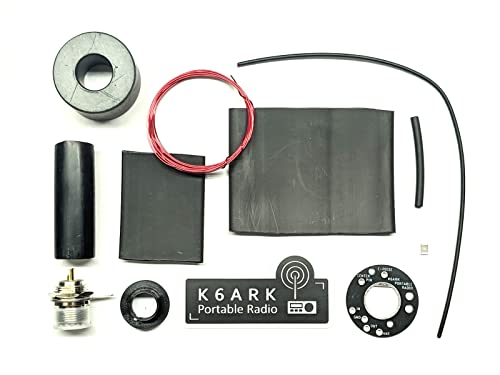
This kit provides a 100W end-fed setup with a 49:1 or 9:1 unun option, enabling operation from 160m up to 10m. The kit is designed for flexible mounting and quick field deployment. It’s best for operators who want a compact, tuner-free end-fed solution with the ability to adapt to various field conditions. A caveat is that some installations may require careful impedance considerations and appropriate coax layout to maintain stable SWR across bands.
WOOKLEA End Fed Antenna 1-30MHz

WOOKLEA offers a 1-30 MHz end-fed antenna that includes 160m in its frequency range. This model emphasizes easy installation and portable use, with a 1:64 balun for efficient multi-band operation without external tuners. It’s a good choice for quick field deployment and emergency communications, especially for operators who value portability. Limitation: performance can vary with mounting height and nearby structures, so plan placement accordingly.
GOWENIC End Fed Half Antenna

GOWENIC’s end-fed half antenna covers 1–30 MHz with a built-in 1:49 balun for broad impedance matching. It’s designed for compact, portable use and includes a high-efficiency setup that supports CW, SSB, and digital modes. It’s best for operators who need a lightweight, field-ready solution that still reaches 160m. A potential limitation is that performance becomes highly dependent on setup geometry; ensure clear lines of sight and proper balun placement for best results.
DmgicPro Upgraded 150W End Fed Antenna

The upgraded DmgicPro end-fed antenna operates from 1–30 MHz with 1:64 balun, supporting multi-band use including 160m. It comes in 4-band and 8-band configurations, designed to minimize signal loss and maintain stable quality. Best for operators who want blendable multi-band performance with durable construction for both portable and home setups. Limitation: some users may need to tailor installation to achieve optimal SWR across all bands.
Buying Guide: Key Considerations For 160 Meter End Fed Antennas
- Band coverage and impedance: Look for a 1:49 or 1:64 balun to ensure smoother matching from 160m up through higher bands. Multi-band capability reduces the need for external tuners in many setups.
- Power handling: If you plan to operate SSB or CW on 160m, verify that the antenna supports at least 100–150W in those modes. Transmit power handling varies by model and balun design.
- Install environment: 160m performance improves with height and clear surroundings. Dipoles require space, while end-fed solutions often work in tighter spaces with proper balun placement.
- Portability vs. permanent setup: Portable options excel for field activations and emergency comms, while longer-term home installations may benefit from more robust mounting and weatherproofing.
- Ease of use: For beginners, tuner-free designs with integrated baluns simplify operation. More complex kits may require impedance matching considerations during setup.
FAQ
- Is a 160m antenna compatible with end-fed designs? Yes, many end-fed antennas cover 160m via 1–30 MHz or broader ranges, especially with 1:49 or 1:64 baluns.
- Do I need a tuner with end-fed 160m antennas? Many models are designed to operate without external tuners on several bands, but a tuner may still help on some bands or in challenging environments.
- What is the advantage of a 1:64 balun? It improves impedance matching across multiple bands, reducing SWR and simplifying multi-band operation.
- Can end-fed antennas be used for portable operations? Yes, many options are designed for quick deployment, field use, and SOTA/POTA activations with lightweight, compact design.
- How high should the antenna be for best 160m performance? Higher mounting reduces ground capacitance and improves efficiency; aim for clear line-of-sight and minimal obstructions.
- What should I consider when choosing among these models? Consider band coverage, power handling, mounting options, portability, and whether you need a tunerless setup for quick deployment.