Best Electrical Panel Watt Meter for Home Energy Monitoring
When managing a home energy system, a reliable electrical panel watt meter helps you monitor voltage, current, power, and energy usage in real time. This guide highlights top Amazon picks designed for panel monitoring, solar setups, and battery banks. Each model balances accuracy, ease of installation, and clear LCD displays to support efficient energy monitoring projects across residential and small-scale applications.
Summary of chosen products
| Product | Brand | Voltage Range | Current Range | Key Feature |
|---|---|---|---|---|
| MORNING GROUP AC Current Voltage Amperage Power Energy Panel Meter | MORNING GROUP | 80-260V | 0-100A | Split CT, overload alarm |
| MORNING GROUP 2 Pieces AC Current Voltage Meter | MORNING GROUP | 80-260V | 0-100A | Two-pack, auto data storage |
| ANKG 150A Watt Meter Power Analyzer | ANKG | 0-60V | 0-150A | Eight readings, high precision |
| Proshopping 150A RC Watt Meter | Proshopping | 0-60V | 0-150A | 8 in 1 measurements, alarm |
| MECHEER Upgraded Watt Power Meter Plug | MECHEER | DC 0-100V | 0-15A typical, up to 150A variants | 7 modes, backlit display |
The following sections profile five selected meters that balance practicality and performance for American households and hobbyist energy projects. Each entry includes an accessible product link, a visual, and a concise summary aligned with real-world usage scenarios.
MORNING GROUP AC Current Panel Meter With Split CT

This digital multimeter-style panel meter displays voltage, current, active power, energy, frequency, and power factor simultaneously. The split current transformer (CT) simplifies installation, especially in crowded panels. A critical feature is the overload alarm: when a preset limit is exceeded, the backlight and indicators flash to alert the user. The device also stores the last test data automatically if power is interrupted, reducing the risk of data loss during outages. Suitable for home energy monitoring and small solar-battery setups.
Two-Pack AC Panel Meter With Split CT

This two-pack of panel meters offers the same core capabilities as the single-unit variant, enabling synchronized monitoring across two circuits or panels. It measures voltage, current, power, energy, frequency, and power factor. The split CT design streamlines wiring, and the overload alarm helps prevent unexpected spikes in consumption. Automatic data storage ensures continuity of readings when power fluctuates, making it a practical choice for multi-circuit monitoring in larger installations or workshops.
ANKG 150A Watt Meter Power Analyzer

The ANKG watt meter delivers eight electrical readings on a clear LCD, including current, voltage, watts, amp-hours, watt-hours, peak amps, minimum volts, and peak watts. With a 0-150 A input range and 0.01 A resolution, it provides precise data suitable for RC hobbyists, small solar setups, and battery management. It is designed for higher accuracy within the 60 V ceiling, making it a reliable option when monitoring DC or AC energy streams in compact systems.
Proshopping 150A RC Watt Meter With Alarm

This 8-in-1 meter continuously displays current, voltage, watts, amp-hours, watt-hours, peak amps, minimum volts, and peak watts. It supports a wide DC input range (0-60 V) and up to 150 A, which covers most 12/24/48 V battery banks used in RVs and off-grid systems. The unit includes an alarm feature for overcurrent conditions and a backlit LCD for readability in dim environments. Its compact form makes it suitable for portable energy monitoring alongside solar and battery projects.
MECHEER Upgraded Watt Power Meter Plug
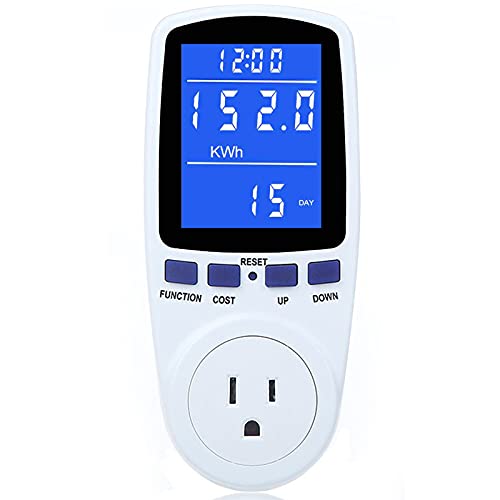
This plug-in meter provides multi-parameter monitoring with seven display modes, including power (W), energy (kWh), voltage (V), current (A), frequency, power factor, and even cost estimates. The upgraded backlight can be set to different durations, improving readability from day to night. It is particularly convenient for appliance-by-appliance tracking and for users who want quick insights without installing panel-mounted devices. The device also logs cumulative usage, aiding in budgeting and energy awareness within the home environment.
Buying Guide
- Voltage and current range: Choose meters that cover your system’s operating voltage (DC or AC) and your expected current. For home mains panels, meters with 80-260V AC and up to 100A or 150A are common and versatile.
- Measurement capabilities: Look for devices that report voltage, current, power (W), energy (Wh/kWh), frequency, and power factor. Some models add amp-hours and watt-hours for more detailed energy accounting.
- Accuracy and resolution: Higher precision matters for battery management and solar systems. A typical good range is 0.01 A or 0.01 V resolution with 0.1 W or better for power readings.
- Installation style: Split-core CT meters simplify installation around existing breakers and conductors without full disassembly. Plug-in meters offer easy, portable monitoring for appliances or small panels.
- Alarms and data retention: Overload alarms help protect wiring and devices. Automatic data storage protects readings during outages, which is valuable for trend analysis and auditing.
- Display and usability: A bright, legible LCD with backlight improves readability in varying lighting. Some meters offer multiple display modes to prioritize the most relevant data.
- DC vs AC compatibility: For solar, EV, and battery systems, ensure the meter supports DC ranges as well as the appropriate voltage window. Some models are optimized for DC monitoring, while others are designed for AC mains.
- Durability and form factor: Consider whether you need a wall-mount panel meter, a compact gauge for a portable setup, or a plug-in variant for temporary monitoring. Build quality can influence long-term reliability in attic or garage environments.
- Brand and support: Reputable brands with clear documentation and responsive support help with installation questions and data interpretation, especially for complex systems.
- Cost-to-value balance: For most household setups, prioritize meters that provide essential measurements (V, I, W, Wh) along with data storage and alarms. If you require advanced analytics, consider higher-accuracy, multi-reading meters with robust data export options.
Across the selected models, users gain a spectrum of options—from compact plug-in meters for daily household data to more advanced panel-mounted devices suitable for solar and battery monitoring. Each offers critical measurements, ease of installation, and practical features like data retention and alarms to support responsible energy management.