Best Electrical Engineering Kits for College Students: Hands-on STEM Projects for Learning
Students pursuing electrical engineering often seek hands-on kits to apply classroom concepts to real-world circuits and systems. The following five kits offer a range of experiments—from basic circuit building to structural engineering concepts—that can complement coursework, labs, and independent study. Each selection emphasizes safe, modular projects you can tackle solo or collaborate on with peers.
| Product | Brand | Focus | Amazon Link |
|---|---|---|---|
| Thames & Kosmos Structural Engineering: Bridges & Skyscrapers | Thames & Kosmos | Force, load, compression, tension; build 20 models | https://www.amazon.com/dp/B06VT7WQPH?tag=infinitepower06-20 |
| Playz Advanced Electrical Circuit Board Engineering Kit | Playz | Over 328 experiments; circuits, voltage, current, resistance, magnetism | https://www.amazon.com/dp/B07QBQZXHK?tag=infinitepower06-20 |
| EUDAX School Physics Labs Basic Electricity Discovery Circuit | EUDAX | Electricity & electromagnetism basics; 56+ items | https://www.amazon.com/dp/B07FM2QFQK?tag=infinitepower06-20 |
| Burnur Circuit Electric DC Motor Kit | Burnur | Motor, switches, bulbs; hands-on circuits for STEM projects | https://www.amazon.com/dp/B0C8T1FQ19?tag=infinitepower06-20 |
| Mysterystone Science Experiment Kit: Electricity & Magnetism | Mysterystone | 50+ experiments; electricity, magnetism, circuitry | https://www.amazon.com/dp/B0953X8911?tag=infinitepower06-20 |
Thames & Kosmos Bridges & Skyscrapers Kit

Structured around civil and mechanical engineering concepts, this kit challenges students to explore force, load, compression, and tension through the construction of 20 distinct models. With more than 285 interchangeable pieces and a comprehensive 36-page illustrated manual, it provides a tactile way to understand how structures respond to different stresses. This kit is well-suited for group lab sessions or independent study, helping learners connect theoretical concepts to real-world designs without requiring advanced tools.
Playz Advanced Electrical Circuit Board Kit

This kit emphasizes hands-on exploration of electrical principles. With more than 328 experiments, students can wire and test circuits that demonstrate lights, sounds, radios, and magnetic effects. It supports a spectrum from beginner to intermediate projects, making it useful for coursework or personal exploration. The set aims to improve practical understanding of voltage, current, resistance, and circuit behavior, while encouraging experimentation and problem-solving in a controlled, safe environment.
EUDAX Basic Electricity Discovery Circuit
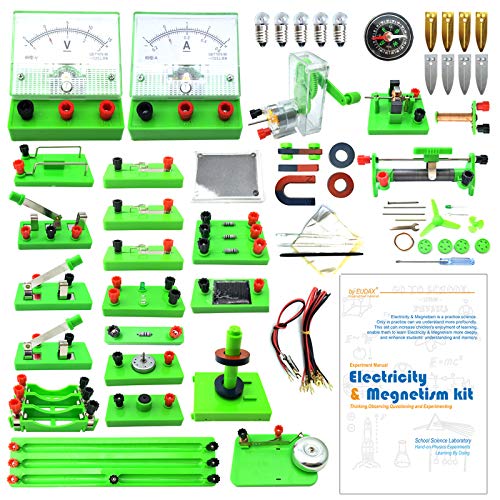
Designed for high school to early college levels, this kit emphasizes foundational electricity and magnetism concepts. It includes clear, color-page manuals and a mix of components to build series and parallel circuits. While the emphasis is on fundamentals, the hands-on assembly supports developing students’ experimental thinking, documentation skills, and technical reasoning, making it a practical bridge between theoretical coursework and lab practice.
Burnur Circuit Electric DC Motor Kit

This kit centers on a complete circuit build around a direct current motor. It includes essential components like wires, bulbs, a motor, a switch, a buzzer, and a fan. It’s a versatile option for hands-on experiments in electronics, mechatronics, and embedded projects, offering a tangible pathway from circuit theory to mechanical motion and control systems. Suitable for individual projects or small-group lab exercises, it fosters practical design thinking and troubleshooting.
Mysterystone Electricity & Magnetism Kit

With more than 50 projects and a well-illustrated manual, this kit covers electricity and magnetism through a practical, hands-on approach. Learners can explore electric circuits, electromagnetism, and related phenomena with numerous components and guided activities. The kit is suitable for beginners stepping into physics labs or for supplementing university coursework where students build intuition before tackling more complex systems.
Buying Guide
Key purchase considerations for college students selecting electrical engineering kits include:
- Curriculum alignment: Choose sets that mirror course topics such as basic circuits, electromagnetism, control systems, or structural engineering to reinforce classroom learning.
- Project depth and breadth: Look for kits offering both foundational experiments and advanced challenges to match skill progression and independent study goals.
- Component quality and safety: Prioritize kits with durable parts, clear safety guidelines, and age-appropriate materials to support sustained use in dorm environments or shared labs.
- Documentation and learning aids: Manuals with step-by-step instructions, diagrams, and explanations help reinforce concepts and support group work.
- Expandability: Consider kits that can be augmented with additional components or compatible modules, enabling ongoing exploration as coursework grows.
- Cost-to-value balance: Evaluate the number of experiments and potential applications against price, opting for sets that deliver long-term educational value.
- Storage and portability: Kits with organized storage cases or bags facilitate easy transport between classrooms, labs, and study spaces.
- Digital and multimedia support: QR codes, video tutorials, or online resources can enhance understanding and cater to different learning styles.
In selecting kits, students should balance immediate lab needs with opportunities for independent exploration. For collaborative projects, favor sets that support group work through modular components and a range of experiment types. Where possible, review user feedback and compatibility with common lab equipment to ensure practical, repeatable results in a college setting.