Best Electric Wheelchair Motors for Reliable Mobility
Answering the core buyer question: these electric wheelchair motors provide reliable propulsion and easy retrofitting for power wheelchairs or mobility scooters. They are best for DIY upgrades, replacements, or custom builds. This guide highlights five motors that balance torque, speed, durability, and ease of installation, helping you pick the right option for your mobility needs. The table below compares key specs to support quick, informed decisions.
| Product | Brand | Voltage | Power | Top RPM | Best For |
|---|---|---|---|---|---|
| MY1016Z 24V 250W Electric Wheel Chair Motor | Kuayi | 24V | 250W | 120 | Compact replacement, regular wheelchairs |
| Wheelchair Motor 250W 24V, 75RPM | SongChaza | 24V | 250W | 75 | Low-speed, high-torque needs |
| Bemonoc DC 12V 250W Gear Reduction Motor | Bemonoc | 12V | 250W | 300 | Versatile gear motor for various platforms |
| Topyond 250W 24V Wheelchair Motor | Topyond | 24V | 250W | 120 | High torque on mixed terrains |
| 250W 75RPM Fockety Wheelchair Motor | Fockety | 24V | 250W | 75 | Low-speed, high-torque builds |
Note on compatibility and setup: each motor uses a brushed DC design with gear reduction options, suited for wheelchairs, mobility scooters, or DIY conversions. Check shaft size, gear ratio, and wiring polarity when pairing with your controller or joystick system. If space is tight, the more compact units (like the 120 RPM options) may fit more easily. For uphill or rough terrain needs, choose higher torque or gear-reduction variants, and verify mounting compatibility with your chair frame.
Kuayi MY1016Z 24V 250W Motor

The Kuayi MY1016Z is a compact 24V, 250W brushed motor delivering up to 120 RPM. It features a 45mm shaft and 17mm diameter, with a design that supports reversing direction by swapping the power polarity. This makes it suitable for standard wheelchair upgrades or replacements where space is a prime consideration. Best for: straightforward, mid-torque wheelchair applications where quick retrofits are needed. Limitation: lower top speed may not suit applications requiring higher speeds on flat terrain.
SongChaza 250W 24V Wheelchair Motor

This 250W, 24V brushed motor provides a rated speed of 75 RPM and is built with copper and aluminum construction. It emphasizes durability, corrosion resistance, and efficient operation for continuous use. Best for: low-speed, steady-torque requirements with a balance of efficiency and longevity. Caution: performance may vary with different control systems and mounting configurations; verify compatibility with your existing joystick/controller kit.
Bemonoc DC 12V 250W Gear Reduction Motor

The Bemonoc unit uses a 12V supply with a 300 RPM actual speed (after gearing) and a 9-tooth sprocket included for straightforward chain-drive integration. It features adjustable rotation direction via wiring and is designed for durability across demanding tasks. Best for: projects requiring flexible wiring to reverse rotation and a compact, versatile motor. Limitation: operates at lower voltage; ensure your controller and battery system are compatible with 12V motors.
Topyond 250W 24V Wheelchair Motor
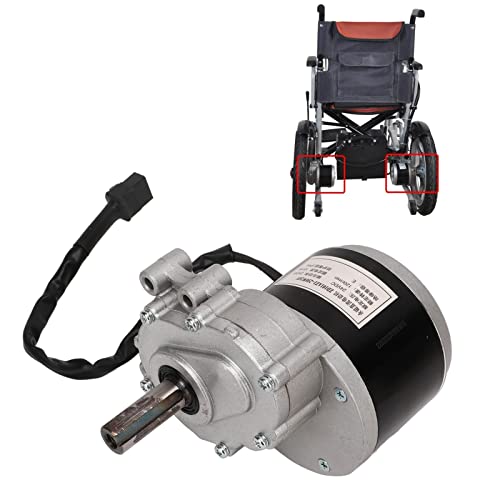
Designed for high-torque needs, the Topyond motor is a 250W, 24V brushed unit with 120 RPM operation. It is described as effective for hills and uneven surfaces, supporting smooth operation across varied terrains. Best for: power wheelchairs and scooters requiring reliable torque on inclined paths. Caution: verify gear alignment and mounting compatibility with your chair frame to avoid interference with wheels or brake systems.
Fockety 250W 75RPM Wheelchair Motor

The Fockety unit emphasizes low noise and high reliability with a robust aluminum alloy housing and copper wiring. It delivers 75 RPM for greater torque and controlled acceleration, suitable for go-kart-style wheelchair conversions or heavy-duty mobility projects. Best for: high-torque, slower-pace needs where stability matters. Limitation: slightly heavier; ensure your mounting can accommodate the additional weight.
Buying Guide
What to consider when choosing an electric wheelchair motor:
- Voltage and compatibility: Most wheelchair motors run on 24V, with some options at 12V. Match to your power system, controller, and battery pack.
- Torque versus speed: Higher torque (lower RPM) helps on inclines and rough terrain. If you prioritize speed on flat surfaces, a higher RPM model may be preferred.
- Gear reduction and shaft size: Gear reduces speed but increases torque. Check output shaft diameter and mounting interfaces to fit your chair’s drive system.
- Control compatibility: Ensure the motor is compatible with your joystick, controller, throttle, or drive controller. Some units support easy wiring reversal for direction control.
- Durability and heat: Look for brushed motors with robust casings and quality bearings to minimize maintenance and heat buildup during long use.
- Adaptability: If you plan to repurpose a motor for other mobility devices, consider models with flexible mounting options or sprocket compatibility.
Practical questions to help you decide
- Which motor is best for uphill performance? Look for higher torque and appropriate gearing (e.g., 120 RPM variants with strong gear reductions).
- What is the easiest motor to install? Motors with standard shafts and simple mounting plates tend to be simplest to retrofit into existing wheelchairs.
- Do I need a 12V or 24V motor? 24V systems typically deliver more power for wheelchairs and mobility scooters, while 12V motors can be suitable for lighter, indirect-drive projects.
- Is a lower RPM motor better for stability? Yes, lower RPM with higher torque often yields steadier acceleration and better control on uneven terrain.
- Can I mix motors from different brands? It’s best to match voltage, torque, and mounting compatible features to avoid controller or drive issues.
FAQ
- Q: Can I replace my wheelchair motor with any brushed DC motor? A: Replacement should match voltage, torque, mounting, and control wiring to ensure compatibility and safe operation.
- Q: Do these motors require specialized controllers? A: Many can work with standard wheelchair controllers, but verify wiring polarity and throttle compatibility.
- Q: Are these motors waterproof or weatherproof? A: Most are not specially rated for outdoor exposure; protect and seal connections as needed for outdoor use.
- Q: How do I choose motor speed vs torque? A: Higher torque supports difficult terrain; higher RPM supports faster travel on smooth surfaces. Consider your typical use case.
- Q: Are there safety considerations when upgrading? A: Ensure correct mounting, secure fasteners, proper wiring insulation, and compatibility with existing safety sensors and brakes.