Best Electric Water Heat Exchangers for Fast, on-Demand Hot Water
Electric water heat exchangers offer compact, efficient hot water solutions for homes, offices, and remote spaces. This guide highlights five reliable options that balance installation ease, energy use, and on-demand performance. From plug-and-play tanks to compact point-of-use units and robust heat exchangers, these selections cover multi-user homes, small apartments, and specialized installations. Explore options that fit small spaces, retrofit projects, or setups where you want immediate hot water without a full-size tank.
| Product | Brand | Best Use | Notes |
|---|---|---|---|
| GE 18 Gallon Versatile Plug and Play Electric Water Heater | GE | Small homes, apartments, or limited spaces | 120 V, adjustable thermostat; easy install |
| Rheem 3.5kW Point of Use Thermostatic Unit | Rheem | Under-sink or bench installations | 1 x 30 A breaker; compact, adjustable |
| EcoSmart ECO 27 Tankless Electric | EcoSmart | Whole-house or multi-point hot water | Digital controls; efficient, scalable |
| GE 6 Gallon Versatile Mini Tank | GE | Under-sink boost or small appliance hot water | 1/2 in NPT connections; compact |
| WiseWater 38″ Side Arm Heat Exchanger | WiseWater | Secondary heating with existing water heater | High heat transfer; durable stainless design |
This article examines five options tailored to different installation needs, from plug-and-play storage to advanced heat-exchange configurations. Each section provides practical details, installation considerations, and how the unit handles typical household hot-water demand. By comparing space requirements, electrical needs, and heating capacity, you can identify the model that best fits your home or work environment.
GE 18 Gallon Plug and Play Electric Water Heater

The GE 18 Gallon model provides whole-home flexibility for smaller residences, condos, or apartments. It installs quickly using standard 3/4-in NPT connections and runs on a 120-volt supply, making it suitable for retrofit projects where a full-size water heater isn’t feasible. Its compact design fits kitchens, bathrooms, laundry rooms, cabins, and garages. The adjustable thermostat helps balance energy use with hot-water needs, while its versatile output supports a single hookup or a small dwelling. Consider space size, peak hot-water demand, and proximity to fixtures when evaluating this unit.
Key features include easy installation, compatibility with standard water connections, and a design that accommodates limited spaces without sacrificing reliability. For households with modest hot-water needs and constrained spaces, this model can be a practical choice that minimizes structural alterations while delivering dependable on-demand hot water.
Rheem 3.5kW Point of Use Thermostatic Tankless

This Rheem point-of-use heater is designed for tight spaces like a bathroom, office break room, or garage. It requires a 30-amp double-pole breaker and a 120-volt circuit, emphasizing its suitability for low-flow applications. The unit’s compact size can be up to 98% smaller than a standard electric water heater, making it ideal where floor space is at a premium. Thermostatic controls adjust water temperature in 1-degree increments, enabling precise hot-water delivery on demand. This model fits well for incremental hot-water needs such as a single shower or sink application.
Electrical planning is important with this model: ensure electrical panel capacity supports the 30-amp load and confirm local code requirements. Its efficiency and quick-install design make it a practical upgrade for spaces that require targeted hot-water delivery without a full-size heater.
EcoSmart ECO 27 Tankless Electric
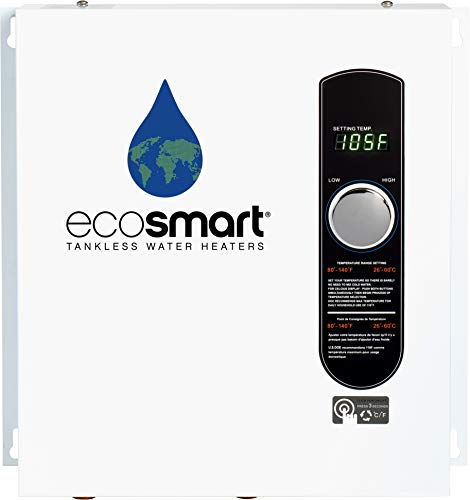
The EcoSmart ECO 27 is a compact tankless electric system designed to deliver continuous hot water at the point of use. It’s configured for climates where incoming water temperatures can be quite cold, enabling reliable performance even in cooler regions. The unit can heat approximately 3 gallons per minute, depending on incoming water temperature and desired output. Digital temperature control allows adjustments in 1-degree increments, supporting precise comfort and energy management. The ECO 27 is scalable when multiple fixtures demand hot water, making it a popular choice for modern homes seeking efficiency and on-demand comfort without a bulky tank.
Consider installation factors such as the number of simultaneous hot-water outlets, serial or parallel plumbing layouts, and electrical service capacity. While efficient and flexible, a tankless system requires proper venting and professional hookup to ensure optimal performance and safety.
WiseWater 38″ Side Arm Heat Exchanger

The WiseWater side-arm heat exchanger is designed to work with existing water heaters to improve efficiency and heat transfer. Its stainless steel construction and the 38-inch length optimize heat exchange, making it suitable for applications requiring additional hot water, such as heating and domestic water integration for larger tanks. The design includes finned tubes inside to maximize heat transfer area, delivering higher efficiency with less energy draw. The standard FNPT ports (3/4″ for tank side/cold water and 1″ for hot-water side) simplify installation, and the double-wall protection reduces potential water ingress concerns. This model suits retrofit projects or systems where a dedicated secondary heat exchanger is desirable.
When evaluating a side-arm heat exchanger, consider the compatibility with your existing water heater, flow rates, and the available space in the plenum or mounting area. Its effectiveness depends on proper integration with your current hot-water system and the overall thermal dynamics of the home.
Buying Guide: Key Purchase Considerations
- Application and space: Assess whether you need a plug-in storage heater, a point-of-use unit, or a tankless/heat-exchanger configuration. Measure available space and consider proximity to fixtures to minimize heat loss and pipe length.
- Electrical requirements: Tankless and point-of-use electric heaters demand specific breaker sizes and wiring. Confirm service panels and local codes before purchasing to avoid electrical bottlenecks.
- Hot-water demand: Estimate peak usage for showers, sinks, and appliances. Tankless and multi-point units scale differently—choose based on simultaneous demand rather than single-point capacity.
- Temperature control: Look for models with precise thermostat control, ideally with 1-degree increments, to balance comfort and energy efficiency.
- Durability and materials: Stainless steel or corrosion-resistant tanks and heat exchangers extend service life in varying water conditions. Steel, aluminum fins, and copper tubing influence heat transfer and longevity.
- Installation complexity: Plug-and-play storage heaters are simplest to install, while heat exchangers and tankless systems may require professional installation for safety and compliance.
- Maintenance and warranties: Review maintenance requirements and warranties. Some systems require periodic flushing or descaling, especially in hard-water areas.
- Energy efficiency and operating costs: Tankless and heat-exchanger solutions can reduce standby heat loss but may depend on climate, water temperature, and usage patterns. Compare energy ratings and expected savings over time.
- Scalability: If future hot-water needs could grow, consider models that scale (e.g., multi-unit stacks or expandable tankless systems) to avoid a later full replacement.
Choosing the right electric water heat exchanger involves balancing space, demand, and energy considerations. By aligning product capabilities with your living pattern and electrical setup, you can optimize hot water delivery while managing costs and installation effort. Always consult product manuals and, when in doubt, engage a licensed professional to confirm electrical and plumbing compatibility.