Best Electric Tankless Water Heaters for Four Bathrooms
Choosing the right electric tankless water heater for a home with four bathrooms requires evaluating flow rates, power requirements, and install constraints. The following selections are among the top options that can deliver reliable hot water for multiple simultaneous uses without the standby energy waste of traditional tanks. Each model supports different household configurations, so you can compare capacity, efficiency, and wiring needs to find the best fit for your home’s electrical service and water demand.
| Product | Brand | Estimated Capacity | Approx. Points Of Use |
|---|---|---|---|
| WINTEMP 36kW Tankless Electric Water Heater | WINTEMP | Up to 8.7 GPM | 3-5 points |
| WINTEMP 27kW Tankless Electric Water Heater | WINTEMP | Up to 6.3 GPM | 2-4 points |
| Ranein 18kW 240V Tankless Water Heater | Ranein | Up to 4.3 GPM | 2-3 points |
| 2025 GEN II Ranein 18kW Tankless Water Heater | Ranein | Up to 4.3 GPM | 2-3 points |
| Rheem 18kW 240V Tankless Electric Water Heater | Rheem | Up to 4.4 GPM | 2-3 points |
Buying Guide For Four-Bathroom Homes
When evaluating electric tankless heaters for a four-bathroom home, key considerations include maximum flow (GPM), electrical requirements, space, and installation constraints. Self-modulating and demand-based designs help optimize energy use, but you must ensure your electrical panel can support the required amperage. Consider a model with a higher GPM rating to handle simultaneous showers or sinks. Also assess installation constraints such as clearance, venting (if applicable), and water inlet/outlet sizing. Finally, verify warranty terms and available service support in your region for long-term reliability.
Orbek 14kW Tankless Water Heater

The Orbek 14kW electric tankless heater is designed for 240V and 60A service with a two-pole breaker. It delivers up to 3.38 GPM to two to three points of use. Its LED digital display helps monitor temperature settings, and the unit emphasizes water-electricity separation to reduce scale and corrosion. This model is best suited for homes where the electrical service can support a high-demand point-of-use configuration, rather than the whole-house approach.
Nessxa 4-Gallon Mini Tank Water Heater

This under-sink unit provides instant hot water at the point of use with a 4-gallon tank. It features a temperature adjustment range of 77°F to 176°F (25°C to 80°C) and a standby mode when cooler water is detected. The design emphasizes safety with ABS exterior and stainless steel internal tank while maintaining rapid heating for small-scale needs or supplemental hot water support in multi-bath homes without running a large-volume system.
EcoSmart ECO 11 Electric Tankless Water Heater

The EcoSmart ECO 11 offers 13 kW at 240V with self-modulating technology, supplying up to a 1-degree temperature variance in operation. While compact and wall-mountable, it is best suited for smaller homes or as a supplementary heater. It emphasizes energy efficiency and space savings, making it a strong choice for tight installations where the entire home can be served by a single unit or combined with another unit for higher capacity in a larger home.
Ranein 18kW Electric Tankless Water Heater

Ranein’s 18kW model provides up to 4.3 GPM and uses an LED temperature display. It is designed for residential whole-house use with a compact footprint and energy-efficient operation that supports two to three water points. The unit requires a 2x40A breaker configuration and 3/4″ NPT connections, reflecting typical electrical readiness for mid-sized households seeking reliable on-demand hot water.
2025 GEN II Ranein Tankless Water Heater

The GEN II version increases efficiency to 99% thermal performance with up to 4.3 GPM flow. It necessitates two dedicated 240V circuits (2×40A DP breakers) and 8 AWG wiring. Its compact dimensions and strong point-of-use performance make it suitable for mid-to-large homes needing reliable hot water across multiple fixtures without preheating delays.
Rheem 18kW 240V Tankless Electric Water Heater
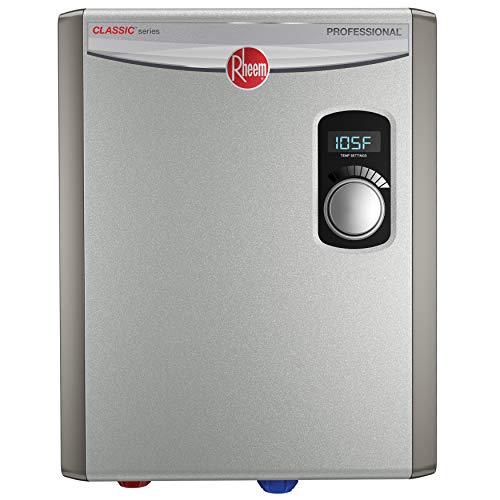
Rheem’s 18kW unit features external digital thermostatic control with LED display, self-modulation, and durable copper immersion elements. It offers up to 4.4 GPM and a design focused on dependable performance with serviceable components. For homes that require straightforward install and robust performance across multiple fixtures, this model balances capacity with maintainable hardware.
Buying Guide: Key Purchase Considerations
- Flow rate needs: For four bathrooms, target models capable of 4.0 GPM or higher across multiple fixtures. Higher GPM units better accommodate simultaneous showers and sinks.
- Electrical service: Many 18 kW units require dual 40-amp breakers; larger 27 kW or 36 kW units demand multiple high-amperage circuits and robust service panels. Verify available amperage and panel capacity before purchasing.
- Space and installation: Tankless heaters are compact, but some require more wall space and proper clearance. Assess mounting options, venting needs (if any), and water line routing.
- Temperature control: Self-modulating technology minimizes energy use by adjusting heat output in real time. Look for models with easy-to-read digital displays and stable output across changing inlet temperatures.
- Reliability and support: Consider brands with strong warranties and regional service networks. Read customer reviews for real-world performance, maintenance intervals, and part availability.
- Point-of-use vs whole-house approach: Point-of-use units are ideal for supplementing a larger system or serving a single bathroom cluster, while multi-point configurations distribute loads across several units for entire-home coverage.
- Safety and materials: Look for water-electricity separation, corrosion resistance, and sturdy internal tanks. ABS externals and stainless steel interiors are common for durability and safety.
Table of recommended models provides a snapshot of capacity ranges, electrical needs, and potential fit for homes with four bathrooms. When selecting a model, align your choice with local electrical service, wall space, and your preferred balance between upfront installation effort and long-term energy savings. These considerations help ensure reliable hot water across multiple fixtures while maintaining efficiency and cost effectiveness.