Best Electric Sailboat Outboard Motors for Quiet, Clean Propulsion
If you’re choosing an electric sailboat outboard motor, you want quiet operation, reliable range, and simple maintenance. This guide spotlights five top options that balance power, efficiency, and portability for coastal, lake, and calm river use. The Newport NT300 suits long trips with high thrust; Newport NV-Series models cover mid-to-large boats; PEXMOR, VEVOR, and BODIOO offer strong 55–68 lb thrust for smaller boats or lighter setups. Ideal buyers include anglers, coastal cruisers, kayakers, and boaters seeking emissions-free propulsion with easy control and headroom for upgrades.
Summary of chosen products
- Newport NT300 Electric Outboard Motor — 3HP, 66-mile range, digital throttle
- Newport NV-Series 62lb Thrust Trolling Motor — high thrust for larger boats
- PEXMOR 55LBS Thrust Electric Trolling Motor — balanced power and efficiency
- VEVOR Electric Trolling Motor — 55lb thrust, adjustable handle
- BODIOO 68lb Thrust Trolling Motor — robust auxiliary propulsion with low noise
Newport NT300 Electric Outboard Motor

Power and range: The NT300 delivers 3HP equivalent (1300 watts) with 110 lb of thrust for both saltwater and freshwater. It can reach up to 6.5 MPH and cover about 66 miles per charge, with a maximum runtime of 30 hours depending on boat type and conditions. Best for longer day trips or fishing expeditions where quiet, emissions-free propulsion matters.
Controls and build: Features a digital throttle with an LCD display, a 24.6″ shaft, and a 9.8″ 2-blade composite propeller. Trim/tilt options include 0°, 7°, 14°, 21° (70°). Field-oriented control provides smooth operation in varied water conditions. Best for anglers and shorefront cruisers who want precise throttle feedback and easy adjustments.
Who it’s best for and why: Ideal for boaters needing substantial thrust and reliable range in salt or fresh water. Better for longer trips where quiet operation plus a display-driven, easy-to-read throttle is valued. Caution: Real-world range depends on boat weight, load, and environmental factors; plan charging accordingly.
Newport NV-Series 62lb Thrust Trolling Motor

Power and purpose: This high-thrust 12V trolling motor is designed for larger boats and heavier loads, delivering strong forward power with 62 lb of thrust. It uses a 36″ shaft and a 3-blade propeller for robust pushing capacity. Best for jon boats, larger fishing craft, and tidal or windy conditions where extra thrust improves control.
Features and control: Includes LED battery indicator, 36″ shaft, adjustable mount height, and adjustable direction. Eight speeds (4 forward, 4 reverse) allow careful pacing in varying water conditions. It’s built for trolling duties with reliable, long-day operation without overheating.
Who it’s for and why: Choose this if you regularly fish or cruise on bigger boats and need consistent torque and dependable control. Limitation: It’s a 12V system, so battery capacity and weight affect endurance and boat balance.
PEXMOR 55LBS Thrust Electric Trolling Motor
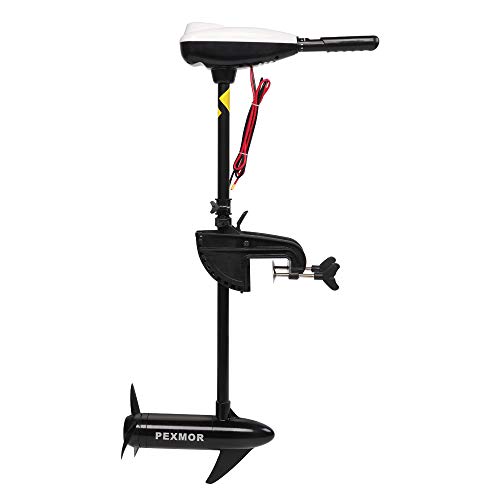
Power and efficiency: The 55 lb thrust model is designed to provide strong all-day operation with less risk of overheating. It features a 6″ adjustable handle, 5 forward speeds, and 3 reverse speeds for smooth control in freshwater or saltwater.
Depth and angle: An adjustable shaft angle helps tailor performance to different sailing conditions. The motor supports easy depth adjustments via a control knob, making it practical for varying water depths and vegetation.
Who it’s for and why: Best for smaller to mid-sized boats where reliable, quiet propulsion is needed without heavy power demands. Limitation: Real-world speed depends on boat weight and water conditions; not intended for high-speed running on large vessels.
VEVOR Electric Trolling Motor

Thrust and control: This 12V motor delivers 55 lb of thrust with 8 speeds (5 forward, 3 reverse). A 3-blade propeller improves low-speed torque and reduces tangling, while a 6.3″ to 10.6″ adjustable telescoping handle aids comfort for standing or seated operation.
Mounting and depth: Transom-mounted with an adjustable shaft height and a 30″ shaft for versatile fit on various craft. The motor’s design emphasizes low noise around 50 dB, helpful for anglers and wildlife watchers. Best for small to medium boats seeking a balance of power and quiet operation.
Who it’s for and why: Choose when you want a feature-rich, configurable trolling motor with clear battery readouts and adjustable depth. Limitation: Real-world performance varies by boat type and water conditions; ensure compatibility with your transom before purchase.
BODIOO 68Lb Thrust Trolling Motor

Power and reliability: A robust auxiliary or primary propulsion option with 68 lb thrust, designed for larger vessels or heavier loads. It uses a copper-core wiring design and a 90° rotatable bracket with 10-position steering for enhanced control in shallow or cluttered waters.
Durability and features: Includes a 3-blade/9.5″ propeller, LED voltage display, and an adjustable depth/angle collar-release mechanism. The ergonomic bracket and debris-resistant propeller reduce maintenance in vegetation-heavy waters. Best for anglers on bigger craft needing strong thrust and flexible mounting.
Who it’s for and why: Choose this if you need substantial thrust for larger boats or tougher currents. Limitation: Heavier unit and higher setup complexity may require careful mounting and weight distribution considerations.
Buying Guide: Key Considerations For Electric Sailboat Outboard Motors
What boat size and weight should drive your choice?
Smaller boats benefit from 36–55 lb thrust motors; larger craft often need 62–68 lb or more. Heavier loads require higher thrust to maintain control and maneuverability in wind and current.
What water conditions matter most?
Saltwater requires corrosion resistance. Freshwater users still benefit from durable housings and reliable seals. Consider motors with reinforced housings and longer warranties in harsh environments.
How important is range and runtime?
Electric outboards vary in runtime from several hours to longer day trips. Choose based on typical trip length, speed, and payload. Plan for charging opportunities or spare batteries if extended usage is common.
How do control features affect operation?
Digital throttles, LCD displays, and adjustable trims improve precision, especially in variable currents. An adjustable handle height helps both standing and seated operators. Compatibility with existing mounting setups is essential.
What about maintenance and reliability?
Look for low-noise operation, simple propeller access, and robust materials for salt and freshwater use. Regular checks of seals, batteries, and wiring help sustain performance over time.
Choosing the right setup: quick decision aids
- Big boats on windy days: aim for 62–68 lb thrust.
- Lightweight kayaks or small boats: 36–55 lb thrust is usually enough.
- Frequent long trips: prioritize higher range and a digital throttle for efficiency.
FAQ
Q1: Do electric outboard motors work well in saltwater?
A1: Yes, many models use corrosion-resistant materials designed for saltwater use. Check for motor housings and propellers rated for saltwater exposure.
Q2: How many speeds do most trolling motors offer?
A2: Most models provide 5 forward and 3 reverse speeds, with some offering additional gear ranges within 8 speeds total.
Q3: Is a longer shaft better for deeper waters?
A3: Longer shafts help with water depth management and reduce cavitation in choppy waters. Choose shaft length to fit your boat’s transom height.
Q4: Can these motors be used as primary propulsion?
A4: Some can serve as primary propulsion on small craft, but many are optimized for trolling or auxiliary use. Verify motor thrust, mounting, and boat weight with your application.
Q5: Do electric outboards require special battery setups?
A5: Most use compatible 12V or 36V battery systems. Confirm voltage, capacity, and charging options for your boat to ensure reliable operation.
In this guide, five options span high-thrust models for bigger craft and compact models for smaller boats. Each product is selected for clear, practical advantages in quiet propulsion, maintenance simplicity, and real-world usability on various water environments.