Best Electric Radiant Heat Thermostat Guide: 5 Top Choices for Efficient Floor Heating
Answering buyers seeking reliable control for electric radiant heating, this guide highlights five strong options that balance safety, ease of use, and energy savings. Ideal buyers include do-it-yourself homeowners upgrading underfloor or baseboard systems, property managers seeking straightforward scheduling, and tech-minded shoppers wanting smart connectivity. The selection focuses on devices with dual voltage suitability (120V/240V), built-in safety features like GFCI, and flexible sensing (air and/or floor). Below is a quick comparison table to help you scan key capabilities at a glance.
| Product | Voltage | Key Safety | Smart Features | Best For |
|---|---|---|---|---|
| Programmable Thermostat for House Radiant Underfloor Heating, Dual Sensing | 120/240V | Built-in GFCI | Floor and Air Sensor, Self-adaption | Users prioritizing safety and floor-sensing control |
| MAXKOSKO 1PC WiFi Smart Thermostat for Electric Floor Warming | 120/240V | Not specified | Smart remote, Alexa/Google Assistant | Smart home integration and remote control |
| OJ Microline UDG4 Touchscreen Programmable Thermostat | 120/240V | Class A GFCI | 7-day program, adaptive self-learning | Precise scheduling with self-adjusting efficiency |
| Honeywell TH115-AF-GA/U Radiant Thermostat | 120/240V | GFCI | 7-day programmable | Trusted brand with straightforward programming |
| meross Smart Thermostat for Electric Baseboard Heaters | 120/240V | Not specified | Apple HomeKit, Alexa, Google | Broad smart home compatibility |
Programmable Thermostat for House Radiant Underfloor Heating
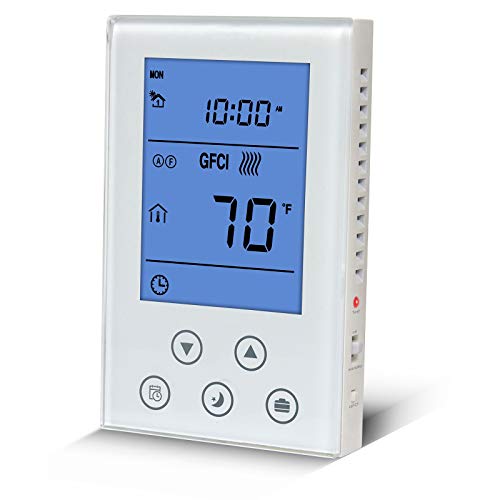
This underfloor radiant heating thermostat operates on 120V or 240V and supports up to 3600W at 240V. It includes floor and air sensors and a built-in GFCI for electrical safety. The device emphasizes safety testing and a clear user flow for tripped GFCIs, making it a prudent choice for homes with concrete or tile floors where moisture protection matters. Best for safety-conscious installers who want dual-sensing control and straightforward GFCI testing.
Best for: Homes requiring robust ground fault protection and dual sensing to optimize comfort and safety.
Potential limitation: Some users may need guidance for GFCI troubleshooting if tripping occurs frequently.
MAXKOSKO 1PC WiFi Smart Thermostat for Electric Floor Warming

This 120V/240V thermostat supports remote control via smartphone and voice assistants like Alexa and Google. It is designed for compatibility with most underfloor heating systems and emphasizes energy savings through programmable modes. Best for tech-forward homes seeking convenient remote control and voice-enabled comfort, plus integration with a broader smart-home ecosystem.
Best for: Homeowners who want remote control and voice assistant integration to manage floor heating from anywhere.
Limitation: The feature set relies on stable WiFi and compatible voice ecosystems for full functionality.
OJ Microline UDG4 Touchscreen Thermostat

The UDG4 offers a responsive color touchscreen, dual sensing, and built-in Class A GFCI. It is suitable for 120V or 240V circuits and includes a floor sensor for precise temperature management. Best for users who value a modern interface, adaptive control, and reliable safety features. A good pick when energy efficiency and simple programming are priorities.
Best for: Users who want a self-contained, easy-to-use touchscreen with adaptive temperature control.
Limitation: Non-voice control features may be less appealing to some smart-home enthusiasts.
Honeywell TH115-AF-GA/U Radiant Thermostat

Honeywell’s TH115-AF-GA/U is a 7-day programmable line voltage thermostat with a focus on straightforward operation for radiant heating. Its classic design and proven brand reliability make it a solid option for those who prefer familiar interfaces and predictable performance. Best for traditional setups where simple daily programming suffices and GFCI protection is desired.
Best for: Users wanting dependable, easy-to-program control from a trusted brand.
Limitation: Lacks some of the newer smart features found in WiFi models.
meross Smart Thermostat for Electric Baseboard Heaters

Meross provides a high-voltage compatible smart thermostat supporting 120V/240V with remote control and voice assistants. It requires four or more wires in the electrical box and supports integration with Apple HomeKit, Alexa, Google, and SmartThings. Best for households seeking broad smart home compatibility and energy-management via app control.
Best for: Smart-home enthusiasts who want broad ecosystem compatibility and remote scheduling.
Limitation: Some installations may require more wiring and careful compatibility checks with existing baseboards.
Mysa Smart Thermostat LITE for Electric Baseboard Heaters
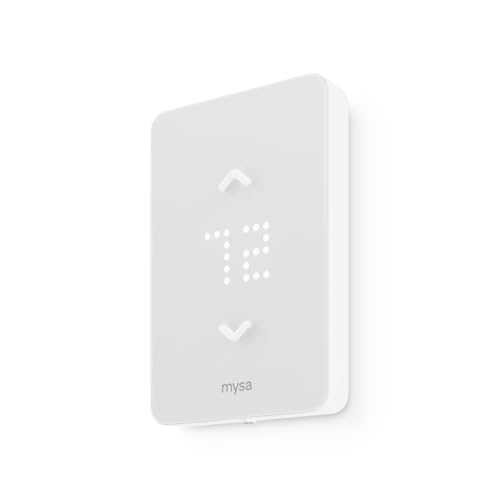
Mysa’s LITE model emphasizes energy savings with 7-day scheduling and local WiFi control. It works with HomeKit, Alexa, and Google, and supports 120V-240V systems. Best for users who want budget-friendly smart control and strong scheduling capabilities without a hub. It helps reduce heating costs when the home is unoccupied.
Best for: Homeowners seeking cost-efficient smart control with reliable scheduling.
Limitation: Some advanced features require newer app updates and compatible devices/apps.
Dr. Infrared Heater DR-001 Wall Thermostat
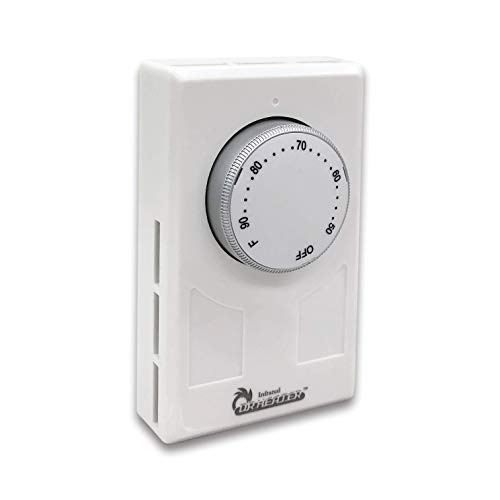
This wall thermostat handles a broad range of high-power radiant settings, supporting up to 7756W at 277 VAC. It offers traditional control dials and a flush wall-mount design. Best for large spaces or high-wattage radiant systems where a robust, non-digital control method is preferred.
Best for: High-wattage radiant installations needing durable, dial-based control.
Limitation: Not a smart thermostat; lacks remote access and scheduling features.
Buying Guide
Key considerations help you pick the right electric radiant heat thermostat for your space:
- Voltage compatibility: Ensure the device supports your wiring (120V or 240V) and matches your heating system’s load.
- Safety features: Look for built-in GFCI or similar protection, especially for floor heating installations and damp environments.
- Sensing type: Floor sensing improves comfort with radiant heat, while air sensing can adjust for room temperature fluctuations.
- Programming vs. smart control: Decide between simple programmable models and full smart thermostats with app control and voice assistants.
- Installation requirements: Some units require multiple wires or a specific mounting setup; verify compatibility with your electrical box.
- Brand reliability and support: Trusted brands often provide easier troubleshooting and long-term support.
If you value energy savings, prioritize models with adaptive or programmable features and the ability to schedule occupancy-based reductions. For homes already integrated with smart ecosystems, choose thermostats with HomeKit, Alexa, or Google compatibility to maximize convenience.
In summary, the best pick depends on your priorities: safety and dual sensing (Programmable Underfloor Thermostat), smart home integration (MAXKOSKO or meross), intuitive touch control (OJ Microline), or strong brand reliability (Honeywell). Consider your space, electrical setup, and desired level of automation when choosing.
FAQ
- Do all radiant floor thermostats require GFCI protection?
Many do, especially for electrical floor heating, to reduce shock risk. Check product specifications and local codes.
- Is WiFi connectivity essential for radiant heat control?
No, but it adds remote management and scheduling. Non-smart models provide reliable local control only.
- What is dual sensing in thermostats?
Dual sensing uses both air (room) and floor sensors to balance comfort and energy use.
- Can I install a thermostat on any existing baseboard heater?
Compatibility depends on voltage, current rating, and wiring. Refer to product specs and an electrician if needed.
- What is the advantage of a 7-day programmable thermostat?
It lets you set different temperatures for each day, optimizing comfort while reducing energy consumption.
- Do smart thermostats require hub devices?
Most do not; many connect directly to WiFi, but some integrations may be enhanced by hubs or compatible apps.