Best Electric Baseboard Heaters for 24-Inch Installations
Answering your search for a 24-inch electric baseboard heater, this guide highlights five solid options suited to compact spaces and quick room warmth. Ideal buyers include apartment dwellers needing slim, easy-install units; homeowners seeking discreet heat along walls; and renovators aiming for reliable convection without fans. Below, each product is evaluated for suitability, with practical pros, limitations, and who should choose it.
| Product | Approx. Length | Best For |
|---|---|---|
| Cadet F Series 24″ Electric Baseboard Heater | 24″ | Small rooms, simple install, quiet operation |
| Marley 2′ Baseboard Heater | 24″ | Convection heating with quick warmth, allergy-friendly |
| Dimplex LC2507W31 25″ Linear Convector | 25″ | Efficient convection for faster room heat |
| Cadet F Series 72″ Electric Baseboard Heater | 72″ | Long walls, uniform heat distribution |
| Comfort Zone CZ600 Electric Baseboard | Various lengths | Medium rooms, adjustable thermostat, safety features |
Cadet F Series 24″ Electric Baseboard Heater
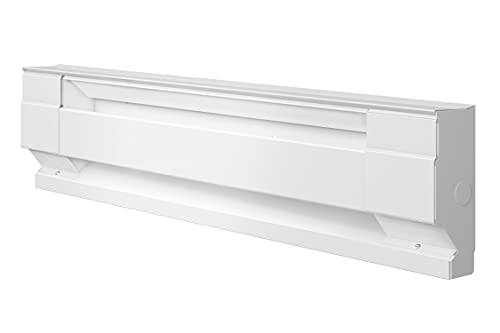
Product overview: Cadet’s 24-inch F Series offers compact, robust electric baseboard heating with 24-inch length, a white steel body, and power options at 240/208 volts with a 350/262 watt output. Best for small rooms, hallways, or spaces where visible heater size must be minimized. The universal wiring and pre-punched knockouts support a straightforward installation.
Best for: Small apartments, offices, or bedrooms where discreet heating is preferred and a single 24″ unit suffices. This option is chosen for tight installations and predictable convection heating. Limitation: Lower wattage compared to larger models means less bedroom-wide warmth in very chilly spaces.
KING 2K2405BW K Series Baseboard Heater

Product overview: The KING 2K2405BW is a 27-inch baseboard heater with a 500W rating at 240V. It features an aluminum ribbon fin element, full-length safety cutout, and a crushproof element. Best for: spaces where a slightly longer unit is acceptable to achieve stronger warmth while keeping a slim profile. Limitation: It is not a strict 24-inch length, so installation on a strict 24-inch pocket may require planning around mounting space.
Marley 240V 2′ Baseboard Heater
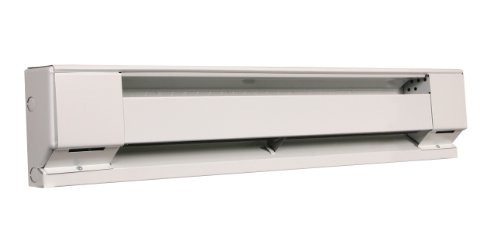
Product overview: Marley’s 2′ (24″) baseboard heater is a convection unit designed to heat a room rapidly without fans. It helps maintain even temperatures from floor to ceiling and reduces the dispersion of dust and allergens. Best for: allergy-sensitive environments and spaces where quiet, steady heating is valued. Limitation: 2′ length may provide moderate warmth—larger rooms might require additional units or higher wattage models.
Marley 120V 2′ Baseboard Heater
Product overview: Marley’s 120V 2′ baseboard heater provides convection heating with similar benefits to its 240V counterpart. It excels in spaces that require simple wiring and quick installation with minimal footprint. Best for: single rooms, studios, or spaces wired for 120V where a compact, efficient heat source is needed. Limitation: 120V models may have lower total heat output than 240V equivalents, affecting warmth in larger rooms.
Cadet F Series 36″ Electric Baseboard Heater
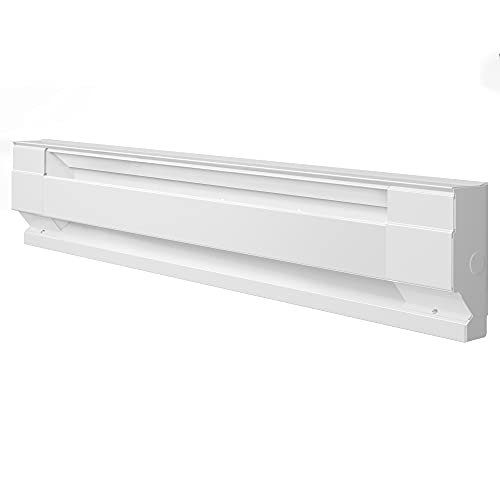
Product overview: Cadet’s 36-inch F Series baseboard heater provides higher wattage with multi-watt capabilities (750/563 Watts) and 240/208-volt options, enabling more robust room heating. Best for: larger rooms or spaces where a longer baseboard is feasible and stronger heat is preferred. Limitation: Longer length may require more wall space and careful alignment with furniture.
Buying Guide
What should you consider when choosing a 24-inch electric baseboard heater?
- Heat output: Assess wattage and volt requirements. Higher wattage models generate more heat, suitable for colder climates or larger small rooms.
- Electrical compatibility: Ensure your electrical system matches the device’s voltage (120V vs. 240V). Some homes require split-load or dedicated circuits.
- Installation space: Measure wall length and mounting heights. 24-inch units suit narrow walls and tight corridors.
- Safety features: Look for end-caps, overheat protection, and tip-over switches to reduce risk, especially in bedrooms or play areas.
- Convection vs. radiant touch: Most baseboards rely on convection to distribute warm air; consider models with grille design that minimizes dust disturbance if allergies are a concern.
- Maintenance and durability: Steel bodies tend to be durable; check for pre-punched knockouts and wiring compartments for easy wiring access during install.
FAQ
- What length should I choose for a 24-inch space?
Answer: A 24-inch unit is ideal for narrow walls or when you want a discreet heater; if you need more warmth, consider a longer unit or adding a second one. - Are 240V models more powerful than 120V for the same length?
Answer: Yes, 240V models typically deliver higher total wattage, enabling greater heat output in the same footprint. - Is convection heating better for allergy safety?
Answer: Convection heaters circulate air without a fan, which can reduce dust movement compared to fan-forced units. - Do baseboard heaters require professional installation?
Answer: Installation may involve wiring and mounting on walls; consult a licensed electrician or installation guide for safety and compliance. - Can these units heat a whole room or just part of it?
Answer: Baseboard heaters create even warmth across a room, but effectiveness depends on room size, insulation, and layout. Multiple units may be needed for larger spaces.