Best Efficient Electric Tankless Water Heaters for on-Demand Hot Water
For homes seeking endless hot water with lower energy waste, electric tankless heaters offer compact design, rapid heating, and precise temperature control. This guide highlights five top options that balance efficiency, installability, and performance. Read on to compare features, power needs, and suitability for your household flow requirements, from point-of-use upgrades to whole-house solutions.
The following quick-reference table summarizes the featured products and their core strengths. Use it to jump to a detailed section for each model.
| Product | Brand | Max Power | Approx. Typical Use | Key Benefit |
|---|---|---|---|---|
| EcoSmart ECO 11 | EcoSmart | 13 kW | Small homes, point-of-use | Self-modulating, space-saving |
| Rheem 18kW 240V | Rheem | 18 kW | Mid-size homes | Digital control, durable elements |
| WINTEMP 8kW | WINTEMP | 8 kW | Under-sink or single fixture | LED display, steady temp |
| Orbek 14kW | Orbek | 14 kW | 2–3 fixtures | Efficient, strong flow |
| WINTEMP 27kW | WINTEMP | 27 kW | Whole-house | WiFi control, high GPM |
EcoSmart ECO 11 Electric Tankless Water Heater (13KW) with Self Modulating Tech

The EcoSmart ECO 11 provides on-demand hot water by continuously monitoring water temperature and adjusting flow to maintain within one degree of the selected setting. With a compact footprint and a claimed 99% thermal energy efficiency, this model emphasizes space savings and energy savings by heating water only when called for. Its 13 kW rating at 240V makes it well-suited for small homes or point-of-use installations. Installation considerations include adequate electrical service and proper mounting location to maximize efficiency and performance.
Features from the listing include: endless hot water on demand, precise temperature stability, self-modulating technology, and a compact size (approximately 11.5 x 8 x 3.75 inches). The unit is designed to save energy and space, with a typical application where only a portion of the home is served by the heater.
Rheem 18kW 240V Tankless Electric Water Heater

Rheem’s 18kW model combines an external digital thermostat with LED display for precise control, along with self-modulation to adjust power based on hot water demand. It features copper immersion elements and a field-serviceable design for ease of maintenance. This unit supports a flow rate up to 4.4 GPM, making it a strong choice for mid-sized homes or multi-point usage where reliable hot water is needed across several fixtures. The controller allows temperature adjustments in small increments for consistent comfort.
WINTEMP 8KW Tankless Water Heater (240V)

This 8 kW WINTEMP model is designed for installation under a bathroom sink or at a single fixture. It emphasizes stable water temperature with automatic adjustments based on incoming water temperature and flow, ensuring efficient operation and consistent output. The LED temperature display helps monitor performance, while the unit’s compact dimensions support space-saving installations. It is best suited for scenarios where a single or few fixtures require reliable on-demand hot water.
Orbek 14kW Tankless Electric Water Heater (240V)

Orbek’s 14 kW on-demand heater supports up to 3.38 GPM, suitable for 2–3 fixtures. The model notes a requirement for a robust electrical setup (a total circuit capacity of at least 150 amps, two-pole 240V 60A breaker, 6 AWG wiring). It promotes energy savings with a design intended to deliver instant hot water and reduce electricity usage compared to traditional tank systems. The unit targets reliable performance for multi-point use within homes that have adequate electrical capacity.
WINTEMP 27kW Tankless Water Heater (240V)

The 27 kW WINTEMP model is designed for whole-house hot water with a high maximum output (up to 6.5 GPM). It requires significant electrical service, including three 40-amp double-pole breakers and three 8 AWG conductors, and typically a 250A power supply in the home. Features include a stable water temperature with auto-adjusted energy use, a sizable heat output for multiple fixtures, and a modern LED display. This unit targets larger households or homes with higher simultaneous hot water demands and adequate electrical capacity.
APUS 27kW Tankless Water Heater (240V)
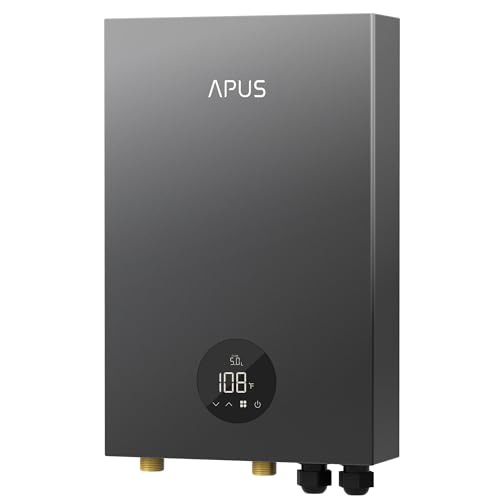
APUS’s 27kW unit delivers up to 6.5 GPM with a memory function and LED display for precise temperature control (86°F–140°F). It emphasizes energy savings through self-modulating technology and a compact footprint suitable for whole-home use or targeted installations. The unit requires three 40 A breakers and 6 AWG conductors, reflecting its high-performance capability for homes with substantial hot water needs and a robust electrical system. The memory feature helps retain preferred settings after power cycles for convenience and consistent operation.
Buying Guide: Key Purchase Considerations
- Household hot water demand: Estimate the number of fixtures that will draw hot water simultaneously. Larger homes or high-demand scenarios benefit from higher kW ratings (e.g., 18–27 kW) and multiple heating elements, while smaller setups can rely on 8–13 kW models.
- Electrical service capacity: Most electric tankless heaters require substantial electrical service. Review your home’s available amperage, panel space, and whether a service upgrade is necessary. Common requirements include 150A–200A service and multiple double-pole breakers of 40A or more.
- Flow rate and temperature rise: GPM ratings indicate how much hot water you can pull at a given temperature rise. In colder climates or for multi-point use, opt for units with higher flow capability and robust self-modulation.
- Installation considerations: Space-saving wall-mount or point-of-use installation is a major advantage of tankless models. Ensure proper venting isn’t required for electrical units and verify water connections (NPT sizing) align with existing plumbing.
- Control and efficiency features: Self-modulating technology helps minimize energy use by adjusting power to actual demand. LED displays, memory functions, and Wi‑Fi compatibility add convenience and monitoring capability.
- Maintenance and durability: Look for units with durable copper heating elements and field-serviceable components if you anticipate future servicing. Regular descaling may be needed in areas with hard water to preserve efficiency.
- Code and safety considerations: Ensure the chosen model complies with local electrical codes and that proper breakers and wire gauges are used. Consult a licensed electrician for panel upgrades or complex installations.
- Cost of ownership: While price data is not shown here, factor in installation costs, potential electrical panel upgrades, and ongoing energy savings from self-modulating units when evaluating overall value.
Glossary: Quick Terms for Buyers
- : Gallons per minute, a measure of water flow. Higher GPM supports more simultaneous hot-water use.
- : A technology that adjusts energy input based on water temperature and flow to reduce energy waste.
- : National Pipe Tertination thread sizing for plumbing connections, typically 1/2″ or 3/4″ in these units.
- : Double-pole circuit breaker in the electrical panel protecting each heating element.
All models listed here are designed for on-demand heating with an emphasis on energy efficiency and space savings. When selecting a unit, assess your peak simultaneous hot-water needs, available electrical service, and installation constraints to identify the best match for your home.