Best Duo Battery Solar Controllers for Dual-Battery Setups in 2026
Answering the demand for reliable two-battery solar charging, these duo battery solar controllers manage two banks with prioritized charging and protection. They’re ideal for RVs, boats, caravans, and off-grid cabins where two battery banks must be charged efficiently. The top picks below are aimed at users who want independent battery charging, temperature compensation, and solid protection features. The following table highlights the five products selected for practical comparison.
| Product | Best For | Key Feature |
|---|---|---|
| EPEVER EPIPDB-COM 10A | Compact dual-bank systems | Independent charging with 2 banks |
| EPEVER EPIPDB-COM 20A | Moderate dual-bank systems | Higher current, dual-bank protection |
| Morningstar SunSaver Duo 25A | USA-designed reliability | Four-stage charging, remote options |
| Morningstar SSD-25RM | Dual-battery with remote display | Graphic remote meter, USA design |
| EVPEVER 20A | Budget-friendly dual-bank | Independent charging control |
EPEVER EPIPDB-COM Series 10A Dual Battery Solar Controller
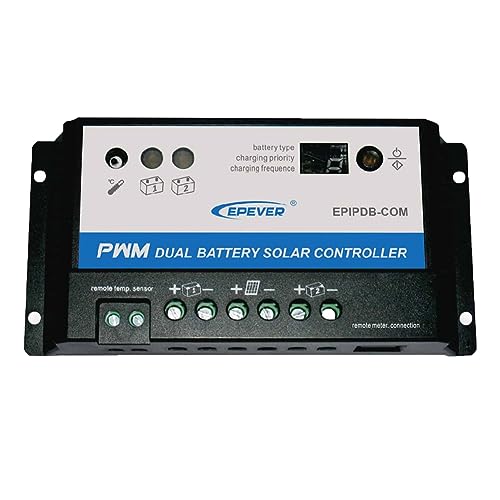
The EPEVER EPIPDB-COM 10A is designed to charge and protect two batteries or battery banks independently with a defined charging priority. It includes built-in protections such as short-circuit, open-circuit, reverse, and overload protections. This model is suitable for small dual-battery systems on RVs, caravans, and boats. Best for users who want a compact, affordable dual-bank controller with straightforward setup.
Best for: small dual-battery setups where space and cost are critical. Caution: lower current may limit performance in larger solar arrays.
EPEVER EPIPDB-COM Series 20A Dual Battery Solar Controller
The 20A version adds higher current capacity while retaining dual-battery independent charging with a priority option (e.g., 30%/70%). It includes the same protective features and RTS auto-switch locally when a remote temperature sensor is connected. This makes it better for mid-sized systems and longer daylight hours. Best for: RVs, caravans, and boats needing more charging headroom without stepping up to a larger controller.
Limitation: higher current requires more robust wiring, and installation should follow the local safety standards.
Morningstar SunSaver Duo 25A PWM Solar Charge Controller (SSD-25)

The Morningstar SunSaver Duo 25A uses PWM to deliver dual-battery charging with four-stage charging and temperature compensation to extend battery life. It supports DIP switch options for different battery types and provides a software-free approach via MSView for advanced users. Best for: users who value a USA-designed controller with dependable, widely supported software options and strong protection features.
Limitation: by PWM nature, it may be less efficient in high-voltage array scenarios compared to MPPT options, especially in hot climates.
Morningstar SunSaver Duo 25A PWM Solar Controller (SSD-25RM) with Remote Meter
This variant adds a Remote Meter that displays charging status, battery level, protections, and disconnect conditions. It retains the four-stage PWM charging and tentatively benefits from a low self-consumption design. Best for: users who want real-time visualization of battery health and charging progress without connecting to a PC. Limitation: remote meter adds extra component to the installation.
EVPEVER 20A Dual Battery Solar Controller
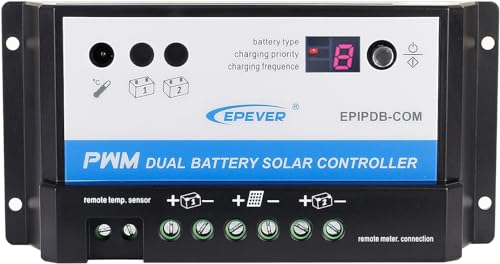
This 20A EVPEVER model focuses on independent charging for two batteries or battery banks with a priority scheme (e.g., 80%/20%). It includes standard protections—short-circuit, open-circuit, reverse, overload—and adjustable parameters for system tuning. Best for: affordable dual-bank charging with straightforward setup. Caution: ensure compatible with your battery chemistry and array size to avoid underutilization of capacity.
Victron Energy BlueSolar PWM DUO Controller

The Victron BlueSolar PWM DUO provides a concise display of data and includes USB charging, plus a programmable lighting function for integrated systems. It’s designed for 12/24V systems with a dual-battery configuration. Best for: users who want clear digital readouts and built-in USB charging for small electronics. Limitation: Victron’s ecosystem often suits longer-term investment due to broader compatibility expectations.
Renogy Wanderer 10A PWM Dual-Battery Controller
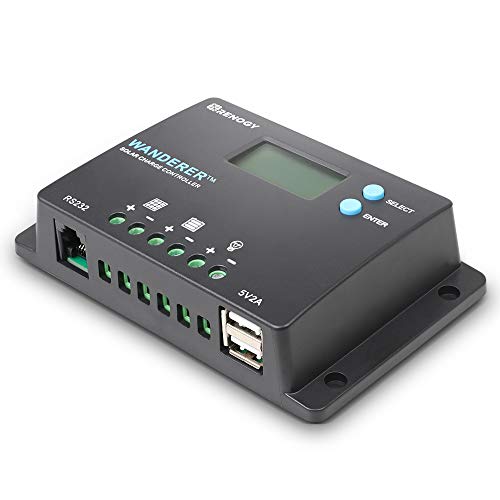
The Renogy Wanderer 10A PWM controller supports 12V/24V systems with a four-stage charging process, broad battery compatibility (including Lithium, AGM, Gel, Flooded), and manual as well as automatic modes. It features a compact design, LEDs for real-time status, and a negative-ground setup for RV or marine use. Best for: compact off-grid or mobile setups where space and ease of use matter. Caution: some advanced features require firmware awareness for optimal tuning.
Buying Guide: Choosing The Right Duo-Battery Solar Controller
What should you consider when selecting a dual-battery solar controller?
- Battery type compatibility: Ensure the controller supports your battery chemistry (flooded, AGM, Gel, Lithium). Some models offer flexible mode switches or DIP options.
- Current rating: Match the controller’s amperage to the solar array’s output and your two-battery charging needs. Higher currents provide faster charging but require proper wiring.
- Charging profile: Four-stage PWM controllers maximize battery life; MPPT options improve efficiency in bright sun or high-voltage arrays. Prioritize models with temperature compensation to extend life in hot environments.
- Independent bank control: Look for dual-bank support that charges banks with configurable priority (e.g., 30%/70% or 80%/20%) to balance usage scenarios.
- Protection features: Short-circuit, reverse polarity, over-load, and over-discharge protection are essential for safe operation in mobile installations.
- Ease of installation: Consider remote displays, meter options, and whether a negative-ground setup is compatible with your vehicle or vessel.
- Future expandability: If you anticipate larger solar arrays or additional batteries, choose a controller with headroom or modular features.
Frequently Asked Questions
- What defines a “duo battery solar controller”? — A controller designed to manage two separate battery banks with independent charging, often with a priority setting for allocation of charging power.
- Is PWM enough for dual-battery systems? — PWM works well for many setups, especially smaller arrays. MPPT can offer better efficiency in hot climates or with longer cable runs.
- Can I mix battery chemistries in a dual-bank setup? — Prefer matching chemistries within each bank and use a controller that explicitly supports those types to avoid compatibility issues.
- Do all dual-bank controllers require a remote meter? — No. Some include built-in displays; others offer remote meters for easier monitoring.
- What maintenance is required for these controllers? — Regularly inspect wiring, connectors, and fuses. Ensure ambient temperature ratings match your installation environment.
- How do I choose the right amperage? — Base it on your solar array output under typical sun conditions and your intended charging priorities for both banks.