Best Dual Solar Charge Controllers for Two-Battery Systems in 2026
Find the right dual solar charge controller to manage two battery banks efficiently. This guide highlights top options for RVs, boats, caravans, and off‑grid setups. The ideal choice depends on system voltage, battery types, and whether you need MPPT or PWM control. Below you’ll see five well-suited models, with who they’re best for, key benefits, and practical cautions to aid side-by-side comparisons.
Buyer’s quick reference: top dual controllers reviewed
| Product | Best For | Key Strength | Limitations |
|---|---|---|---|
| EPEVER EPIPDB-COM Series Dual Battery Solar Charge Controller 10A | Small RVs and boats needing independent battery banks | Independent battery charging with priority settings | Low amperage; not ideal for large arrays |
| EPEVER 30A MPPT Dual Battery Solar Charge Controller 12V/24V | Medium-sized RVs and caravans | High tracking efficiency; dual battery support | More complex setup for beginners |
| EVPEVER 20A Solar Charge Controller 12V/24V Dual Battery | Motorhomes and boats needing simple PWM control | Independent bank protection and adjustable parameters | Limited to lead-acid types in the note |
| Renogy Wanderer 10A PWM Dual Battery Controller | Compact systems needing LCD and rugged design | Four-stage charging with LCD display | PWM not MPPT; performance depends on panel voltage |
| Victron Energy SmartSolar MPPT 15A | Premium setups prioritizing maximum efficiency | Bluetooth monitoring and synchronized charging | Higher price; requires compatible ecosystem |
EPEVER Epipdb-Com Dual Battery Controller 10A
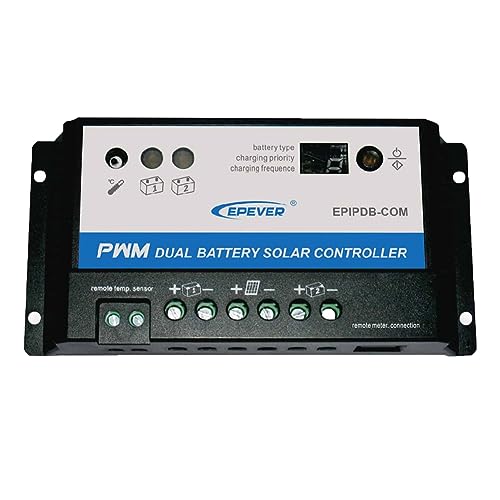
The EPEVER EPIPDB-COM Series is a compact dual-battery PWM controller designed for two independent battery banks. It supports charging priorities, such as 30%/70%, and works with 12V or 24V systems. Built-in protections include short-circuit, open-circuit, reverse polarity, and overload safeguards, making it suitable for RVs, caravans, or boats where two batteries must be managed separately. Best for buyers who need simple, reliable dual-bank control without MPPT complexity.
Best for: small RVs or boats requiring two batteries with separate charging priorities. Choose this if you want straightforward two-bank control with clear protection features and a low-amperage setup. Avoid this if you need high efficiency from very large solar arrays or lithium-specific charging without extra configuration.
Limitation to note: the 10A rating may limit how much solar power you can harvest in a larger system, so match to a modest array and modest daily loads.
EPEVER 30A MPPT Dual Battery Controller

This dual-battery MPPT controller from iSunergy is sized for RVs, campers, caravans, or small boats with two battery banks. It supports 12V/24V auto operation and a high maximum PV input (100V) with a robust power ceiling (390W for 12V, 780W for 24V). It accommodates Sealed, Gel, Flooded, and Lithium types, offering precise tracking efficiency and a broad battery compatibility map. Best for: users needing efficient, flexible dual‑battery charging with strong voltage handling. Better for: larger everyday solar loads than PWM options. Caution: MPPT efficiency can be less impactful if your array is undersized relative to load.
EVPEVER 20A Dual Battery PWM Controller
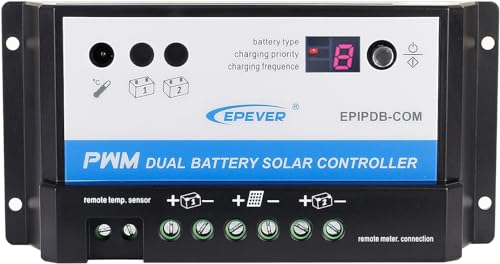
This EPEVER PWM model is designed to charge and protect two separate battery banks with independent control. It includes protections against short circuits, open circuits, reverse polarity, and overload, plus adjustable system parameters for easier setup. It is well suited for users who prefer a simple PWM approach with dual-battery protection and adjustable settings. Best for: motorhomes or boats needing two banks with straightforward configuration. Limitation: PWM controllers are generally less efficient than MPPT in bright sun conditions, potentially reducing solar harvest at higher arrays.
[Upgraded] 30A Solar Charge Controller 12V/24V PWM

This upgraded PWM controller provides auto-remembered settings and auto-adapts to 12V or 24V systems, with a built-in LCD and dual USB outputs for charging mobile devices. It supports lead-acid batteries and warns against lithium charging. Best for: users needing a cost-effective, adjustable dual system with USB ports and clear display. Choose this if your system uses lead-acid batteries and you don’t require lithium support. Caution: do not use with lithium-type batteries as noted in the manual.
EPEVER 100A MPPT Dual PV Input Controller
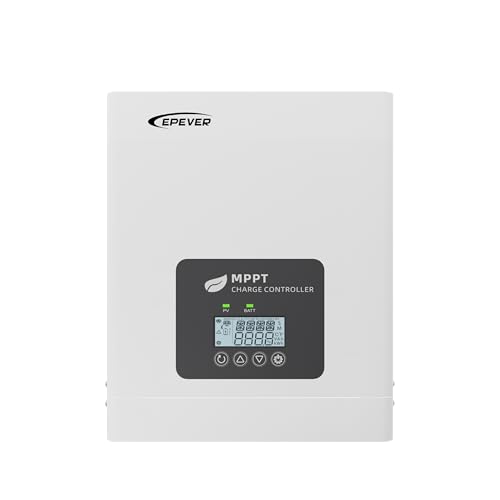
Designed for heavy loads, this SolarEpic unit features dual PV inputs (50A x 2) and supports up to 250V PV open-circuit voltage with a high input capacity. It introduces a battery-less operation mode, allowing direct supply to loads with sufficient sun, and supports 12V, 24V, and 48V systems with multiple battery chemistries including Lithium. Best for: off-grid camps, large RVs, and cabins needing high power and no-battery operation capability. Caution: advanced features may require careful configuration and understanding of no-battery mode behavior.
Victron Energy SmartSolar MPPT 75V 15A

The Victron SmartSolar MPPT controller is a feature-rich option with Bluetooth monitoring and synchronized charging across multiple controllers. It is designed for maximizing power output with advanced MPPT algorithms and can help extend battery longevity through optimized charge cycles. Best for: higher-end systems where monitoring and smooth integration with Bluetooth-enabled devices matter. Better for: users who already rely on the Victron ecosystem for expanded system control. Caution: higher price and reliance on compatible app ecosystem.
Buying Guide: Key Considerations For Dual Battery Solar Controllers
- System voltage and battery type: Decide between 12V/24V and whether you need support for Lead-Acid, Gel, AGM, Flooded, or Lithium chemistries.
- MPPT vs PWM: MPPT controllers extract more power, especially with larger panels or partial shade; PWM controllers are simpler and often cheaper but less efficient.
- Dual-battery management: Look for independent charging channels, clear priority settings, and protection features for each battery bank.
- Max PV input and power handling: Match the controller’s input specs to your solar array’s voltage and wattage to avoid under- or over-sizing.
- Protection features: Short-circuit, over-discharge, reverse polarity, temperature compensation, and under/over-voltage protections help safeguard batteries.
- Monitoring and connectivity: Bluetooth, LCD displays, or mobile app integration can simplify setup and ongoing monitoring.
- Ease of installation: Consider wiring suitability, mounting options, and whether the unit is suitable for automotive, marine, or off-grid environments.
- Future expansion: If you plan to scale, ensure the controller supports higher capacity or parallel configurations.
Frequently Asked Questions
- What is a dual battery solar charge controller?
A dual battery solar charge controller manages two separate battery banks from a single solar array, often with independent charging profiles and protections. - Do I need MPPT for dual-battery setups?
MPPT generally delivers better efficiency, especially with larger arrays or marginal sunlight, but PWM can be sufficient for smaller, low-load systems. - Can dual controllers work with lithium batteries?
Some dual controllers support lithium chemistries; check each model’s battery compatibility before use. - Is it important to match controller rating to panel wattage?
Yes. Ensure the controller’s maximum input current and voltage align with your solar array’s specifications to prevent shutdowns or damage. - What are the benefits of independent battery banks?
Separate banks allow you to isolate critical loads, extend session durations, and protect essential electronics from bank-specific issues. - Can I run a system without a battery using a dual controller?
Some high-capacity MPPT models offer a no-battery mode, but this feature varies by model and may affect inverter compatibility.