Best Dual-Input DC to DC Chargers for Multi-Source Battery Systems
Dual-input DC-DC chargers let you power house batteries from both solar panels and a vehicle’s alternator or DC source. This article highlights top options that balance MPPT efficiency, multi-source charging, and battery compatibility for RVs, marine applications, and off-grid setups. Each product supports lithium and lead-acid chemistries, with robust protections and smart charging logic to maximize uptime while protecting batteries.
The following table summarizes the featured products to help you compare core capabilities at a glance.
| Product | Brand | Main Benefit | Battery Types |
|---|---|---|---|
| Renogy DC to DC Charger with MPPT 12V 30A | Renogy | Prioritized solar input with 3-stage charging | Lead-Acid, Li-ion/LiFePO4, AGM, Gel |
| Renogy DC to DC Charger with MPPT 12V 40A | Renogy | Dual charging options with adaptive 4-stage logic | LiFePO4, Gel, Flooded, Sealed Lead Acid |
| LiTime 12V 40A DC-DC Charger with MPPT | LiTime | Hybrid charging via DC and solar with emergency reverse charging | LiFePO4, AGM, Gel, SLA |
| venveal 12V 40A DC to DC Charger with MPPT | venveal | IP68 waterproof; solar-first prioritization | LiFePO4, AGM, STD, Gel, Cal |
| VEVOR DC to DC Charger with MPPT 520W | VEVOR | High-power MPPT for solar + alternator | LiFePO4, Lead Acid, GEL, AGM |
Renogy DC to DC Charger with MPPT 12V 30A

Dual-source charging enables service and start batteries to be charged from solar panels and alternators. The MPPT-enabled charger prioritizes solar energy when both inputs are active, helping reduce fuel costs in RVs, boats, and cars. It supports lead-acid, lithium, AGM, gel, and flooded batteries and includes protection against over-voltage, over-current, and heat. 3-stage charging (Bulk, Boost, Float) ensures batteries reach and maintain proper voltage levels for reliability.
Renogy DC to DC Charger with MPPT 12V 40A

This charger offers two charging options and automatically switches modes to maximize efficiency whether you’re on the road or parked. It’s designed for RVs, boats, and off-grid systems with a solar/alternator integration that can handle LiFePO4, Gel, Flooded, and Sealed Lead Acid batteries. Adaptive four-stage charging optimizes voltage and current per battery chemistry, while comprehensive protection safeguards solar, generator, and battery connections during operation.
LiTime 12V 40A DC-DC Charger with MPPT

LiTime’s charger supports 12V LiFePO4, AGM, Gel, and SLA batteries and includes an ACC wire for both smart and traditional alternators. It allows charge from DC input and solar panels simultaneously in hybrid mode, with MPPT efficiency up to 99% and conversion efficiency up to 93%. An emergency reverse charging feature enables starter battery recovery from the auxiliary battery, enabling quicker road readiness in emergencies.
venveal 12V 40A DC to DC Charger with MPPT
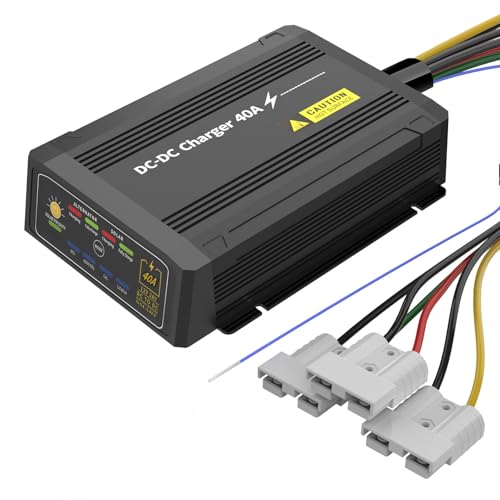
venveal’s dual-input charger features IP68 protection and an Anderson plug for rugged, outdoor-ready mounting. It prioritizes solar charging with built-in MPPT and includes LED indicators to show charging mode and status. The unit protects against overvoltage, reverse polarity, over-temperature, and charging timeouts, making it suitable for LiFePO4, AGM, and standard lead-acid batteries in harsh environments.
VEVOR DC to DC Charger with MPPT 520W

VEVOR offers a high-power 520W MPPT charger suitable for heavy-duty dual-input scenarios. It supports LiFePO4 and various lead-acid chemistries. The charger is designed to prioritize solar input while maintaining robust protection against short-circuits, over-voltage, and temperature fluctuations, ensuring reliable multi-source charging for RVs, boats, and off-grid back-up systems.
40A in-Vehicle DC to DC Charger with MPPT (POWA Carlife)

This 40A unit is IP68-rated for robust protection in challenging environments and supports charging from solar panels and alternators with MPPT optimization. It is designed for AGM, Gel, Cal, and LiFePO4 chemistries, featuring smart protections and a user-friendly interface that helps manage multi-source charging in vehicles and marine applications.
Buying Guide: Key Considerations for Choosing a Dual-Input DC-DC Charger
- Charge source prioritization: Look for MPPT-empowered charge controllers that can prioritize solar inputs when available, reducing engine idle time and fuel use.
- Battery chemistry compatibility: Ensure the charger supports your battery types (LiFePO4, AGM, Gel, Flooded, Cal). Some models offer broad compatibility and adaptive multi-stage charging.
- Input versatility: Dual-input designs that accept solar and alternator/DC power inputs provide flexibility for both on- and off-grid applications.
- Protection features: Seek over-voltage, over-current, short-circuit, reverse polarity, and temperature protections to safeguard both batteries and electrical systems.
- Efficiency: MPPT efficiency and high conversion efficiency reduce energy loss and improve overall performance, especially in off-grid setups with intermittent sunlight.
- Installation environment: IP68 or weatherproof ratings are important for outdoor, marine, or exposure-heavy installations. Consider enclosure design and wiring accessibility.
- System integration: Some units offer easy integration with solar panels, alternators, and battery monitor systems, plus features like reverse charging for emergencies.
- Size, weight, and wiring: Ensure the charger fits space constraints and matches the gauge of wiring and fusing requirements for your vehicle or vessel.
- Installation complexity: Review mounting options, accessible terminals, and whether a professional installation is recommended for safety and warranty.
In multi-source configurations, selecting a charger with strong MPPT performance and robust protection helps maximize battery life and reliability. Consider your typical usage patterns (on-road vs. parked, solar availability, battery bank size) to pick a model with appropriate current output and charging modes.