Best Dual Head EV Chargers for Home and Small Business Use
Looking for a dual-head EV charger to power two vehicles on a single circuit? This guide highlights top dual-port Level 2 chargers ideal for households, fleets, or high-traffic setups. Each option is evaluated for best use cases, durability, and installation ease. The list focuses on models that can charge two EVs simultaneously or on the same circuit, helping to avoid costly electrical upgrades when practical. Buyers include homeowners with two EVs, small businesses with parking lots, and commercial settings needing high-traffic resilience.
| Product | Brand | Max Output | Ports | Plug Type | Notes |
|---|---|---|---|---|---|
| Enphase Level 2 Dual EV Charger, HCS-D40 | Enphase Energy | 32 Amps to one, 16 Amps to two | 2 | Hardwired | Dual-port on a single circuit; rugged, all-weather enclosure |
| 40 Amp Dual EV Charger, Enphase HCS-D50 | Enphase Energy | 40 Amps to one, 20 Amps to two | 2 | Hardwired | Commercial-grade, 5-year warranty, ETL safety certified |
| 32 Amp Plug-in Dual EV Charger, Enphase HCS-D40 (NEMA 14-50 Plug) | Enphase Energy | 32 Amps to one, 16 Amps to two | 2 | NEMA 14-50 plug | Plug-in option for easy installation; sealed NEMA 4 enclosure |
| Raylix Upgraded Level 2 Fast EV Charger | Raylix | 24 Amps per outlet (configurable 8–24A) | 2 | NEMA 14-30/14-50 (dual compatibility) | LCD data display; timer and adjustable current |
| Tesla Universal Wall Connector | Tesla | Up to 48 Amps | 2 (dual plug type) | Hardwired or wall-mounted | Universal compatibility with NACS/J1772 connectors |
Enphase HCS-D40 Dual Head EV Charger — 32A/240V, Hardwired

The HCS-D40 offers dual charging on a single circuit, delivering 32 Amps to one vehicle or 16 Amps to both. It emphasizes commercial-grade durability and a rugged connector designed for high-traffic use. This model comes with a NEMA 4-rated enclosure and a flexible, weather-ready cable for harsh environments. Best for: households with two EVs or small fleets needing simultaneous charging without complex electrical upgrades. Caution: Hardwired installation may require professional electrical work and panel capacity assessment.
Enphase HCS-D50 Dual Head EV Charger — 40A/240V

Best for high-demand charging on a single circuit: the HCS-D50 supports 40 Amps to one EV or 20 Amps to two EVs, depending on circuit configuration. It is safety-certified, all-weather, and designed for high-traffic environments. The enclosure is fully sealed (NEMA 4), and Enphase provides a 5-year limited warranty with ongoing support. Choose this if you need maximum single-vehicle power on one outlet while retaining dual-port capability. Caution: Requires a minimum 50 Amp dedicated circuit; miles-per-hour rates vary by vehicle model.
Enphase HCS-D40 Dual Head Plug-In (NEMA 14-50) — 32A/240V

Best for easy installation with existing NEMA 14-50 outlets: dual ports on a 32A/240V system, with a 5-year warranty and ETL safety certification. It charges one vehicle at 32 Amps or two at 16 Amps each. The plug-in design simplifies retrofitting where a hardwired setup is not desired. Caution: Requires a minimum 40 Amp dedicated circuit and a compatible outlet; actual charging speed varies by EV model.
Raylix Dual Head Level 2 Charger — 24A, NEMA 14-30/14-50
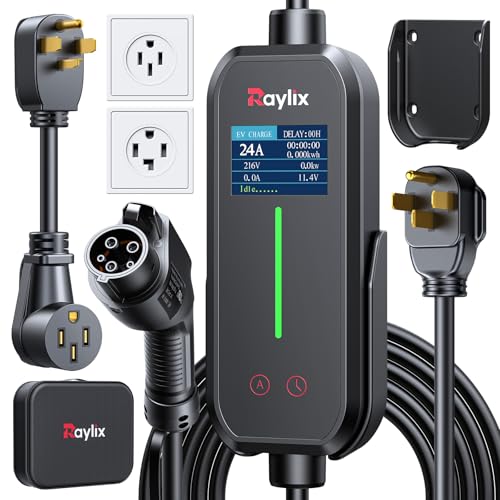
Best for flexibility and off-peak charging: Raylix supports dual outlets (NEMA 14-30 and 14-50) for wider installation options without expensive updates. It offers adjustable current settings (8–24A) and a timer function, plus a clear LCD showing real-time voltage, current, and power data. This makes it suitable for homes with dryer outlets or alternative parking configurations. Caution: Charger data indicates a 24A cap per outlet; actual performance depends on wiring and breaker sizing.
Tesla Universal Wall Connector — Dual Plug Type

Best for Tesla and non-Tesla compatibility in a dual-plug design: the Tesla Universal Wall Connector is configured to handle two connectors and supports up to 48A depending on the installation. It accommodates both NACS and J1772, making it versatile for mixed fleets. Best for: households with a mix of Tesla and non-Tesla EVs seeking a single, dual-port charging solution. Caution: Real-world output depends on electrical service and breaker configuration; ensure compatible wiring and local codes.
Buying Guide: Dual Head EV Chargers
- What to prioritize: number of ports, maximum per-port current, and whether you prefer hardwired or plug-in installations.
- Single-circuit dual-port operation: look for models that describe load sharing or dual-port management to avoid exceeding panel capacity.
- Installation environment: choose NEMA 4 or equivalent enclosures for outdoor or high-traffic areas.
- Safety certifications: ETL/UL/ENERGY STAR listings indicate reliability and compliance with safety standards.
- Compatibility: ensure connectors and plug types match your EVs’ inlet requirements (J1772, NACS, or both).
- Warranty and support: longer warranties and responsive customer support reduce ownership risk for commercial or fleet use.
FAQ
- Do dual-head EV chargers require special electrical upgrades?
– Some setups need a dedicated circuit and proper load management; verify panel capacity with a licensed electrician. - Can I install a dual-head charger outdoors?
– Yes, if the unit has an outdoor-rated enclosure (NEMA 4 or equivalent) and proper weatherproofing. - Is a plug-in dual charger easier to install than a hardwired one?
– Plug-in models can be easier for retrofits, but hardwired units often offer better weather sealing and reliability. - Will two cars charge at full speed on a dual-head charger?
– It depends on the configuration; some models deliver full power to a single car, and reduced power to both cars simultaneously. - Do these chargers support both J1772 and NACS connectors?
– Some models offer dual-plug compatibility or dual connectors; verify the specific product’s connector options. - Are there dual-head chargers with higher efficiency for fleets?
– Yes; commercial-grade units are designed for frequent use, higher duty cycles, and longer lifespans.