Best Dual Battery Solar Controller Options for RVs and Boats
Looking for a dual battery solar controller to manage two battery banks efficiently? This guide highlights top dual-battery PWM/MPPT controllers, explains who each is best for, and includes a concise buying table to compare key points. Ideal buyers include RV enthusiasts, boaters, caravanners, and off-grid hobbyists who need independent battery charging with reliable protection and simple setup.
Top picks overview table
| Product | Best For | Key Benefit | Limitations |
|---|---|---|---|
| EVPEVER 20A Dual Battery Controller | Small RVs, caravans, boats | Independent charging for two banks | PWM, lower voltage handling than larger MPPT units |
| EPEVER EPIPDB-COM 20A | Two-battery setups with priority | Independent charge with priority control | Similar to other EPEVER 20A models |
| EPEVER 30A MPPT DuoRacer | larger RVs and boats | High efficiency tracking up to 99.5% | MPPT, higher price |
| Reliability focus, DIY RV/boat projects | Four-stage charging, proven design | PWM, older interface | |
| Compact builds, tight spaces | Negative-ground design with LCD | Lower amperage |
EVPEVER 20A Dual Battery Solar Controller
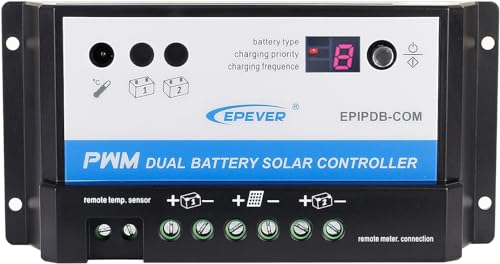
Designed to charge and protect two batteries or battery banks independently with a defined charging priority (for example 80%/20%). It includes built-in short-circuit protection, open-circuit protection, reverse protection, and over-load protection. The controller provides adjustable system parameters and is straightforward to set up and operate. Best for compact RVs, caravans, or small boats needing dual-battery management without complex software.
Who this is best for: buyers wanting clear independent charging for two banks in a portable, 12/24V system. Why selected: robust protections and adjustable control fit simple dual-battery needs. Caution: PWM-based controllers may be less efficient at very high irradiance compared with MPPT units, though functionally solid for moderate sun conditions.
EPEVER EPIPDB-COM Series 20A Dual Battery Controller
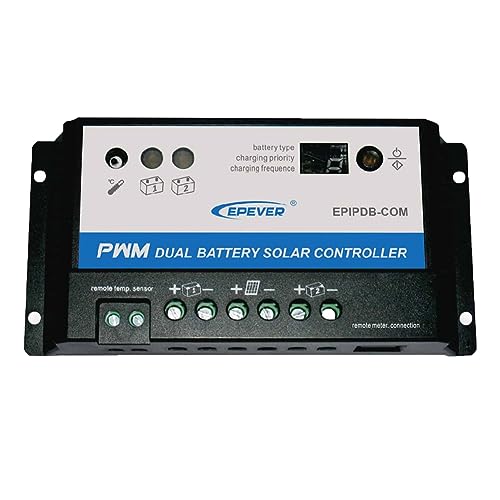
This 20A dual-battery controller is designed to charge and protect two batteries or battery banks independently, with a defined priority (e.g., 30%/70%). It includes built-in protection against short circuits, open circuits, reverse polarity, and over-load. The RTS auto-adjust feature helps the controller switch to RTS automatically when the temperature sensor is connected. Best for caravans or boats with two distinct battery roles where battery priority matters.
Who this is best for: users needing independent battery control and a clear charging priority. Why selected: integrated protection suite and RTS-aware behavior. Caution: RTS feature depends on sensor availability and may require proper placement for temperature readings.
EPEVER 30A MPPT Dual Battery Controller

This MPPT dual-battery controller supports two batteries with 12V/24V auto switching and a maximum PV input up to 100V. It handles up to 390W (12V) or 780W (24V) of solar input and is compatible with Sealed, Gel, Flooded, LiFePO4, and Li-NiCoMn battery chemistries. Best for larger RVs, caravans, boats, or trailers needing higher charging capacity and MPPT efficiency.
Who this is best for: users requiring high efficiency and higher power handling. Why selected: broad battery compatibility and strong input tolerance. Caution: MPPT units may be more complex to configure; ensure proper wiring and documentation follow safety guidelines.
EPEVER EPIPDB-COM Series 20A Dual Battery Controller
This 20A dual-battery controller mirrors the earlier EPIPDB-COM model with protections and independent battery banks. It offers configurable charging priority and RTS automatic adjustments when temperature sensing is available. Best for mid-sized dual-battery setups on RVs or boats where two separate charging profiles are advantageous.
Who this is best for: dual-battery users who want dependable protection and simple control. Why selected: consistent protection features and auto RTS behavior. Caution: as with similar models, PWM-type operation means performance depends on solar conditions and panel orientation.
Morningstar SunSaver Duo 25A PWM Controller

Morningstar SunSaver Duo 25A PWM solar regulator provides dual-battery charging with a four-stage charging process. It supports sealed or flooded batteries and offers optional MSView software for parameter adjustments. The design emphasizes reliability and ease of installation, making it a good fit for RVs, boats, or off-grid cabins seeking long-term service.
Who this is best for: buyers prioritizing proven reliability and configurable, safety-focused charging. Why selected: four-stage PWM charging plus temperature compensation help extend battery life. Caution: PWM technology generally offers less efficiency than MPPT at high voltage differences or very strong sunlight.
Powlsojx Dual Battery PWM Controller 10A/20A/30A

This PWM controller supports 12V and 24V systems with multiple current options (10A, 20A, 30A) and a maximum PV voltage of 41V. It uses four charging stages (Boost, Direct, Constant Voltage, Float) for battery longevity and includes comprehensive protection against short circuits, reverse current, and overcharging. Best for flexible setups that need a scalable PWM solution.
Who this is best for: users needing scalable current options and robust protections. Why selected: straightforward PWM charging with clear stage transitions. Caution: 30A models require adequate heat dissipation in enclosed spaces.
Renogy Wanderer 10A PWM Controller
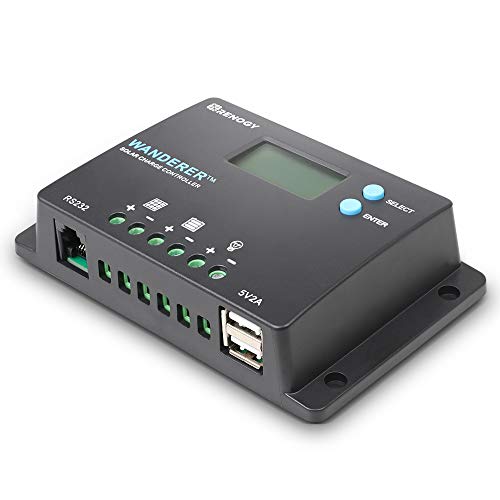
Renogy Wanderer 10A PWM Controller features a smart four-stage charging profile (Bulk/Boost/Float/Equalization) to maximize battery life. It supports AGM, Gel, Flooded, and Lithium chemistries. The negative-ground design is common in RV and marine applications, and the LCD provides at-a-glance status. Best for compact systems needing a reliable, easy-to-read controller.
Who this is best for: small, space-constrained dual-battery setups. Why selected: strong balance of features and Renogy’s ecosystem. Caution: lower amperage means slower charging for larger panels or higher-capacity batteries.
Buying Guide: Key Considerations for Dual Battery Solar Controllers
- System voltage and battery chemistry: Ensure the controller supports your 12V/24V system and battery types (AGM, Gel, Flooded, LiFePO4, Li-NiCoMn).
- MPPT vs PWM: MPPT controllers typically offer higher efficiency and better performance in variable sunlight, especially with larger arrays. PWM controllers are simpler and often cheaper, suitable for smaller setups.
- Dual-battery management: Look for independent charging for two batteries or banks, and whether you can assign charging priority (e.g., 70%/30%, or 80%/20%).
- Protection features: Prioritize short-circuit, reverse polarity, over-charge, over-discharge, and temperature protections to safeguard batteries and equipment.
- Protection of RTS and temperature sensing: Some models auto-adjust charging based on local temperature; verify sensor compatibility and installation requirements.
- Ease of setup: Factory presets, DIP switches, or software (MSView) options can simplify configuration and ongoing maintenance.
- Physical design and installation: Consider compact size, mounting options, negative-ground design, and whether a display is included for quick status checks.
- Environmental suitability: IP ratings and enclosure considerations matter for outdoor or marine use.
FAQ
- What is the difference between PWM and MPPT for dual-battery controllers?
PWM controllers are simpler and usually cheaper, best for smaller systems. MPPT controllers are more efficient at converting sunlight and are preferable for larger arrays or challenging conditions. - Can a dual-battery controller manage two different battery chemistries at once?
Some models support multiple chemistries; check the manual for supported types and any separate charging profiles per bank. - Is independent charging of two batteries beneficial for RVs and boats?
Yes, it helps ensure critical systems remain powered if one bank is low, and reduces cross-discharge between banks. - What should I consider when choosing a dual-battery controller for a small setup?
Choose appropriate amperage (e.g., 10A–20A for small arrays), PWM vs MPPT based on panel size, and ensure protection features meet your safety needs. - Do these controllers require software for setup?
Some models offer software or online configuration; others use simple DIP switches or built-in presets. Check the product page for specifics.