Best DI Water Conductivity Meter Guide for Precise Water Testing
Answering buyers who need quick, reliable conductivity readings for water quality, this guide selects five durable meters suited to labs, classrooms, hydroponics, and home testing. Each option targets a specific use case: classroom demonstrations, field or bench testing, hydroponics nutrient monitoring, and versatile 4-in-1 monitoring. Below is a concise product table to help compare core capabilities at a glance.
| Product | ||
|---|---|---|
| Myron L 512M5 DS Conductivity Meter | Professional labs needing temperature compensation | 0-5000 µM/µS; automatic temperature compensation |
| United Scientific Electric Conductivity Tester | Classroom demonstrations and educational labs | Ten-level LED display; dual-probe design |
| HoneForest TDS Meter | Home and hobbyists needing 3-in-1 readout | TDS, EC, and Temperature with auto-lock |
| Bluelab PENCON Conductivity Pen | Hydroponics and nutrient monitoring | Portability; ATC; multiple unit options (EC/PPM/CF) |
| MEXYBE 2026 All-New 4 in 1 TDS Meter | Versatile testing for drinking water, RO/DI, aquariums | 4 in 1: TDS, EC, Temp C/F; auto-off; backlit LCD |
Myron L 512M5 DS Conductivity Meter

The Myron L 512M5 DS is a conductivity meter designed for precision measurement with automatic temperature compensation across 50° to 160°F (10° to 71°C). It reads 0-5000 µM/µS, and is powered by a single 9V battery with a long expected life. Best for professionals who need temperature-compensated, stable readings in varied lab conditions. A potential limitation is battery maintenance; long-term use requires regular battery checks to avoid measurement interruptions.
United Scientific Electric Conductivity Tester

Designed for classrooms and educational labs, this unit provides qualitative conductivity readings via a ten-level green LED display. It features a dual-probe design for testing conductivity in solids or liquids and arrives ready to use, including a 12V battery and instructions. It’s ideal for demos and quick checks, with the caveat that it emphasizes visual indicators over precise numerical values, which may limit its use for detailed lab analysis.
HoneForest TDS Meter
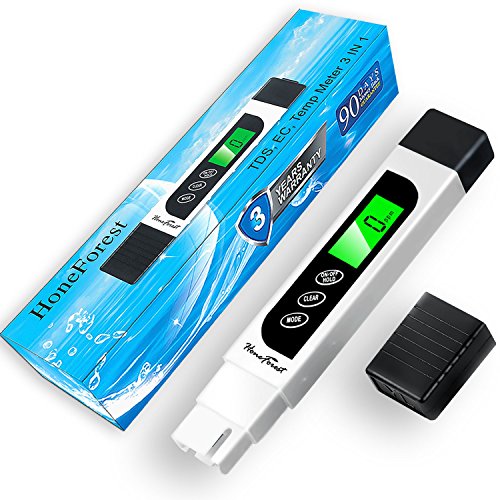
The HoneForest TDS Meter provides a 3-in-1 readout for TDS, EC, and temperature (°F/°C) with a large backlit LCD and auto-lock function. It’s easy to use for quick checks in homes, aquariums, RO/DI systems, and hydroponics. A potential limitation is reliance on a single probe type, which may require calibration if used across very different water sources or after extended use.
Bluelab PENCON Conductivity Pen

The Bluelab PENCON is a portable conductivity pen suitable for hydroponics and nutrient monitoring. It features automatic temperature compensation (ATC) for stable readings and offers multiple unit options (EC, PPM 500, PPM 700, CF). It is best for on-the-go measurements and field use; however, regular calibration is recommended to maintain accuracy, and durability depends on handling given its handheld form.
MEXYBE 2026 All-New 4 in 1 TDS Meter

The MEXYBE 2026 model is a 4-in-1 tester measuring TDS, EC, and temperature in both Celsius and Fahrenheit. It features a backlit LCD, auto-lock, and an auto-off function to conserve battery life. This makes it suitable for households and hobbyists who require straightforward, reliable readings across multiple water-quality parameters. A noted limitation is that, like many 4-in-1 devices, highly precise lab-grade readings may require a dedicated single-parameter meter.
Buying Guide: key considerations for selecting a DI water conductivity meter
- Measurement range and units: Choose a meter with a range that covers your typical water samples and supports units you use (µS/m, mS/cm, EC, CF, PPM).
- Temperature compensation: If testing water at varying temperatures, prefer automatic or manual temperature compensation for accurate readings.
- Probe type and durability: For liquids-only testing, ensure the probe is corrosion-resistant and easy to clean. For solids or semi-solids, a dual-probe design can be advantageous.
- Calibration needs: Some meters ship ready-to-use; others require calibration fluids or procedures. Consider ease of calibration and availability of calibration standards.
- Form factor: Handheld vs. benchtop; portability matters for field use and classroom demonstrations.
- Readout type: Visual LED indicators are quick for demos; backlit LCDs are preferred for low-light environments and precise readings.
- Auto-off and battery life: Look for auto-off features to preserve battery life in field scenarios.
- Intended use: Lab-grade instruments emphasize precision; educational tools prioritize ease of use and visual cues; hydroponic tools focus on compatibility with nutrients and plant growth readings.
Frequently asked questions
- What is the difference between TDS and EC meters?
– TDS meters estimate total dissolved solids from conductivity, while EC meters measure the ability of a solution to conduct electricity. Some meters display both or have simple conversions between units. - Do I need temperature compensation for my readings?
– Yes, especially for liquids with varying temperatures, since conductivity changes with temperature. Look for automatic temperature compensation for ease of use. - Can a consumer-grade meter be used for aquariums or hydroponics?
– Yes, many meters are suitable for hobby and household applications, but ensure the device supports the units and ranges relevant to your nutrient monitoring needs. - How often should I calibrate my meter?
– Calibration frequency depends on usage and environmental conditions. Regular checks with calibration solutions help maintain accuracy. - What should I do if readings drift or become unstable?
– Clean the probe, verify calibration, and replace the probe if corrosion or wear is evident. Temperature compensation settings should be rechecked. - Are 4-in-1 meters reliable for precise lab work?
– They are convenient for general testing and field use, but for highly precise lab analyses, a dedicated single-parameter meter may be preferred.