Best Electric Demand Water Heaters for Instant Hot Water in Homes
Electric demand water heaters offer on-demand hot water with compact design and energy-efficient operation. This guide highlights five reliable models well-suited for American households seeking point-of-use or whole-home solutions. Each product features smart controls, safety protections, and varying power levels to fit different electrical setups. Explore practical options from trusted brands to help you choose the right electric tankless system for your needs.
| Product | Brand | Key Use | Typical Setup |
|---|---|---|---|
| ECOTOUCH ECO140S | ECOTOUCH | 2-3 fixtures, instant hot water | 240V, 60A breaker, 6 AWG wires |
| Rheem 6.5kW POU | Rheem | Point-of-use, small spaces | 240V, compact footprint |
| Rheem 18kW 240V | Rheem | 2-3 fixtures, higher flow | 240V, higher amperage |
| Orbek 14kW 240V | Orbek | 2-3 fixtures, led display | 240V, 60A breaker |
| Orbek 18kW 240V | Orbek | 2-3 fixtures, robust capacity | 240V, 2-pole breakers |
Note: When selecting an electric tankless heater, electrical capacity in your home is critical. Many models require dedicated 60A or higher two-pole breakers and appropriately rated wiring. Consulting a licensed electrician is recommended to ensure safe installation and code compliance.
ECOTOUCH ECO140S: High-Flow Digital Tankless

The ECOTOUCH ECO140S is a 14kW electric tankless unit designed for 240V operation. It delivers up to 3.38 GPM, suitable for 2-3 sinks or a shower without temperature fluctuations. The system uses a self-modulating controller to optimize energy use by adjusting power based on demand. It is ETL certified and UL-qualified, with safety protections including leakage and over-temperature safeguards. Installation notes emphasize a 60A double-pole breaker and 6 AWG grounding conductors for proper operation. The compact footprint makes it a good fit for tight utility spaces.
Key considerations include ensuring correct electrical capacity, wiring sizing, and water connections (1/2″ NPT). The unit’s smart control minimizes temperature variance during use, providing a reliable source of instant hot water for everyday activities.
Features: 14kW at 240V, up to 3.38 GPM, ETL/UL compliance, self-modulating heating, 20,000-cycle response monitoring, 1/2″ NPT fittings, compact dimensions, leakage and over-temp protections.
Rheem 6.5kW POU Electric Tankless

The Rheem 6.5kW point-of-use tankless heater offers a compact solution for supplying hot water to a single fixture or a small space. With a continuous-on-demand design, it maintains water temperature with tight control of flow rates, ensuring stability within about one degree of the selected temperature. The unit is designed for easy installation in tight spaces and helps conserve energy by heating water only as needed. Its external digital interface provides straightforward temperature setting, and the installation footprint is significantly smaller than traditional tanks.
Considerations include the need for a dedicated 240V circuit and the ability to maintain adequate water pressure at lower flow rates. This model is ideal for under-sink applications, bathrooms, or small workspaces where a full home system isn’t required.
Features: On-demand hot water, LED/ digital temperature control, compact size, energy-efficient operation, flow management for stable output, 240V electrical requirement, 6.5kW heating capacity.
Rheem 18kW 240V Tankless Electric

This Rheem unit delivers higher heating capacity for larger households or settings needing more hot water at speed. With an external digital thermostat and self-modulation, it adjusts power to meet the actual demand, helping maintain a consistent temperature with flow control. The copper immersion heating elements offer durability and better heat transfer, while field-serviceable components support easier maintenance. The maximum flow rate can reach up to 4.4 GPM, making it suitable for multiple fixtures running concurrently.
Important considerations include electrical service capacity to support 18kW at 240V, appropriate wiring, and space for the unit. This model is well-suited for scenarios where multiple outlets or larger bathrooms require reliable hot water without a storage tank.
Features: External digital thermostat, self-modulation, copper heating elements, field-serviceable, up to 4.4 GPM flow, 240V operation, compact footprint for its power class.
Orbek 14kW 240V Tankless with LED Display

The Orbek 14kW electric tankless water heater is designed for 2-3 point-of-use installations. It uses a 240V supply with a 60A two-pole breaker and requires 6 AWG wires. The unit provides up to 3.38 GPM, delivering hot water swiftly for multiple fixtures. It features water-electric separation to minimize scale and corrosion and offers a quick, responsive hot water output with a stable, efficient performance. LED display supports straightforward monitoring of operating status and temperature settings.
When installing, verify electrical capacity and wire gauge, along with ensuring adequate space for plumbing connections (1/2″ NPT). This model is a practical choice for kitchens, bathrooms, or small apartments where hot water is needed at multiple points without a large tank system.
Features: 14kW at 240V, up to 3.38 GPM, LED digital display, water-electric separation, smart safety protections, 2-3 point-of-use suitability, 1/2″ NPT fittings.
Orbek 18kW 240V Tankless Power Unit
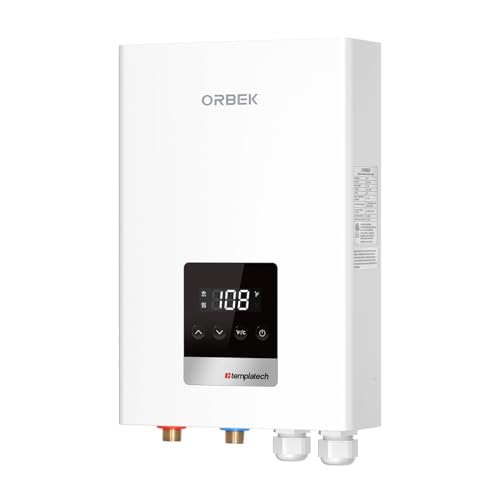
The Orbek 18kW model provides robust capacity for households needing higher hot water flow. With 240V operation and a demanding flow rate, this unit is suitable for 2-3 fixtures running simultaneously, maintaining temperature with fast response. It includes safety features and a digital display to monitor performance and temperature. As with other high-power electric tankless heaters, ensure your home’s electrical service can support the additional load and that wiring adheres to local electrical codes.
Considerations include ensuring your electrical panel can handle the increased amperage, proper breaker sizing (often 60A two-pole), and professional installation to prevent overheating or leakage risks. The 18kW unit is a strong option for homes with higher hot-water demand or larger bathrooms and kitchens.
Buying Guide: Key Purchase Considerations And Comparisons
When choosing an electric tankless water heater, consider the following factors to ensure an optimal fit for your home and usage pattern.
- Flow rate needs: Determine the number of fixtures that will run simultaneously and the desired shower or faucet temperature. Higher GPM ratings suit busier households, but require more electrical power.
- Electrical capacity: Most 240V units require dedicated circuits (commonly 60A two-pole breakers). Inspect the main service panel to ensure there is sufficient capacity and available slots for new breakers and wiring.
- Wiring and breakers: Expect 6 AWG or larger gauge cables for 60A or higher circuits. Improper wiring can lead to overheating, nuisance tripping, or safety hazards.
- Space and installation: Tankless units are compact but need proper clearance for venting (where applicable), water connections, and service access. POU (point-of-use) models save space but may require multiple installations for whole-home hot water.
- Safety features: Look for leakage protection, over-temp protection, dry-boil protection, and water-electric separation to reduce corrosion and scale build-up. ETL/UL certifications provide reliability benchmarks.
- Temperature control: Digital displays and thermostatic control enable precise adjustment. Self-modulating technology can improve energy efficiency by reducing power when demand is low.
- Maintenance and service: Copper heating elements and modular components support long-term durability. Consider models with readily available replacement parts and simple maintenance protocols.
- Cost of ownership: While installation costs vary, energy efficiency and reduced standby losses can lead to lower operating costs over time. Evaluate your typical hot-water usage to choose an appropriate model.
- Compatibility with home setup: For older homes or limited electrical capacity, lower-wattage models or multi-point solutions might be more feasible than a single high-capacity unit.
In sum, the best choice depends on your daily hot-water needs, electrical service strength, and space constraints. The options highlighted here cover a spectrum from compact point-of-use to higher-capacity whole-home solutions, each designed to deliver reliable on-demand hot water with safety and efficiency in mind.