Best Deep Cycle Battery Maintainer Solutions for Reliable Power
Answering the question commonly asked by battery owners: which deep-cycle battery maintainer best balances reliability, ease of use, and compatibility with lead-acid and lithium batteries? This guide highlights five top options designed to keep 6V and 12V batteries healthy, with clear notes on who should choose each product. Ideal buyers include boaters needing on-board maintenance, RV enthusiasts seeking seasonal storage protection, and everyday motorists requiring a compact trickle charger for maintenance-free batteries.
Summary at a glance:
| Product | Best For | Key Benefit |
|---|---|---|
| NoCO GENIUS1 | Budget-friendly 1A maintainer | Ultra-compact, desulfator, temperature compensation |
| NoCO GENIUS10 | Higher power, versatile | 10A, dual-capacity performance |
| NoCO GENIUS2D | Onboard, installed setups | Direct-mount 2A, easy integration |
| YONHAN Battery Charger | Faster charging and winter care | 20A, multi-mode, repair/pulse features |
| NOCO GEN5X1 | Marine/per-bank needs | Five-amp per bank, single bank |
NOCO GENIUS1: 1A Smart Battery Charger

Best for small, space-constrained setups where a gentle 1-amp maintainer is sufficient. The GENIUS1 functions as a battery charger, maintainer, trickle charger, and desulfator, with overcharge protection and an integrated temperature sensor. The compact design makes it ideal for motorcycles, standard lead-acid cars in winter storage, and small boats with limited space. The product supports 6V and 12V lead-acid chemistries as well as LiFePO4 batteries, broadening its suitability beyond traditional SLA or flooded batteries.
Who it’s best for: owners seeking a single, affordable unit for basic maintenance across multiple small battery types without occupying much space. Why selected: its all-in-one feature set reduces clutter and the thermal sensor helps prevent damage due to heat or cold. A potential limitation: the 1A rate means slower recovery for deeply discharged or larger deep-cycle batteries.
Key features quick reference:
- All-in-one: charger, maintainer, trickle charger, desulfator
- Supports 6V and 12V lead-acid and LiFePO4
- Integrated thermal sensor for temperature-compensated charging
NOCO GENIUS10: 10A Smart Battery Charger
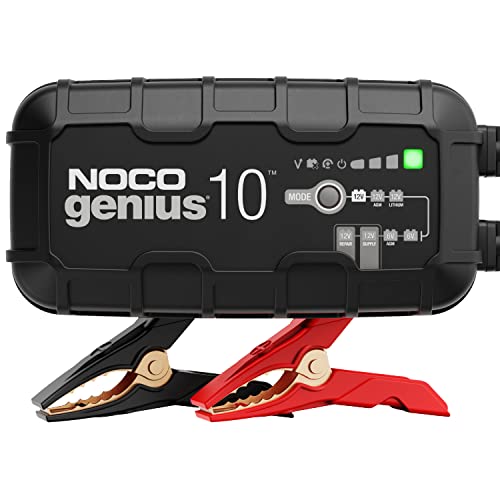
Best for frequent charging needs where higher current is beneficial. The GENIUS10 delivers substantially more power than entry-level models, designed for 6V and 12V lead-acid and LiFePO4 batteries. It remains an all-in-one solution encompassing charging, maintaining, trickling, and desulfating with temperature compensation for accurate charging in varying environments. This makes it well-suited for larger deep-cycle batteries in marine, RV, or industrial settings, where a faster charge can reduce downtime.
Who it’s best for: users with larger batteries or frequent recharge requirements who need a more robust maintainer without a separate charger. Why selected: the higher current enables quicker restoration and ongoing maintenance for bigger systems. Caution: ensure your battery’s amp-hour rating matches the charger’s output to avoid prolonged charging times or heat buildup on very small batteries.
Key features quick reference:
- 10A total output; suitable for 6V and 12V systems
- All-in-one with temperature compensation
- Desulfator for lead-acid and LiFePO4 chemistries
NOCO GENIUS2D: 2A Onboard Battery Charger
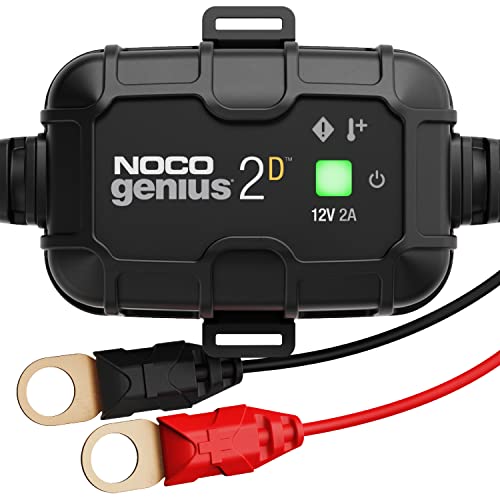
Best for integrated vehicle or equipment installations where the charger must mount directly near the battery. The GENIUS2D mounts with a sturdy bracket and is designed for 12V lead-acid batteries, including flooded and maintenance-free types. It functions as an onboard charger, maintainer, trickle charger, and desulfator, with temperature compensation. Its direct-mount design reduces cable clutter and makes it appealing for under-hood or compact mounting applications, such as boats or small vehicles.
Who it’s best for: installers seeking a reliable, fixed-location charging solution for under-the-hood or near-battery setups. Why selected: the direct-mount feature simplifies wiring and keeps the system neat. Limitation: installation requires a compatible mounting surface and proper hardware, which may be a minor hurdle for DIY hobbyists.
Key features quick reference:
- Direct-mount onboard charger for 12V lead-acid
- Maintainer and desulfator capabilities
- Temperature-compensated charging
YONHAN Battery Charger 20A: Fast 12V/24V Maintainer

Best for those needing faster charging and robust winter care with multi-mode control. The YONHAN unit provides 12V 20A or 24V 10A charging for a wide range of lead-acid and LiFePO4 batteries, including AGM, GEL, EFB, and other deep-cycle types. It includes a winter mode and smart control to adjust to temperature changes, helping prevent battery drain during storage. It also features protective measures such as overcurrent and short-circuit safeguards, making it suitable for frequent or seasonal use across vehicles, boats, and equipment.
Who it’s best for: users who demand quicker restoration and strong protection features for extended idle periods. Why selected: its high charging rate and winterized controls provide practical resilience in seasonal storage or remote locations. Caution: not a jump-starter; it must be plugged into an outlet to function, and care should be taken to match battery size to the charger rating.
Key features quick reference:
- 20A for 12V, 10A for 24V systems
- Winter mode + smart control
- Repair/pulse features to aid recovery of older batteries
NOCO Genius GEN5X1: 1-Bank 5A Onboard Charger
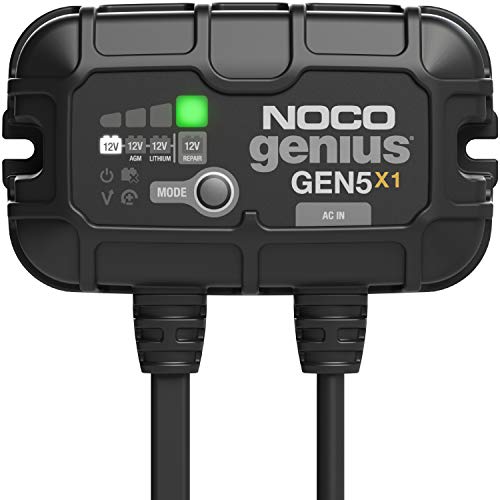
Best for dedicated marine or single-bank maintenance in compact spaces. The GEN5X1 provides a single 5A bank with the option to select 12V modes including AGM, Li, and a Repair Mode. It’s designed to withstand harsh marine environments while delivering precise, temperature-compensated charging for the battery it services. This model is especially suitable for boats or other setups requiring a rugged, single-bank solution with robust protection features.
Who it’s best for: boaters and marine enthusiasts needing a high-quality, compact onboard charger for a single battery bank. Why selected: it combines compact size with a marine-grade build and precise mode options. Limitation: being single-bank, it can’t independently manage multiple battery groups without additional units.
Key features quick reference:
- One 5A bank, 12V marine charging
- Selectable modes and temperature compensation
- Durable, compact, and reliable in harsh environments
NOCO GEN2: 2A 6V/12V Smart Charger

Best for versatile daily maintenance with a balance of size and power. The GEN2 provides 2A charging for 6V and 12V systems, designed to handle a range of lead-acid and lithium chemistries. It includes a Force Mode feature to charge batteries down to zero volts by bypassing sensing technology, useful for reviving deeply discharged cells in non-critical health scenarios. This model suits homeowners, hobbyists, and light-duty users who want a compact, reliable maintainer that does not overwhelm small batteries.
Who it’s best for: users needing a capable everyday charger that remains compact. Why selected: it hits a sweet spot between speed and space, with a recovery option for low-voltage batteries. Caution: Force Mode should be used with understanding of battery condition to avoid stressing extremely damaged cells.
Key features quick reference:
- 2A output for 6V/12V systems
- Force Mode for zero-volt batteries
- Temperature compensation for safe charging
Buying Guide: What To Consider When Choosing A Deep Cycle Battery Maintainer
What battery chemistry is supported? Look for models that cover lead-acid variants (AGM, Gel, SLA, VRLA) and LiFePO4 to maximize compatibility with your fleet of batteries. Some units include special modes for maintenance and repair to extend battery life.
How much current do you need? Lower-amp units (1A–2A) are ideal for small batteries and seasonal storage, while higher-amp models (10A and above) power larger deep-cycle or marine batteries and reduce charging time. Consider future needs and battery bank size when choosing.
Is temperature compensation important? Chargers with an integrated temperature sensor adjust charging based on ambient temperature, preventing overcharge in heat and undercharge in cold. This feature protects battery health in varying environments.
Do you need onboard mounting? Direct-mount onboard chargers simplify installations in vehicles or equipment where space is tight and wiring should be neat. If you only need a portable maintainer, a standard benchtop model may suffice.
Is winter or seasonal storage a concern? Models with winter modes and smart control help prevent battery drain during long storage periods and adjust charging for temperature shifts, improving readiness when you return to use the battery.
What about safety features? Look for overcharge protection, short-circuit protection, reverse polarity safeguards, and fireproof materials. These features reduce risk and improve reliability in various settings.
Frequently Asked Questions
- What is a deep cycle battery maintainer? A device that regularly charges and preserves a battery’s charge, preventing sulfation and extending battery life.
- Can I use a marine charger for a car battery? Yes, if the charger supports the battery’s voltage (12V) and chemistry. Check the charger’s modes to ensure compatibility.
- Is it okay to leave a maintainer plugged in? Most modern maintainers include overcharge protection, but follow the manufacturer’s guidance and do not leave unattended in extreme conditions.
- What is Force Mode? A feature on some chargers that bypasses sensing to force charging for batteries that have dropped to very low voltage.
- How do I choose the right amperage? Match the charger’s current to your battery’s capacity and the intended usage. Smaller batteries benefit from 1–2A, larger or frequently used systems benefit from 10A or more.
- Should I use a desulfator? Desulfation helps certain lead-acid batteries recover from sulfation, but effectiveness varies with battery condition. Use as part of a complete maintenance regimen.