Best Deep Cycle Battery for Solar: Top 5 Picks for Off-Grid Power
Selecting a reliable deep cycle battery is essential for maximizing solar storage, RV camping comfort, and off-grid resilience. This article reviews five leading options that balance safety, longevity, capacity, and performance across AGM and LiFePO4 chemistries. Each entry links to its Amazon listing and summarizes key features to help you compare at a glance.
| Product | Chemistry | Capacity | Approx. Weight | Best For |
|---|---|---|---|---|
| Weize 100Ah AGM | AGM | 100Ah | About 28 lbs | RV, solar, off-grid |
| Renogy 100Ah AGM | AGM | 100Ah | About 26-28 lbs | Safe, maintenance-free |
| GRNOE 2-Pack 100Ah LiFePO4 | LiFePO4 | 100Ah each | About 22 lbs each | Small spaces, cold climates |
| Renogy 200Ah AGM | AGM | 200Ah | Approx. 50 lbs | Higher capacity needs |
| HRBEENERGY 100Ah LiFePO4 | LiFePO4 | 100Ah | About 19–20 lbs | Lightweight, long life |
The following selections emphasize solid cycle life, safety, and compatibility with typical solar setups, including off-grid cabins, RVs, boats, and home energy storage. Each product section provides a concise overview of why it fits a solar-centered power system.
Weize Deep Cycle AGM 12V 100Ah Battery
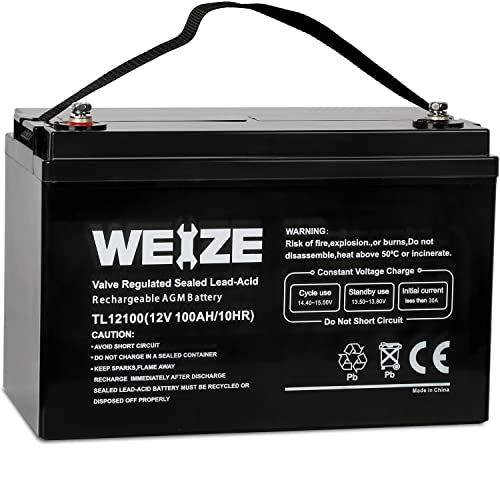
The Weize 12V 100Ah AGM battery uses absorbent glass mat technology to minimize acid leakage and maintenance. It features a sealed design with a maintenance-free profile and a relatively low self-discharge rate of 1-3% per month, which benefits long-term storage in solar setups. Operational temperatures span from 14°F to 122°F for charging and from 5°F to 122°F for discharging, with a recommended operating temperature around 77°F. Its max discharge current reaches 1100A for short bursts, making it suitable for powering inverters and solar controllers during sunless periods. Its compact dimensions fit many RV and cabin installations, and its left-right terminal layout is clearly marked for easy wiring. A solid all-around choice for budgets-minded solar users seeking a dependable AGM option.
Renogy Deep Cycle AGM 12V 100Ah Battery

Renogy’s AGM 12V 100Ah battery is a trusted, maintenance-free choice with a safety-forward design. It supports series and parallel configurations (no practical limit stated for series; parallel up to four units is noted for other Renogy AGM models) and has earned broad adoption in RVs, cabins, and off-grid systems. The chemistry emphasizes stability and safety, offering minimal risk of leaks and reduced troubleshooting compared to other chemistries. It’s widely recognized for dependable discharge performance and a long service life when used in moderate climates with proper ventilation and thermal management. This makes it a leading option for solar energy storage where reliability is valued over high energy density.
GRNOE 2-Pack 12V 100Ah LiFePO4 Battery

This GRNOE LiFePO4 pack pairs two 100Ah modules with a built-in BMS for low-temperature protection, short-circuit protection, overcharge and over-discharge protection, and overall advanced safeguards. Weighing around 22.5 pounds per unit, these cells deliver a compact option with significantly higher energy density than lead-acid equivalents. The BMS also includes auto-balancing features, which helps maintain consistent state of charge across the two batteries when used in parallel or serial configurations. The recommended charging voltage around 14.6V with care for charger compatibility is noted. Ideal for lightweight solar builds, off-grid cabins, and RVs seeking extended lifespan and better weight efficiency over AGM options.
Renogy Deep Cycle AGM Battery 12V 200Ah

Renogy’s 200Ah AGM option doubles the energy capacity, delivering higher storage for larger solar systems or households with greater draw. The AGM design remains maintenance-free and spill-proof, making it well-suited to enclosed spaces such as RV compartments or cabin utility rooms. Its higher capacity enables longer run times between charges, reduced reliance on generators, and more robust energy reserve during dim spells. While heavier than 100Ah variants, the 200Ah unit can be a cost-effective upgrade path for expanding a solar setup without migrating to lithium chemistry.
HRBEENERGY 100Ah LiFePO4 Battery

This 100Ah LiFePO4 battery from HRBEENERGY emphasizes fast charging and discharging with a maximum continuous discharge of 100A and a 200A inrush. A built-in 100A BMS provides full protection against overcharging, over-discharging, overheating, and short circuits, while low-temperature cut-off helps maintain safety in cooler environments. Weighing roughly 19-20 pounds, it offers a lighter alternative to traditional lead-acid batteries while delivering higher cycle counts and longer overall life. The compact form factor suits tight spaces in RVs, boats, and portable solar systems, making it a practical choice for space-conscious users pursuing lithium-based energy storage without sacrificing safety or performance.
Buying Guide: Key Purchase Considerations
- Chemistry and lifecycle: AGM batteries offer maintenance-free reliability and lower upfront cost, but LiFePO4 provides longer cycle life, lighter weight, and deeper depth of discharge. Choose based on tolerance for weight, budget, and desired lifespan.
- Capacity and ideal usage: Higher Ah ratings extend run time but add weight and size. Match capacity to your solar array size, daily energy consumption, and whether you need occasional reserves for cloudy days.
- Battery management system (BMS): Lithium options require a robust BMS to manage charging safety, temperature, and balancing. Ensure compatibility with your solar controller and inverter.
- Weight and space: For portable or vehicle-based systems, weight matters. LiFePO4 modules are typically lighter than their AGM equivalents for the same capacity.
- Temperature tolerance: Cold weather can reduce lead-acid performance; LiFePO4 generally handles cold better but may need temperature-aware charging strategies.
- Charging parameters: Verify recommended charging voltages (12V systems typically around 14.4–14.6V for LiFePO4 cells) and ensure your solar charger supports the chemistry and BMS requirements.
- Warranty and support: Consider manufacturers offering longer warranties and clear guidance on in-field maintenance, replacements, and system integration.
- System integration: Plan for series/parallel configurations if expanding beyond a single 12V system. Some LiFePO4 packs are easily scalable, while AGM packs are straightforward but limited by chemistry.
- Cost of ownership: Upfront cost varies by chemistry, but LiFePO4 often delivers savings through longer lifespans and lighter weight, reducing replacement frequency and installation costs over time.
- Compatibility: Ensure the chosen battery is compatible with your existing inverter, solar charge controller, and wiring standards to avoid performance or safety issues.
In sum, the best deep cycle battery for solar depends on your priorities: cost and maintenance (AGM), or longevity, weight, and cycling capability (LiFePO4). The five options highlighted above offer representative choices across these categories to support reliable solar energy storage in American homes, RVs, boats, and off-grid setups.