Best DC-DC Chargers With MPPT for 12V Systems and Multi-Source Power
For RVs, boats, and off-grid setups, a DC-DC charger with MPPT helps maximize solar charging while balancing alternator input. This guide highlights five MPPT DC-DC chargers to fit different batteries and power needs. Best for multi-source charging, longer runtimes, and easier installation in harsh environments.
| Product | Battery Types | Best For | Main Benefit |
|---|---|---|---|
| Renogy DC to DC Charger with MPPT 12V 30A | Lead-acid, lithium, AGM, gel, flooded | Small rigs, light-duty use | Dual-source charging prioritized to solar |
| Renogy 12V 50A DC to DC MPPT Charger | LiFePO4, Gel, AGM, Flooded, Sealed Lead Acid | Medium to large auxiliary batteries | Dual input with high efficiency and rapid charging |
| Renogy DC to DC Charger with MPPT 12V 40A Solar Input | LiFePO4, Gel, Flooded, Sealed Lead Acid | RVs, boats, off-grid needs | Two charging options with adaptive four-stage logic |
| LiTime 12V 40A DC-DC MPPT Charger | 12V LiFePO4, AGM, Gel, SLA, Calcium | Plug-and-play installations | Hybrid DC and solar charging with emergency reverse charging |
| POWO Carlife Waterproof DC-DC MPPT Charger 25A | LiFePO4, Lead-Acid, SLA, Gel, AGM | Harsh environments and marine use | IP68 waterproof with dual input and solar prioritization |
Renogy DC to DC Charger with MPPT 12V 30A

This unit offers dual-source charging, prioritizing solar energy when both solar panels and an alternator are active. It supports charging of lead-acid, lithium, AGM, GEL, and flooded batteries, making it a flexible choice for RVs, marine craft, and car dual-battery setups. The MPPT design aims to maximize solar input and reduce fuel use by integrating solar and alternator power efficiently.
Best for: Small to mid-size vehicles or boats needing compact MPPT charging with solar-first operation. Caution: Ensure compatibility with your battery chemistry and vehicle alternator to avoid undervoltage or overheat in extreme conditions.
Renogy 12V 50A DC to DC Battery Charger with MPPT
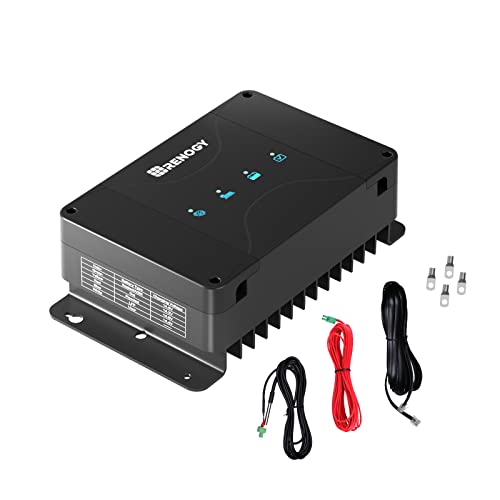
This high-capacity charger supports multiple battery types and offers two charging inputs: the car starter battery through the alternator and solar panels directly. It combines multi-stage MPPT charging with up to 99% MPPT tracking efficiency and 94% conversion efficiency, enabling faster top-offs for a sizeable auxiliary bank. It’s well-suited for longer trips or larger off-grid systems.
Best for: Vehicles with substantial auxiliary battery banks or owners who want faster top-ups using both solar and engine power. Caution: Larger units require adequate mounting space and proper heat management in hot climates.
Renogy DC to DC Charger with MPPT 12V 40A Solar Input

With dual charging options, this Renogy model prioritizes solar input while ensuring efficient alternator charging. Its adaptive four-stage charging (Bulk, Absorption, Float, Equalization) targets optimal voltage management for LiFePO4, Gel, Flooded, and Sealed Lead Acid batteries. This model emphasizes ease of use in RVs and marine setups that rely on both solar and engine power.
Best for: RVs or boats seeking a balanced, adaptive charging strategy that maximizes available solar energy. Caution: Performance depends on correct solar panel sizing and alternator behavior in your vehicle.
LiTime 12V 40A DC-DC MPPT Charger

LiTime’s 40A model supports LiFePO4, AGM, Gel, SLA, and Calcium batteries and includes an ACC wire for smart alternator compatibility. It combines DC input and solar charging in a hybrid mode, with MPPT tracking efficiency up to 99% and conversion efficiency up to 93%. It also features emergency reverse charging to recover a flat starter battery from the auxiliary battery.
Best for: Those who want a plug-and-play setup with broad battery compatibility and a robust emergency charging option. Caution: Real-world MPPT gains depend on solar availability and vehicle electrical architecture.
POWO Carlife Waterproof MPPT DC-DC Charger 25A

This IP68 waterproof DC-DC charger is designed for harsh environments such as ships, yachts, and off-road vehicles. It features MPPT solar charging, dual input, and an Anderson plug connection for easy integration with solar panels and alternator power. It prioritizes solar when available and provides robust protection for marine or rugged installations.
Best for: Marine or outdoor setups needing waterproof MPPT charging and simple plug-in operation. Caution: 25A may limit charging speed for very large auxiliary banks or high-demand systems.
Buying Guide: Key Considerations For MPPT DC-DC Chargers
- Battery chemistry compatibility: Ensure the charger supports LiFePO4, Gel, AGM, Flooded, or Calcium chemistry used in your system.
- Input sources and prioritization: If you rely on solar, look for MPPT with solar-first logic and clean alternator integration.
- Voltage and current ratings: Choose a charger with a max current that matches your auxiliary battery bank size and a voltage range suitable for 12V or 24V systems.
- Protection features: Over-voltage, under-voltage, reverse polarity, temp protection, and short-circuit safeguards help prevent system damage.
- Durability and environment: IP ratings (IP67/IP68) and operating temperature ranges matter for off-grid, marine, or rugged vehicle installations.
- Ease of installation: Look for compact form factors, clear wiring diagrams, and logical, label-friendly terminals to simplify setup.
Frequently Asked Questions
- What is an MPPT DC-DC charger used for?
It manages charging from both solar panels and the vehicle’s alternator to optimize battery charging and reduce fuel use.
- Do I need MPPT for a small battery bank?
MPPT can improve charging efficiency, but a smaller system might be adequately served by a basic DC-DC charger without MPPT in some cases.
- How do I choose the right amperage?
Match the charger’s output to your auxiliary battery bank size and expected charging time; avoid over-sizing to prevent excessive heat.
- Can I use MPPT DC-DC chargers with any solar panel?
Most MPPT DC-DC chargers support standard solar inputs, but confirm the input voltage range and panel wattage for compatibility.
- Is waterproofing important for marine setups?
Yes, IP67/IP68 ratings protect electronics from water exposure and salt spray in boats and outdoor environments.
- Do these devices provide reverse charging?
Some models include emergency reverse charging to back-feed power to a starter battery if it’s drained.