Best DC to DC Charger MPPT Options for RVs, Boats, and Off-Grid Power
If you need reliable DC-to-DC charging with MPPT to optimize solar input, these top models deliver practical multi-source charging for RVs, boats, and off-grid setups. They’re best for: weekend campers needing efficient solar charging, boat owners seeking steady battery management, and off-grid users who want flexible dual-input charging from alternators and solar panels.
Below is a quick buyer’s guide in table form, highlighting five leading MPPT DC-DC chargers. This helps you compare primary capabilities, input sources, and battery compatibility at a glance.
| Product | Best For | Key Benefit | Typical Battery Types |
|---|---|---|---|
| Renogy DC to DC Charger with MPPT 12V 40A | RVers and boaters needing dual charging | Two charging options with adaptive four-stage logic | LiFePO4, Gel, Flooded, Sealed Lead Acid |
| Renogy 12V 50A DC to DC Charger with MPPT | High-capacity systems | Dual-input multi-source charging with high MPPT efficiency | LiFePO4, Lead-Acid variants |
| Renogy DC to DC Charger with MPPT 12V 30A | Compact setups needing solar+alt simplicity | 3-stage charging; solar prioritized when available | Lead-Acid, Lithium options |
| VEVOR DC to DC Charger with MPPT, 520W 40A | Strong solar-backed charging | High output and MPPT with dual input | LiFePO4, Lead-Acid family |
| LiTime 12V 40A DC-DC Charger with MPPT | Hybrid solar and alternator setups | True plug-and-play with AC-free solar integration | 12V LiFePO4, AGM, Gel, SLA, Calcium |
Renogy DC to DC Charger with MPPT 12V 40A — 670W Dual Charging

Best for RVs and boats that demand two charging modes and robust protection. This Renogy unit includes adaptive four-stage charging logic and supports multi-source inputs, including solar and alternator. It’s suitable for LiFePO4, Gel, Flooded, and Sealed Lead Acid batteries. A caution: complex charging logic may require careful setup to maximize the two-mode switching in varied vehicle conditions.
Renogy 12V 50A DC to DC MPPT Charger
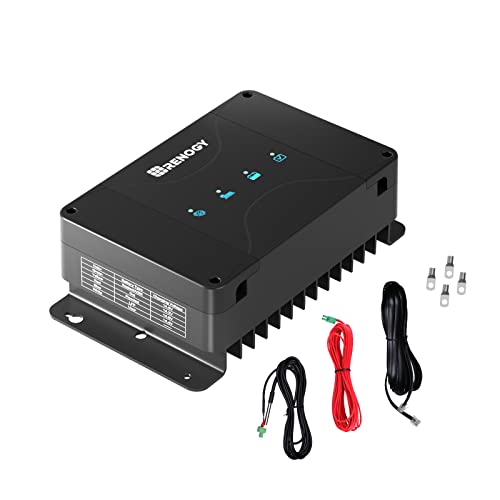
Best for high-capacity systems that need rapid charging from both solar and the alternator. It offers multi-input MPPT charging with high efficiency and soft-start circuitry to protect the battery and electrical system. Best for RVs and off-grid configurations that run on lithium or lead-acid chemistries. Limitation: higher current models may require adequate heat sinking in confined spaces.
Renogy DC to DC Charger with MPPT 12V 30A

Best for compact systems or smaller RVs where space and weight matter. It provides dual-source charging with MPPT and three-stage logic that prioritizes solar when available. Suitable for lithium, AGM, gel, and flooded lead-acid batteries. Caution: lower amperage means slower bulk charging for larger battery banks.
VEVOR DC to DC Charger with MPPT, 520W 40A

Best for users needing higher output and reliable dual-input charging. VEVOR prioritizes solar energy to reduce alternator load while delivering up to 40A and 520W. It supports LiFePO4 and other lead-acid chemistries. Limitation: some installations may require attention to heat dissipation in sunny climates.
LiTime 12V 40A DC-DC MPPT Charge Controller

Best for true plug-and-play setups with dual input from DC and solar. It features automatic adjustment for LiFePO4 and other chemistries, and may offer a simple integration path for campers and small off-grid systems. Caution: some setups may require additional wiring accessories for optimal MPPT performance.
VEVOR DC to DC Charger MPPT 520W 40A (Second Variant)
Best for users comparing MPPT DC-DC options with similar specs. This model emphasizes high efficiency and broad battery compatibility. Use when you want a second VEVOR option to cross-check specifications and installation needs. Limitation: identical feature sets can lead to confusion—confirm exact inputs and protections before purchasing.
Buying Guide: How to Choose the Right MPPT DC-to-DC Charger
- What battery chemistries will you use? Look for chargers that explicitly support LiFePO4, AGM, Gel, Flooded, and calcium batteries if you plan to mix chemistries.
- How many inputs do you need? Dual-input MPPT chargers let you run from solar and an alternator simultaneously; this can reduce charging time but requires proper wiring and safety considerations.
- What is your system size? Higher amperage (30A–50A) is better for larger battery banks or frequent full-battery cycles; smaller banks can use 12V 12–30A units to save space and cost.
- Is remote monitoring important? Some units offer more advanced protections and status indicators. Choose models with clear fault protection (over-voltage, under-voltage, reverse polarity, over-temperature).
- Do you need heat management? Higher current MPPT chargers generate more heat. Ensure adequate ventilation or heat sinking in the installation area.
- Compatibility with your vehicle or vessel: Verify that your alternator output and solar array voltage align with the charger’s input requirements and that you can physically fit the unit in your enclosure.
FAQ
- What is MPPT in a DC-DC charger? MPPT stands for Maximum Power Point Tracking. It optimizes solar input to maximize charging efficiency, especially under varying sunlight conditions.
- Can I charge lithium and lead-acid batteries with the same inverter? Many MPPT DC-DC chargers support multiple chemistries, but verify each battery type’s recommended charging profile in the manual.
- Do these chargers require a separate solar controller? No, most DC-DC chargers with MPPT inline include the necessary MPPT controller functionality, consolidating charging into one unit.
- Will dual-input MPPT chargers protect my starting battery? Yes, most models include protections against overvoltage, under-voltage, and reverse polarity to protect both the starter and auxiliary batteries.
- Is installation difficult for a non-professional? Basic wiring knowledge helps. Follow the manufacturer’s wiring diagram, observe polarity, and ensure proper fusing and ventilation.
- Are there maintenance requirements? Regular inspection of connections, fuses, and battery health will help maintain consistent performance; MPPT units themselves typically require minimal maintenance.