Best DC to 240V AC Inverter for Cars and Off-Grid Power
Answering the needs of travelers, hobbyists, and homeowners seeking reliable DC to AC power, this guide highlights five practical inverters that convert 12V or higher DC inputs to 120V/240V AC. These options cover portable vehicle use, mid-range to high-load home/off-grid needs, and safe operation within listed limits. The best choice depends on load type, desired wattage, and whether you favor pure sine wave output, built-in charging, or multi-device charging. Each pick is explained for who it’s best for and why it was included here.
| Product | Best For | Key Benefit |
|---|---|---|
| Ampinvt 5000W Peak 15000W Pure Sine Wave Inverter | Large loads, off-grid homes | High surge, flexible charging options |
| POWLAND 12000W Hybrid Solar Inverter | Grid-tied, solar-heavy homes | Battery-free design, grid interaction |
| AuraSolar 8000W Hybrid Solar Inverter | Large off-grid systems | Dual MPPT, scalable up to 48kW |
| Pro Chaser 400W Vehicle Inverter | Travelers with moderate power needs | Dual AC outlets, USB charging |
| VoolexGo 180W AC to DC Converter | Compact setups, car accessories | Low-wattage, easy cigarette-lighter use |
Note: When choosing an inverter, consider continuous wattage vs. peak surge, the type of output (pure sine wave vs. modified), number of outlets, warranty, and protection features like overcharge and short-circuit safeguards. The products listed here span a range from portable 400W units to heavy-duty 12kW systems, helping buyers compare practical options for different use cases.
Ampinvt 5000W Peak Pure Sine Wave Inverter

Features indicate a pure sine wave output with a high surge capacity and compatibility with a range of battery types. This inverter is best for buyers needing robust power with reliable waveform quality. It supports an adjustable charging current and is designed to handle heavy loads with minimal distortion. Best for large electronics and appliances that require stable AC power on the road or off-grid sites.
Who it’s best for: Off-grid enthusiasts, mobile workshop users, and families running multiple devices simultaneously. Why selected: It delivers substantial continuous output and a strong surge capacity, ensuring reliable operation for power-hungry devices. Caution: Ensure battery bank compatibility and space for heat dissipation under high loads.
POWLAND 12000W Hybrid Solar Inverter

This inverter offers a massive 12,000W continuous output with a 120V±5% specification and a grid-interfacing capability. It highlights a battery-free design that can feed excess solar energy back to the grid and supports parallel operation with other units. Best for large homes or RV setups where solar generation is abundant and energy costs matter.
Who it’s best for: Large homes, cabins, or RV parks seeking high power and grid interaction. Why selected: It combines high power with grid-backup features and efficient solar harvesting. Caution: Installation complexity and compliance with local grid interconnection rules may apply; professional setup is recommended.
AuraSolar 8000W Hybrid Solar Inverter

All-in-One inverter charger with 16000W surge and built-in MPPT controller inputs. It supports remote monitoring and a capacitive touchscreen display for real-time data on PV, grid, battery, and load. Best for scalable off-grid solar systems and battery backup with high harvesting efficiency.
Who it’s best for: Builders of larger off-grid solar systems needing remote management and modular expansion. Why selected: The combination of MPPT efficiency, dual inputs, and smart control makes it a strong long-term solution. Caution: Higher upfront cost and more complex setup than smaller units.
Pro Chaser 400W Vehicle Inverter
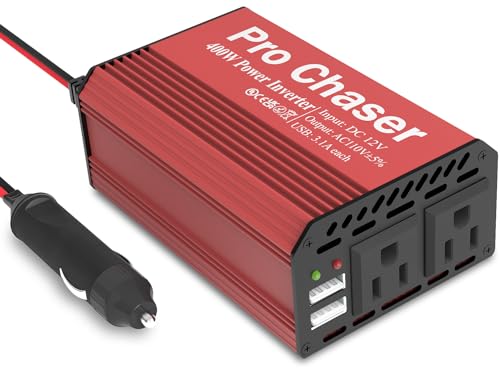
Designed for travel, this unit provides two AC outlets and dual USB charging ports. It’s compact and easy to use in cars, RVs, or tents with moderate power needs. Best for travelers who require quick, on-the-go conversion for laptops, chargers, and small appliances.
Who it’s best for: Road trip families and frequent travelers with light-to-moderate AC loads. Why selected: Its compact size and dual USB ports make it a practical everyday carry option. Caution: The overall continuous wattage is lower than other units listed; avoid powering heavy devices for extended periods.
VoolexGo 180W AC to DC Converter

Small, light, and simple, this converter outputs 12V at up to 15A from 100–240V input. It’s suitable for low-wattage car accessories and compact devices. Best for buyers who need a portable solution for inflators, small coolers, or other 12V devices in a vehicle.
Who it’s best for: Car owners and hobbyists needing a compact, easy-to-use 12V supply. Why selected: It covers common low-power automotive devices with a straightforward plug-and-play approach. Caution: Not suitable for high-wattage appliances or continuous heavy loads.
Buying Guide
What wattage do I need?
Slowly scale from continuous wattage requirements to peak surge needs. For laptops and small appliances, 400–1500W is often enough. For power tools or home appliances, consider 3000–12000W units with high surge tolerance.
Pure sine wave vs. modified sine wave
Pure sine wave inverters provide clean AC power for sensitive electronics and high-efficiency devices. Modified sine wave inverters are cheaper but may cause noise or efficiency losses in some devices.
Grid-tied vs. off-grid use
Grid-tied inverters focus on interaction with the power grid, while off-grid models emphasize battery charging and independent operation. For home backup or solar, consider models with MPPT and battery management features.
Protection features to look for
Overload protection, short-circuit protection, thermal cutoff, low-voltage disconnect, and automatic shutdown safeguards help protect both the inverter and connected devices.
Installation and space considerations
Large inverters require proper mounting, ventilation, and secure connections. Ensure your vehicle or installation site has adequate room for heat dissipation and cable routing.
Battery compatibility and charging
Some inverters offer adjustable charging currents and support for multiple battery chemistries. Check compatibility with your SLA, AGM, gel, Li-ion, or lead-acid batteries to avoid mismatches.
Reliability and maintenance
Look for units with robust enclosures, adequate protection against dust and moisture, and clear documentation for maintenance and troubleshooting.
FAQ
- Can these inverters power my laptop and a mini fridge at the same time? Yes, if the inverter’s continuous wattage rating exceeds the combined load of both devices with headroom for startup surges.
- Is a pure sine wave necessary for a car charger? Not always, but for sensitive electronics or devices with motors, a pure sine wave reduces noise and potential damage.
- Do I need professional installation for high-wattage inverters? For high-power units (several kilowatts), professional installation is advised to ensure electrical safety and grid compliance.
- Can I run these inverters off a standard car battery? Many models are designed for use with vehicle or deep-cycle batteries; verify the recommended battery type and capacity for continuous operation.
- Are there safety concerns with using inverters in hot weather? Yes. High ambient temperatures can reduce efficiency and cause overheating. Ensure adequate ventilation and avoid enclosure in confined spaces.
- What’s the difference between continuous watts and surge watts? Continuous watts indicate steady power output, while surge watts represents the peak power available for brief startup spikes.