Best DC Regulated Power Supplies for Precise Bench Testing
When building, testing, or repairing electronics, a reliable DC regulated power supply is essential. This guide highlights five top-rated options that cover a range of voltages, currents, and features. Each entry includes a concise look at key capabilities, safety features, and typical use cases to help you choose the right bench power supply for your lab or workshop.
| Product | Voltage Range | Current | Main Use |
|---|---|---|---|
| Jesverty SPS-3010V | 0–32 V | 0–10 A | General lab, electronics prototyping |
| Jesverty SPS-12003 | 0–120 V | 0–3 A | High-voltage experiments, educational labs |
| NICE-POWER 30V 10A | 0–30 V | 0–10 A | Benchtop testing, precise regulation |
| FNIRSI DPS-150 | 0–30 V | 0–5 A | Low ripple, CNC/PC control friendly |
| BTECH RPS-30PRO | 9–15 V (adjustable) / 13.8 V | Not specified on table | Radio, CB, and general DC devices |
Jesverty SPS-3010V: 0-32V 0-10A Bench Power Supply

The Jesverty SPS-3010V combines a wide 0–32 V range with 0–10 A maximum current, offering precise encoder-based coarse and fine adjustment for quick, repeatable setups. It includes a 4-digit LED display that shows voltage, current, and power in real-time, aiding accurate experimentation. A USB Type-A and Type-C port provide 20W quick-charge capability for auxiliary devices, keeping test benches uncluttered. An output ON/OFF switch enables safe, momentary power control without disconnecting the load.
Key features include:
- Coarse and fine encoder knobs for precise setting
- 4-digit readout with real-time V, A, and W
- USB-C and USB-A ports for charging and powering peripherals
- Single-output safety switch to control power delivery
Ideal for electronics debugging, Arduino/Raspberry Pi projects, and benchtop experiments that demand stable, adjustable voltage and current with clear visibility of usage metrics.
Jesverty SPS-12003: 0-120V 0-3A Bench Power Supply

This model expands the voltage ceiling up to 120 V, making it suitable for higher-voltage experiments and educational demonstrations. It retains the same 4-digit display for voltage, current, and power, with CV/CC auto-switching to maintain load stability across changing conditions. The design emphasizes coarse and fine adjustments for precise tuning and includes a USB port to keep auxiliary devices charged during long sessions.
Highlights include:
- Wide voltage range (0–120 V) for versatility
- Real-time CV/CC auto-switching ensures protection and stability
- 4-digit display with precise readouts
- USB port for convenient charging of test gear
Suitable for lab demonstrations, electronics course labs, and hobbyist projects requiring higher voltage capability.
NICE-POWER 30V 10A: Precise Benchtop Regulated Supply

The NICE-POWER 30V 10A unit highlights a high-precision 4-digit LED readout with 0.01 V and 0.001 A resolution, offering accurate monitoring of voltage, current, and power in real-time. It includes an OUTPUT control key for safe, convenient switching without disconnecting loads. The device emphasizes safety with robust overload and protection features and notes the US 110V input standard for safety compliance. A USB port supports auxiliary device charging, making it a practical addition to any focused development environment.
Notable aspects:
- High-precision 4-digit display for V, A, and W
- Output ON/OFF control improves safety and workflow efficiency
- Multiple protections to safeguard connected devices
- USB port for charging and auxiliary power
Best suited for meticulous testing, calibration tasks, and projects where precise readouts and reliable protection matter most.
FNIRSI DPS-150: Stable 0–30 V, 5 A Regulated Power

The FNIRSI DPS-150 provides stable output at 30 V and up to 5 A, with a highly readable 4-digit IPS display and a low ripple (<20 mV) specification, ensuring clean power for sensitive electronics. It supports PC programming, QC/DC input modes, and includes six preset output parameter groups for quick adjustments. The versatility is enhanced by multiple connection options, including banana plugs, U-shaped terminals, and copper wires, enabling flexible integration with various test setups.
Key considerations:
- Low ripple for precision electronics
- PC programming and preset parameter functionality
- Multiple input and connection options for flexibility
- CC/CV mode support for dynamic load conditions
Ideal for CNC projects, lab prototyping, and setups requiring programmable control and high stability.
BTECH RPS-30PRO: 30 Amp Regulated Bench Supply
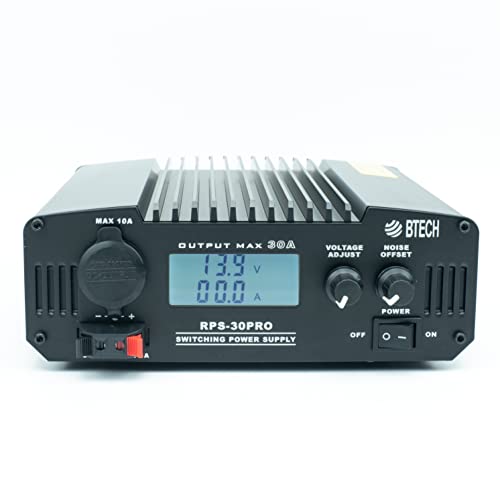
The BTECH RPS-30PRO is designed for high-current bench applications, delivering up to 30 A with adjustable voltage in a compact form factor. It features a cigarette plug and multiple screw-type and snap-in terminals for easy connectivity. The unit emphasizes straightforward plug-and-play operation with a simple on/off switch to control power delivery, making it suitable for RC, CB, and other DC-powered devices where robust current supply is required.
Important details include:
- AC-to-DC conversion with a stable DC output
- Flexible terminal options for diverse devices
- Streamlined operation with a switch to control output
- Compact, portable form factor for bench use
Best for scenarios needing higher current capability and dependable performance in compact spaces, such as radio experiments or lab benches with space constraints.
Buying Guide: Key Purchase Considerations
Choosing the right DC regulated power supply depends on your project needs, safety concerns, and workflow requirements. Consider these factors to compare options effectively:
- Voltage and current range: Ensure the supply covers your expected operating window, with headroom for startup surges.
- CV/CC behavior: Look for automatic switching between constant voltage and constant current modes to protect loads and simplify testing.
- Resolution and readout: Higher resolution (0.01 V, 0.001 A) provides finer control, which is important for delicate electronics.
- Display type and visibility: LCD/LED readability, especially under varying lighting, affects ease of use.
- Protection features: Over-current, over-voltage, short-circuit protection, and thermal protection are essential for longevity and safety.
- Output control: A dedicated on/off switch or push-button helps prevent accidental power delivery.
- Connectivity: Built-in USB ports or PC control can streamline charging and automation workflows.
- Programmability: PC interfaces, memory presets, and scripting can be advantageous for repeatable test sequences.
- Form factor and weight: Consider bench space and how easy it is to reposition equipment in your lab.
- Safety and compatibility: Check input voltage standards (US 110V) and ensure compatibility with your local power infrastructure.
In practice, a model with wide voltage range, strong current capability, precise readouts, and robust protections offers the best balance for a typical American electronics workspace. For education or high-voltage experiments, higher voltage models are valuable. For compact or high-current needs, a pro-grade unit with multiple terminals and PC control may be preferable.