Best DC Power Supply Kit for Electronics Enthusiasts and Hobbyists
Answering your search for a reliable DC power supply kit, this guide highlights five practical options ideal for electronics projects, prototyping, and workshop benches. Each pick suits different needs—from precise CV/CC control to compact portability or advanced encoder tuning. Best for beginners: simple, safe CV/CC operation. Best for hobbyists: compact and feature-rich with clear displays. Best for professionals: high precision and quick-charge ports for multitasking. Use the summary table below to compare at a glance.
| Product | Best For | Key Feature | Where It Shines |
|---|---|---|---|
| Jesverty SPS-3010V | Prototyping & lab work | 0-32V, 0-10A, 4-digit display | Coarse & Fine encoder knobs, USB-C quick-charge |
| WWZMDiB LM317 Kit | Learning & DIY | LM317 regulator, 1.25–12V output | Economical starter kit |
| Ransanx 30V 5A | General bench use | CV/CC modes, 0-30V, 0-5A | Full protection, last-set values retained |
| NICE-POWER 0-30V / 0-10A | Compact portability | 150W, encoder adjustments | Three-digit display, cooling fan |
| NANKADF 30V / 10A | Accurate control | Encoder knob, OCP option | Output enable/disable, audible alert |
Jesverty SPS-3010V 0-32V 0-10A DC Power Supply

The SPS-3010V from Jesverty offers a broad voltage range (0-32V) and current up to 10A, making it suitable for test benches, circuit prototyping, and lab experiments. It features coarse and fine encoder knobs for precise dialing, plus a 4-digit LED display that shows voltage, current, and power with 0.01V and 0.001A resolution. It includes USB-C 20W quick-charge and a USB-A port, enabling simultaneous device charging and power supply duties. Best for engineers, students, and makers who need quick, accurate setup and the flexibility of dual charging alongside testing power circuits. Caution: The unit relies on an encoder mechanism for tuning; if you apply a high inrush load, ensure current limits are set properly to avoid overshoot.
Who it’s best for: professionals and serious hobbyists who require high-precision CV/CC control and fast USB charging in one compact unit. Why selected: wide voltage/current range, high-resolution display, and dual charging ports simplify bench workflows.
Jesverty SPS-V: Encoder-Driven Bench Power Supply
Jesverty’s SPS-V model upgrades traditional bench power supplies with coarse and fine encoder knobs. It supports precise decimal control (0.01V / 0.001A) and provides convenient on/off output via a dedicated button. The unit emphasizes quick setup during complex projects, enabling fast transitions between different voltage/current settings without unplugging the load. Best for precise lab tasks, calibration work, and classroom demonstrations where exact setting recall matters. Caution: Verify that the encoder can be operated smoothly at low voltages to prevent overshoot on sensitive electronics.
Ransanx DC Power Supply 30V 5A

Ransanx offers a compact, feature-rich DC power supply with adjustable voltage (0-30V) and current (0-5A). It provides full CV/CC modes, a 4-digit display showing real-time V, I, and P, and safety protections including overload, short-circuit, and over-temperature safeguards. Best for electronics labs and repair work where a reliable, fully protected supply is essential. Choose this if you need a durable industrial-style unit with a balance of performance and portability. Limitation: While compact, it may have fewer advanced tuning options than models with encoder-based precision knobs.
NICE-POWER 0–30V 0–10A DC Bench Power Supply

From NICE-POWER, this compact 150W bench supply offers a dual voltage/current configuration with a 0–30V, 0–10A range. It provides a three-digit display and an encoder-based adjustment approach for precise setting. Important for space-constrained workbenches, it also includes an automatic cooling fan and a dedicated encoder knob for straightforward control. Best for small shops, makerspaces, and field technicians who need a portable yet capable power source. Caution: The 150 W limit means high-current operation at higher voltages is not possible.
NANKADF DC Power Supply With Encoder

This NANKADF model emphasizes an accurate encoder knob for precise voltage and current settings. It includes an output enable/disable button to prevent accidental operation, plus an audible alert when an overcurrent condition is detected. Best for users who need tight control over output states and quick safety cues during experiments. Limitation: The feature set centers on control aids rather than advanced display readouts, so it’s best when you value quick, tactile adjustments over ultra-high precision readouts.
LM317 DIY Kit By PEMENOL
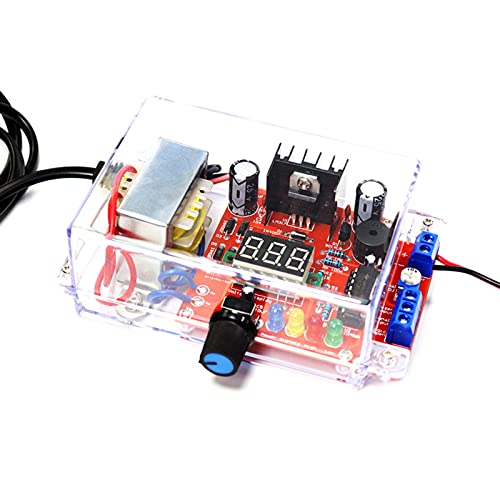
The PEMENOL LM317 kit provides an adjustable regulated output from 1.25V to 12V using the LM317 regulator. It is described as a learning kit with LED display and a signal generator feature, making it suitable for education and hobbyist tinkering. Best for students and beginners who want hands-on experience with voltage regulation and basic experimentation. Limitation: Output is limited to a lower voltage range, and the included components may be basic for advanced lab uses.
SHNITPWR 3V–24V Power Supply Kit

SHNITPWR’s universal AC/DC adapter kit offers adjustable DC output from 3 to 24V up to 3A, with multiple tip options for compatibility with various devices. It comes with a clear LCD readout and a wide tip assortment for DIY projects. Best for multi-device experimentation and soldering practice where you need flexibility in connectors. Caution: The maximum current (3A) may be insufficient for higher-demand projects or power-hungry modules.
Buying Guide: What To Look For In A DC Power Supply Kit
When choosing a DC power supply kit, consider voltage and current ranges, regulation type (CV/CC), display readability, and safety features. For educational settings, look for clear LED displays and beginner-friendly adjustment methods. For professional bench work, encoder knobs, rapid-set features, and multiple ports (USB-C, USB-A) add practical value. Portability and fan cooling influence long sessions and heat management. Ensure compatibility with your target devices and wall power standards (AC input).
Key purchasing considerations:
- Voltage range: Do you need up to 30 V, 32 V, or more?
- Current capability: Is up to 5 A sufficient, or do you need 10 A or more?
- Regulation mode: CV and CC modes, automatic switching, and precision of sets
- Display and controls: 4-digit readouts vs. encoder knobs; ease of visibility
- Safety features: Overcurrent, short circuit, and thermal protection
- Ports: USB-C, USB-A, or charging capabilities alongside power output
Frequently Asked Questions
- What does CV/CC mean on a power supply? — CV stands for constant voltage mode, CC stands for constant current mode. The supply automatically switches between them based on load to protect the circuit and meet requirements.
- Is an encoder knob better than a traditional dial? — Encoder knobs provide precise, repeatable adjustments and easier fine-tuning, which is helpful for sensitive electronics.
- Can I use a bench power supply for charging devices? — Some models include USB ports (USB-A or USB-C) for charging, but always ensure the USB output doesn’t exceed the device’s needs or compromise safety.
- What is a safe voltage/current range for beginners? — Start with lower voltages (e.g., 5–12 V) and currents (0.5–1 A) while testing basic circuits, then gradually increase as needed.
- Do I need a high wattage supply for prototyping? — If your projects involve motors or high-current modules, a higher wattage and current rating (50–150 W within safe limits) is beneficial.
- Are these kits suitable for teaching electronics? — Yes, many kits are designed for learning and practice, featuring LED displays, adjustable outputs, and some with instructional components.