Best DC Motor Wind Generator Kits for DIY Power Projects
Answering the question, these DC motor wind generator kits offer approachable, educational options for building small-scale wind energy projects or powering low-voltage electronics. They’re suited for hobbyists, students, and makers exploring wind-powered DIY setups. The top five selections below balance ease of use, available components, and hands-on learning value. A quick summary table follows to help compare key points at a glance.
| Product | Brand | Best For |
|---|---|---|
| DC Motor Wind Turbine Generator Power Supply 3500rpm DIY | RIYIN | Intermediate DIYers building wind-powered power sources |
| EUDAX Mini Generator Motors 3V-12V | EUDAX | Beginner projects, small science experiments |
| Sntieecr 6 Set Mini Generator Motors | Sntieecr | Classroom kits and multi-vehicle experiments |
| EUDAX 6 Set Mini Generator Motors with Propellers | EUDAX | Educational projects with LED lighting |
| Coliao 10pcs Mini Generator Motors 3V-12V | Coliao | Micro wind turbine concepts and DIY toys |
DC Motor Wind Turbine Generator Power Supply 3500rpm DIY

Best for: Builders seeking a compact wind-powered power source for DIY energy projects. This unit generates DC power with a durable metal housing, suitable for experimenting with wind speeds and integration into custom power setups. It’s designed for projects that require a reliable, small-format turbine with straightforward output.
Why selected: It combines a compact size (4×1.97 inches) with a robust build and versatility to fit various DIY systems. The emphasis on durable construction supports repeated experimentation in home labs or classrooms.
Caution: Exact output depends on wind conditions; use appropriate load management to avoid overloading the generator.
EUDAX Mini Generator Motors 3V-12V DC Motor

Best for: Beginners and students who want a simple, multi-voltage motor to power small experiments or mini-fan projects. The range of voltages (3V, 4.5V, 12V) supports experimenting with speed and output.
Why selected: The varied voltage and high-speed ratings (up to 6500 RPM) allow learners to explore how rotational speed relates to generated electricity in a controlled, educational way.
Caution: The packaged data includes multiple voltage figures; ensure your test setup wires to the correct voltage to avoid damage to components.
Sntieecr 6 Set Mini Generator Motors
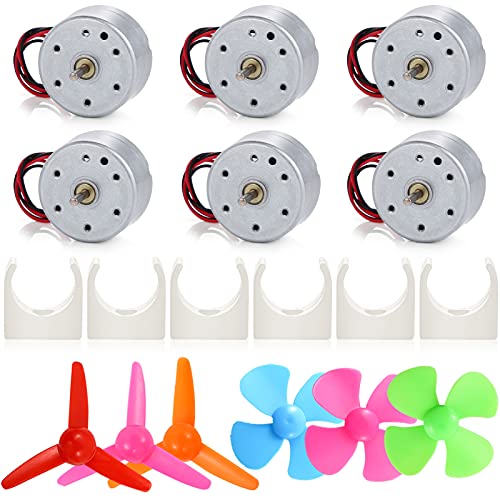
Best for: Educational kits and classroom-style setups where multiple motors and propellers are used simultaneously to demonstrate wind energy concepts.
Why selected: Includes six motors, brackets, and propellers of different colors, enabling group projects or multi-vehicle experiments that illustrate energy conversion from wind to electricity.
Caution: Kit contents vary; verify compatibility with your other hardware before integrating into a larger system.
EUDAX 6 Set Mini Generator Motors with Propellers

Best for: Educational packages that combine motors with propellers, enabling wind-driven demonstrations and LED lighting projects.
Why selected: The kit includes multiple propellers and motors, plus an LED assortment, supporting LED-based experiments to visualize energy transfer from wind to electrical energy.
Caution: The included manuals are in English; ensure proper guidance when wiring and testing to avoid short circuits.
Coliao 10pcs Mini Generator Motors 3V-12V

Best for: Micro wind turbine concepts and small DIY projects requiring multiple motors for parallel experiments or small toy builds.
Why selected: A pack of ten motors supports scalable experiments and hands-on learning about energy conversion in wind-driven systems.
Caution: Small shaft size and diameter require careful handling and appropriate mounting to avoid misalignment during tests.
Buying Guide: Key Purchase Considerations
What voltage range do you need? Choose motors and generators that support the voltage range your project targets (3V, 4.5V, 12V, or higher). If you’re just starting, a kit with multiple voltage options helps you learn how speed affects power output.
How important is the kit size? For classroom or desk-top setups, compact models fit neatly on a workbench. If you plan larger wind experiments, look for modules with mounting hardware and robust housings.
What about propellers and mounting? Ensure propeller sizes and mounting brackets align with the motor shaft and frame. Incomplete fitment can cause wobble or inefficiency in wind capture.
Is LED or load testing included? Some sets include LEDs to visualize energy transfer, which is helpful for demonstrations or low-power experiments. Others focus on raw motor output only.
Durability and materials: Metal housings and corrosion-resistant components extend life in outdoor or challenging indoor environments. Plastic parts are common in beginner kits but may wear sooner under heavier use.
Safety and handling: Handle small motors with care to avoid pinching fingers or damage to exposed wiring. When testing, use appropriate current-limiting and load-resistance to prevent overheating.
FAQ
- What is a DC motor wind generator kit best for? It’s ideal for learning how wind energy can be converted into electricity, building small power sources, and conducting science experiments in schools or makerspaces.
- Do these kits require special tools? Basic hand tools (screwdrivers, pliers) are often enough. Some sets include all necessary mounting hardware; others may need extra fasteners or stands.
- Can I use these motors with solar panels? Many kits support multi-energy input when combined with appropriate controllers or diodes. Check voltage and current requirements for compatibility.
- How do I avoid damaging the motor during tests? Use a safe, low-resistance load and avoid exceeding the rated voltage, RPM, or current. Start with small wind or manual crank input and gradually increase.
- Are these motors suitable for outdoor experiments? Some kits can be used outdoors if protected from moisture and dust; otherwise, indoor use is recommended unless weatherproofing is applied.
- What is the difference between 3V, 4.5V, and 12V motors? Voltage class generally correlates with top speed and output. Higher voltage motors can produce more power at higher rpm, given adequate wind or drive force.