Best DC Amp Clamp Meter Buying Guide: Top Picks for 2026
When shopping for a DC amp clamp meter, accuracy, safety, and ease of use matter most. This guide highlights five reliable models that handle AC and DC current measurements, with features like NCV detection, data hold, backlit displays, and specialized jaws for tight spaces. Each product is summarized with its strengths to help electricians, DIY enthusiasts, and maintenance teams choose the right tool for residential, commercial, or industrial work.
Summary table of chosen products
| Product | Brand | Key Strengths |
|---|---|---|
| Fluke 301D/ESP | Fluke | Slim jaw; AC/DC up to 600 A; CAT III 300V |
| AstroAI Clamp Meter (4000 Counts) | AstroAI | True versatility; non-contact testing; backlit display |
| Klein Tools CL390 | KLEIN TOOLS | TRMS; NCVT; hi-visibility display |
| KAIWEETS Digital Clamp Meter | KAIWEETS | D-shaped jaw; NCV; true-RMS |
| AstroAI Inrush Clamp Meter | AstroAI | Inrush measurement; VFD/LoZ modes |
Fluke 301D/ESP: Slim 600 A AC/DC Clamp Meter

The Fluke 301D/ESP is designed for residential and commercial electrical work, offering measurements for AC and DC current up to 600 A. Its slim 10 mm jaw fits in tight spaces, making it ideal for panel work and crowded electrical boxes. The CAT III 300V safety rating adds a guard of protection for typical maintenance tasks. This model balances portability with dependable accuracy, and Fluke’s reputation in safety-certified instruments is a key consideration for pros evaluating reliability.
Features include a compact body, a slim jaw that slips into cramped areas, and robust safety ratings suitable for common electrical systems. Operators benefit from clear readings, dependable continuity checks, and a design that reduces misreads in busy environments. For those who frequently work on service panels or enclosures, the Fluke 301D/ESP provides a practical, durable option with familiar Fluke ergonomics.
AstroAI Digital Clamp Meter (4000 Counts)
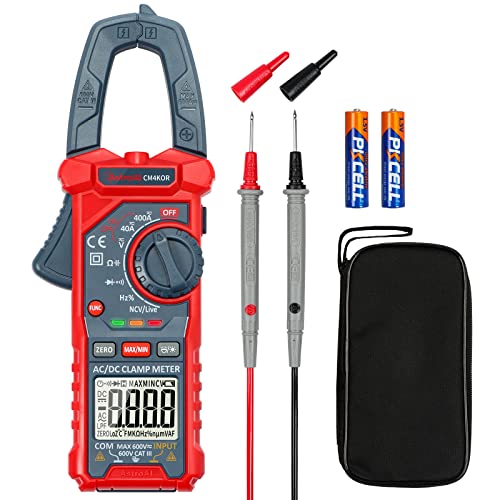
The AstroAI 4000-count clamp meter blends versatility with convenience. It measures AC/DC voltage and current, resistance, capacitance, frequency, duty cycle, and more, with additional tests for continuity and NCV detection. A non-contact voltage tester provides audible and visual alarms to help verify live circuits without direct contact, enhancing safety in on-site inspections.
Designed for practical usability, this meter includes data hold and Max/Min functions, auto power-off, a backlit display, and a built-in flashlight for dim environments. The ZERO function helps mitigate measurement errors caused by magnetic fields, contributing to more accurate readings in real-world scenarios. It’s well-suited for interim fault finding, panel maintenance, and general electrical troubleshooting.
Klein Tools CL390: Auto-Ranging Clamp Meter

The Klein Tools CL390 is a versatile clamp meter that covers AC/DC current and voltage, resistance, and continuity. Its NCVT testing helps identify live circuits without contact, while a TRMS measurement capability improves accuracy in non-sinusoidal waveforms. The high-visibility hi-contrast display supports quick readings in various lighting conditions, which is beneficial for both busy job sites and educational environments.
In addition to clamp measurements, the CL390 provides reliable voltage testing with a test lead interface, and a broad feature set that includes temperature measurement and frequency/duty cycle testing. The device’s sturdy construction and intuitive layout assist professionals in diagnosing electrical issues across residential and commercial applications.
KAIWEETS D-Shaped Jaw Clamp Meter: True-RMS & NCV

The KAIWEETS clamp meter stands out with its distinctive D-shaped jaw that opens up to 1.1 inches, enabling easier clamping around cables in crowded setups. It offers true-RMS readings for AC/DC current and voltage, plus a broad range of measurements including temperature, NCV, capacitance, frequency, resistance, and diode testing. The presence of a non-contact voltage detector with audible and visual alarms adds a safety layer for on-site inspections.
Users benefit from a compact design, backlit display, and a user-friendly interface that supports quick measurements. The device targets electricians who need a versatile tool for everyday troubleshooting, particularly in automotive, solar, or industrial contexts where tight cable runs are common.
AstroAI Inrush Clamp Meter: 1000 A TRMS, VFD Mode

The AstroAI Inrush clamp meter specializes in measuring high inrush currents up to 1000 A, a valuable feature for diagnosing startup issues in motors and electrical equipment. It also supports RTP/TRMS measurements for AC current and voltage, along with capacitance, resistance, frequency, and temperature readings. The device includes LOZ (low impedance) mode to reduce phantom voltages and reading errors caused by inductive loads or wiring configurations.
Inrush testing is particularly helpful for identifying motor problems, contactor failures, or power supply issues that occur only at startup. The meter’s VFD mode and LoZ function extend its usefulness in environments with variable frequency drives and complex electrical systems, making it a practical option for industrial maintenance and service technicians.
Buying Guide: How To Choose The Right DC Amp Clamp Meter
When selecting a clamp meter, consider the following factors to match a tool to your use case:
- Current range and true-RMS: Ensure the meter measures both AC and DC currents to cover a wide range of tasks, with true-RMS for non-sinusoidal signals.
- Safety and ratings: Look for CAT safety classifications appropriate to your environment (e.g., CAT III for panel work).
- Jaw design: A slim or D-shaped jaw helps in crowded panels; a larger jaw improves accessibility around multiple conductors.
- Display and interface: Backlit or high-contrast screens aid readability; data hold, Min/Max, and auto power-off improve workflow management.
- Non-contact voltage (NCV) and audible alarms: Useful for quick status checks and safe operation around live circuits.
- Special modes: Inrush current, LOZ mode, and VFD testing extend the meter’s utility for specific tasks.
- Durability and form factor: Compact, rugged builds are preferable for field work; consider weight and battery life for daily use.
In practice, the best choice depends on work context. A residential technician may prioritize a slim jaw and intuitive display, while an industrial maintenance technician might require high inrush capability and LOZ mode. Consider how often you will rely on NCV detection and whether you need temperature measurement or thermocouple support. Finally, verify warranty and manufacturer support, as these factors influence long-term reliability and service options.
Assessment tips for effective use:
- Always start with safety checks and verify meter calibration according to your region’s standards.
- Use data hold and Min/Max features to capture transient events in noisy electrical environments.
- Leverage backlighting for dim job sites and utilize the flashlight function where applicable.
- For inrush testing, ensure the circuit is de-energized as required and follow proper startup procedures.
- Keep test leads in good condition and inspect the clamps for signs of wear before use.