Best Car Power Inverters That Turn Your Cigarette Lighter Into a Portable Outlet
Looking to power laptops, chargers, or small appliances from your vehicle? A cigarette lighter powered inverter can transform your 12V DC supply into usable AC and USB power. This guide covers five reliable models that balance wattage, USB ports, safety protections, and portability. Use these options to keep devices charged on road trips, camping, or daily commutes without sacrificing convenience.
| Product | Brand | Watts | USB Ports | Key Protection |
|---|---|---|---|---|
| 150W Power Inverter 12V DC to 110V AC Car Plug Adapter Outlet Converter | PiSFAU | 150W continuous | 2 USB | Smart chip + built-in fuse |
| BESTEK Power Inverter DC 12V to AC 110V – 300W | BESTEK | 300W continuous | 2 USB ports | Overload protection, auto shut-off variant |
| FOVAL 150W Car Power Inverter 12V DC to 110V AC | FOVAL | 150W continuous | 2 USB | Dual USB protection and robust shell |
| ALLWEI 300W Car Power Inverter with PD USB-C & USB-A | ALLWEI | 300W continuous | USB-C 27W, USB-A 18W | Smart chip with protection against common faults |
| Ampeak 150W Car Power Inverter 12V DC to 120V AC | Ampeak | 150W continuous | 2 USB | 11 integral protection layers |
This article selects five popular options designed to replace or extend a vehicle’s power capabilities. Each model is compatible with common devices like laptops, tablets, mobile devices, small appliances, and lighting. Consider your device wattage, the number of USB ports you need, and the space you have in your vehicle when choosing the best inverter for your needs.
PiSFAU 150W Power Inverter Review

The PiSFAU 150W inverter provides 150 watts of continuous power with a peak of 300 watts. It includes two USB charging ports and a 110V AC outlet for larger devices such as laptops and tablets. Its protection system combines a smart chip with a built-in fuse, automatically shutting off if it detects a fault and signaling with a red indicator light. This model suits light-to-medium load scenarios on road trips, camping, and daily commutes where compact size matters.
BESTEK Power Inverter DC 12V to AC 110V – 300W

BESTEK is a recognized name in vehicle power inverters. This model delivers 300 watts of continuous power and up to 700 watts peak, with two AC outlets and two USB ports. It emphasizes compatibility with a wide range of vehicles, including updated vehicles and Tesla compatibility notes. The compact, aluminum housing helps with heat dissipation, and the unit includes fast-charging USB ports to rapidly top off USB devices while on the road.
FOVAL 150W Car Power Inverter
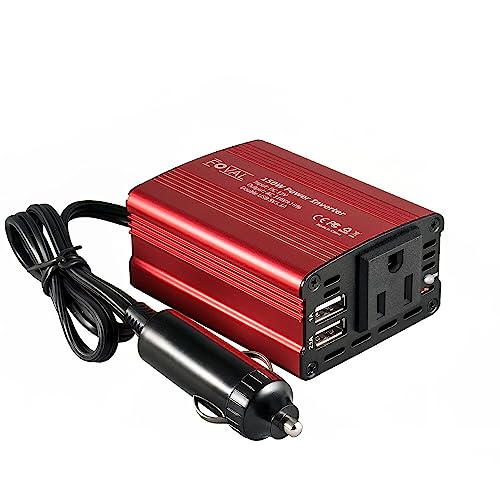
The FOVAL 150W inverter is designed for simple, on-the-go charging. It offers 150 watts of continuous output and two USB ports, plus a standard AC outlet. Its aluminum shell design provides durability and heat dissipation. The device is positioned for road trips, family travel, and users needing a compact, lightweight power source for laptops, small appliances, and portable devices in a vehicle.
ALLWEI 300W Car Power Inverter with PD USB-C

ALLWEI’s 300W inverter combines two AC outlets with USB-C PD (27W) and USB-A (18W) ports in a single unit. The rugged aluminum housing protects internal components, while the smart chip regulates voltage and current to prevent common electrical faults. This model suits users who need to power laptops, tablets, TVs, game consoles, and other devices simultaneously on longer trips or in campers with modest power requirements.
Ampeak 150W Car Power Inverter

The Ampeak inverter provides 150 watts of continuous power with two USB ports and an AC outlet. It emphasizes safety with 11 layers of protection and a compact, portable form factor ideal for cars, RVs, or trucks. Suitable for charging laptops, phones, and small devices, it is particularly useful for travelers seeking a budget-friendly, dependable option for vehicle power conversion.
Buying Guide: Key Considerations When Choosing a Car Inverter
- Wattage and load: Match continuous wattage to your devices’ combined needs. If you plan to run laptops or CPAP machines, prioritize models with higher continuous wattage (e.g., 300W) and a safe peak rating.
- Outlets and ports: Consider the number and type of outlets (AC vs USB-C vs USB-A). USB-C PD ports are ideal for faster charging of modern devices; dual USB ports support simultaneous charging.
- Portability and size: For in-vehicle use, a compact, lightweight design is easier to store in a glove box or center console without clutter.
- Protection and safety: Look for features like short-circuit protection, overcurrent protection, thermal protection, and auto shut-off when overheating or faults are detected. A built-in fuse adds an extra safety layer.
- Heat management: Aluminum housing and good heat dissipation help prevent overheating on longer drives or higher loads.
- Vehicle compatibility: Some inverters are labeled for compatibility with certain vehicles or voltage ranges; verify that your vehicle’s electrical system and fuse rating support the inverter.
- Usage scenarios: Road trips, camping, or daily commuting may influence whether you prioritize portability, extra USB ports, or higher wattage for laptops and other devices.
- Always use within limits: Do not load the inverter beyond its continuous wattage rating. High-power devices like air compressors or vacuums typically exceed the capability of most 150–300W inverters.
When selecting an inverter, you should align its capabilities with your most frequent usages: charging phones and tablets versus powering laptops or small appliances. If you often travel with multiple devices, a model with two USB ports and two AC outlets provides versatility. For higher-wattage needs, a 300W inverter with USB-C PD and robust protection features offers more flexibility and safety for extended trips.