Best Continuous Duty Solenoid Relays for Golf Carts, Winches, and Marine Applications
Direct answer: If you need a reliable continuous-duty solenoid relay for heavy loads, choose models designed for 125–300A continuous operation with robust copper windings and corrosion-resistant coatings. The best options below are suited for golf carts, winches, and marine setups, each selected for durability, compatibility, and clear installation specs. This guide helps buyers compare performance, mounting, and longevity across top performers.
| Product | Brand | Continuous Current Range | Mounting | Best For |
|---|---|---|---|---|
| Max 300A 12V Duty Solenoid Relay 4-Terminal | LDMINDA | Up to 150A recommended working current; 300A max transient | Straight; holes on center | Heavy-duty winches, marine thruster lines |
| Max 300A Continuous Duty Solenoid Relay | Lucky Seven | 14Ω; 10.2W; NO contacts | Straight; holes on center | Golf carts and marine use with multiple OEM replacements |
| Continuous Duty Solenoid Relay 3 Terminal | A ABIGAIL | 200A max transient; continuous ≤ 80A | Brace mounting holes on center | Medium loads; corrosion-prone environments |
| Max 200A 12V 3 Terminal Solenoid Relay | LDMINDA | Up to 100A rated continuous; 200A transient | 5/16 x 24 studs; center holes | Smaller winches and golf carts |
| Newdeli Max 300A Continuous Duty | Newdeli | 12V; 14Ω; 10.2W; max 300A transient | Straight; 5/16 x 19/32 mounting | Marine, winch, golf carts |
Max 300A 12V Duty Solenoid Relay 4-Terminal – LDMINDA

Specification highlights: 12VDC, 14Ω, 10.2W, maximum transient 300A with recommended working current under 150A. This 4-pole battery isolation solenoid includes nickel-plated housing for corrosion resistance. Best for heavy-duty winch lines or marine applications where environmental exposure is common. The design supports straightforward straight-bracket mounting with multiple center-hole spacing options. Consider this unit if you need high transient tolerance and a robust nickel-plated finish. Caution: operating continuously near the 150A range may reduce component life over time.
Who it’s best for: Heavy-duty golf carts, off-road vehicles, and boats requiring strong transient handling and reliable isolation when wiring multiple power circuits.
Max 300A Continuous Duty Solenoid Relay – Lucky Seven

Features include a straight mounting bracket, 12VDC coil with 14Ω resistance, and a 10.2W coil power rating. It uses copper windings and a nickel-plated outer casing. Replaces common OEM part numbers across multiple brands, making it a versatile upgrade or replacement. Best for users needing broad compatibility with well-known models. Limitation: listed as replacing many older part numbers, so verify exact fit with your vehicle/winch model.
Who it’s best for: Fleet operators or DIY installers who want broad compatibility and straightforward NO-operated relays for 12V systems.
Continuous Duty Solenoid Relay 3 Terminal – A ABIGAIL

This model uses 12VDC with 14Ω resistance and 10.2W coil power. It has 200A max transient current and continuous working current under 80A, making it suitable for medium-duty applications. The coil and shell feature 180°C copper wiring and zinc-plating to resist corrosion. Best for applications where corrosion resistance is a priority and continuous load is moderate. Limitation: maximum continuous load is lower than some 300A units, so choose accordingly.
Who it’s best for: Marine or golf-cart setups where exposure to moisture is likely and a durable zinc-plated shell is advantageous.
Max 200A 12V 3 Terminal – LDMINDA

Specification: 12VDC, 14Ω, 10.2W, max transient 200A. It uses a 5/16-24 terminal configuration and 5/16 x 19/32 mounting holes on center. The unit emphasizes a sturdy steel housing with nickel plating for corrosion resistance. Best for smaller winches or golf carts where a compact 3-terminal design suffices. Limitation: continuous current rating is lower than 300A models, which may be insufficient for high-load scenarios.
Who it’s best for: Smaller setups requiring reliable SPST operation without overpowering the system.
Newdeli Max 300A Continuous Duty – Nickel-Plating
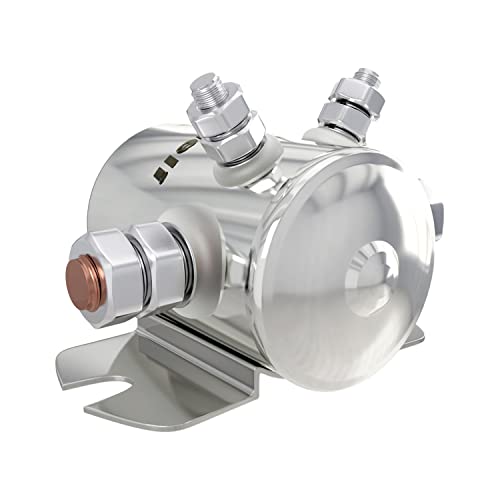
Newdeli’s model features 12VDC operation, 14Ω resistance, and a 10.2W coil, delivering up to 300A transient current with a recommended continuous current under 150A. It includes a nickel-plated outer layer and sealed coil housing for corrosion resistance. Best for marine and golf-cart setups where high transient tolerance and environmental sealing are key. Limitation: continuous operation should stay well below the 300A transient rating to maximize life expectancy.
Who it’s best for: Users needing a high-tolerance relay that can handle harsh environments and intermittent high-current transients.
Buying Guide: Key Considerations For Choosing A Continuous Duty Solenoid Relay
- Continuous vs. transient current: Match the rated continuous current to your device’s typical load. Higher transient ratings are helpful for brief startup spikes.
- Voltage compatibility: Most solenoids operate at 12V DC; confirm compatibility with your system’s voltage platform.
- Coil windings and materials: Look for 180°C copper windings for reliability, and nickel or zinc plating for corrosion resistance in marine or outdoor environments.
- Mounting and terminals: Check bracket type, hole spacing, and terminal stud size to ensure a secure fit with your existing wiring.
- OEM compatibility: Some models list replacement part numbers; verify that the relay matches your vehicle or device’s OEM spec.
- Durability in harsh environments: Sealed housings and environmental plating extend life where dust, moisture, or salt exposure is a factor.
Practical FAQ
- What defines a continuous-duty solenoid relay? It is designed to hold a load for extended periods, with a specified continuous current well below its transient peak to prevent overheating.
- How do I choose the right continuous current rating? Base it on your system’s average current draw. If you regularly exceed the continuous rating, select a higher-capacity model to avoid overheating.
- Why is nickel-plating important? It enhances corrosion resistance, especially in marine or outdoor installations where exposure to moisture is common.
- Can I replace an OEM solenoid with a different brand? Often yes if the terminal size, mounting holes, and electrical ratings align. Always verify OEM numbers and mechanical fit.
- Are 3-terminal models sufficient for all setups? For many SPST circuits, yes. If your wiring requires more control or dual ISOLATION lines, a 4-terminal model may be preferable.
- What maintenance is recommended? Inspect connections for corrosion or looseness, ensure mounting remains secure, and verify insulation and heat dissipation during operation.