Best Constant Current Power Source Options for DIY Projects and LED Drivers
When building LED lighting, battery packs, or any project that requires stable current, a reliable constant current power source is critical. This guide highlights practical options, core considerations, and how to evaluate modules designed for constant current and voltage regulation. The listed products come from reputable brands and are suitable for hobbyists and professionals working with DC-DC step-down or boost configurations.
The following table summarizes five top options that align with “constant current power source” needs. All entries are designed for adjustable CC/CV operation, with clear input ranges, current limits, and voltage outputs. Use this table to compare core specs at a glance and then read the detailed sections for each product.
| Product | Brand | Key CC/CV Feature | Typical Input Range | Output Range |
|---|---|---|---|---|
| LM2596S Constant Current LED Driver Module | GODIYMODULES | CC/CV with adjustable current and voltage | 7V-35V | 1.25V-30V |
| LM2596S 5Pcs Constant Current Driver Module | DORHEA | 2A rated, max 3A with heatsink, CC/CV | 7-35V | 1.25-30V |
| Diymore 2Pcs 20A 300W CC CV Step Down | diymore | High current, adjustable CC/CV | 6-40V | 1.2-36V |
| DROK Adjustable Voltage Regulator | DROK | 5A max, CC/CV with precise setting | 6-36V | 0.6-36V |
| D-FLIFE 20A 300W CC CV | D-FLIFE | CC/CV, high current, wide input range | 6-40V | 1.2-36V |
GODIYMODULES LM2596S CC/CV Power Module

The GODIYMODULES LM2596S module is designed for constant current LED driving and voltage regulation. It features an input range of 7V to 35V and an adjustable output from 1.25V to 30V. This module supports CC/CV operation, enabling stable current for LED strings and small battery-powered experiments. The compact DC-DC buck topology helps minimize heat when used within its rated current range, and multiple units can be paralleled for higher current applications with appropriate heat management.
DORHEA LM2596S 5-Piece CC/CV Modules

The Dorhea set includes five LM2596S-based CC/CV modules intended for flexible LED driving and regulation tasks. Each module offers input voltage from 7V to 35V and adjustable output from roughly 1.25V to 30V. A notable consideration with CC/CV modules is heat: with higher current, ensuring adequate heatsinking is essential to maintain stable operation and prevent thermal throttling during longer runs.
Diymore 20A CC CV Step Down Module
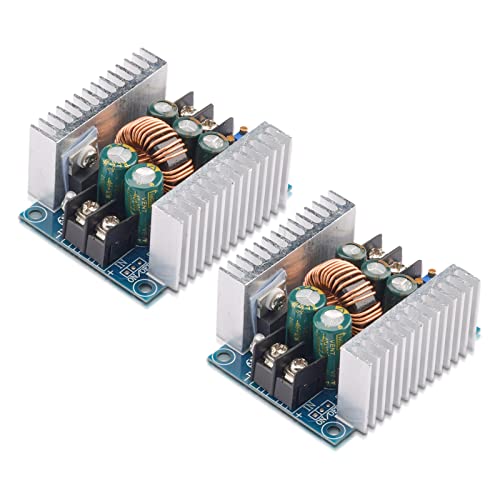
The Diymore module offers 20A continuous current with a wide input range of 6V to 40V and an adjustable output from 1.2V to 36V. It uses robust components, including large current screw terminals for secure wiring and high-frequency capacitors to reduce ripple. This makes it well-suited for LED drivers, battery charging, and prototyping where high current and stable regulation are needed. Users should monitor heat and provide adequate cooling in high-load scenarios.
DROK Adjustable Voltage Regulator CC/CV

The DROK regulator provides a compact, adjustable power solution with a 6 to 36V input window and a 0.6 to 36V output range. It supports current limiting and voltage setting, making it a practical choice for lab benches, LED drivers, and portable power packs. The device emphasizes ease of use: a straightforward interface allows setting precise voltage while securing current limits to protect LEDs or circuits during testing.
D-FLIFE 20A CC CV Step Down Module

The D-FLIFE CC/CV module delivers 20A with a 6-40V input range and an adjustable output from 1.2V to 36V. It emphasizes strong current handling, appropriate for LED strips, battery charging, or motor control experiments where constant current is necessary. Like other high-current modules, heat dissipation and secure wiring are critical for sustained operation. The kit entry often highlights multiple units per order, suitable for bulk hobby setups.
Buying Guide: Key Considerations For Selecting A Constant Current Power Source
Choosing the right constant current power source involves balancing electrical specifications with practical usage. Here are essential considerations and how they influence performance.
- Current capability and heat management: Higher current requires effective cooling. Look for heatsinks, thermal pads, or integrated fans. Ensure the module’s rated current aligns with your load and that you have a plan to dissipate heat during continuous operation.
- Input and output voltage ranges: Confirm that the input supply you have falls within the module’s acceptable range and that the adjustable output voltage covers your target. A wider range offers more flexibility for evolving projects.
- CC/CV behavior: Understand how the module transitions between constant current and constant voltage modes. This is crucial when driving LEDs, battery chemistries, or capacitive loads where current limits must be respected to avoid damage.
- Wiring and connectors: Large current modules often use screw terminals or robust headers. Ensure you have appropriate gauge wires and that connections are secure to minimize voltage drop and heating.
- Efficiency and ripple: Higher efficiency reduces heat and power loss. Look for modules advertising low ripple and high conversion efficiency, especially when powering sensitive electronics or LEDs.
- Protection features: Overcurrent, overvoltage, short-circuit protection, and thermal cutoffs enhance reliability. Check the documentation for protection behavior and reset requirements.
- Physical footprint and mounting: If space is a constraint, consider the module’s dimensions and mounting options. Some kits include standoffs, enclosures, or PCB mounting holes for easy integration.
- Price and availability: For hobby builds, a set of modules (as in the 5-piece options) can reduce per-unit costs and simplify ordering. For critical applications, prioritize trusted brands with clear datasheets and support.
Notes On Implementation And Best Practices
When integrating a constant current power source into a project, begin with a conservative current setting and gradually increase while monitoring voltage, temperature, and load response. Use a multimeter to verify output characteristics at your nominal load. For LED driving, ensure the current limit matches the LED’s forward current ratings, and add proper heat sinking to LED modules when driven near maximum current. Always verify the input supply’s ability to sustain peak loads without sagging, as voltage droop can affect current regulation and efficiency.
These modules are designed to offer flexibility for experimentation, prototyping, and educational purposes. Whether you need a compact CC/CV regulator, a high-current boost or buck converter, or a dedicated LED driver, the options listed here cover common use cases encountered in American electronics hobbyist communities and professional labs alike.