Best Commercial Wireless Fire Alarm System Solutions for Safer Buildings
For businesses seeking reliable, scalable fire safety without complex wiring, modern wireless interlinked alarms offer rapid alerts, easy expansion, and flexible placement. This article reviews top options that cater to commercial environments, emphasizing wireless interconnection, battery life, compatibility, and installation considerations. Each product below provides a distinct approach—from fully wireless light-to-siren networks to hybrid systems that blend wired reliability with wireless signaling. Use the Buying Guide to compare network size, maintenance, and integration with your existing security infrastructure.
| Product | Brand | Key Benefit | Link |
|---|---|---|---|
| X-Sense FS51 with SBS50 Base Station | X-Sense | Central base station supports many devices; robust app alerts | https://www.amazon.com/dp/B0B1QX23QC?tag=infinitepower06-20 |
| X-Sense SD20-W | X-Sense | 10-year sensor life; long-range wireless | https://www.amazon.com/dp/B09YL432XN?tag=infinitepower06-20 |
| AEGISLINK SC-RF200 | AEGISLINK | 6-pack wired-interlinked wireless CO/smoke combo | https://www.amazon.com/dp/B0B18N6J9N?tag=infinitepower06-20 |
| X-Sense XS01-WR Link+ | X-Sense | Wide-range wireless interconnection, battery-powered | https://www.amazon.com/dp/B088KLBK45?tag=infinitepower06-20 |
| System Sensor P2RL Horn Strobe | System Sensor | Professional-grade horn/strobe for commercial installs | https://www.amazon.com/dp/B07B1KDDHP?tag=infinitepower06-20 |
X-Sense FS51 Wireless Interconnected Smoke Alarm with SBS50 Base Station

The X-Sense FS51 kit centers on a 2.4 GHz wireless network managed by the SBS50 base station, designed to alert occupants via the X-Sense Home Security App as soon as smoke is detected. The base station can coordinate up to 50 connected devices, enabling scalable coverage across a mid-size commercial space. While the system supports long-range open-air connectivity (up to about 500 meters), it relies on compatible 2.4 GHz networks and the base station for full interconnectivity. This makes it suitable for offices, small warehouses, and retail environments seeking a quick-install safety network.
Key features include immediate mobile alerts and simultaneous audible alarms across linked devices. This model is particularly useful for facilities requiring centralized monitoring without extensive cabling. The device lineup supports additional XS01-M smoke alarms, XC01-M CO alarms, and other sensor types, enabling a versatile safety ecosystem. Operators should ensure network stability and device placement to maximize coverage and minimize blind spots in large floors or multi-story buildings.
X-Sense SD20-W Wireless Interconnected Smoke Detectors (Pack of 6)
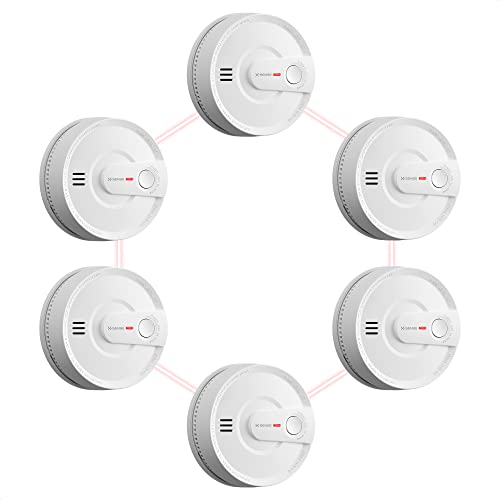
The SD20-W pack provides a 10-year life, minimizing maintenance interruptions in busy commercial settings. Its RF wireless linkage allows up to 24 alarms to form a protective network across a facility, ensuring rapid evacuation alerts even in large layouts. The detectors are battery powered, which simplifies retrofits in existing spaces where wiring is impractical. The pre-connected nature of the multi-pack means fewer on-site configuration steps, but adding devices should follow a planned topology to ensure optimal signal propagation and minimal interference with other RF devices on site.
In commercial deployments, the SD20-W’s long-range capability helps cover open-plan offices, retail floors, and storage areas. Consider pairing with compatible CO detectors or combination units where required by local codes. Regular battery checks and periodic RF network tests are recommended to maintain peak performance over the system’s lifespan.
AEGISLINK SC-RF200 Wireless Interlinked Smoke and CO Detector 6-Pack
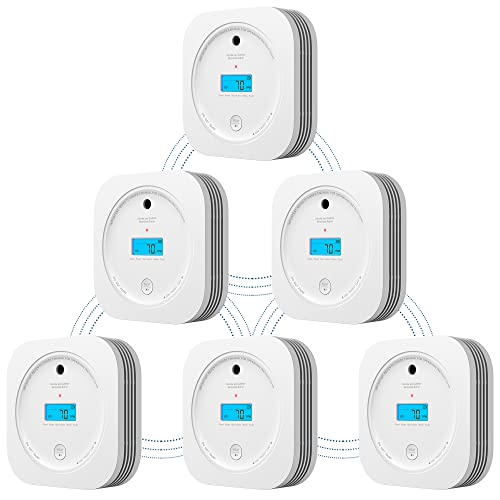
The SC-RF200 combines smoke and carbon monoxide detection in a single, battery-powered unit with wireless interlink. In a commercial setting, a six-pack enables coverage across multiple rooms or zones without running mains power to every detector. The wireless RF interconnection ensures unified notification when any unit detects smoke or CO, transmitting alarms through the network to other devices and, typically, to a central monitor if integrated with a control system. The 10-year sensor lifespan provides durable performance for long-term facilities management, though CO sensors often require more stringent regulatory compliance and testing schedules.
Considerations for deployment include mounting height, airflow patterns, and the presence of metal structures that could impact RF signals. AEGISLINK’s network can be expanded or reconfigured to adapt to changing floor plans, making it suitable for offices, schools, clinics, and light-industrial spaces seeking scalable wireless safety.
X-Sense XS01-WR Link+ Wireless Interconnected Smoke Detector (Pack of 6)

The XS01-WR Link+ emphasizes wide-area wireless interconnection, allowing up to 24 linked alarms within a network. Battery-powered operation supports rapid deployment in retrofit projects where electrical work is restricted. The product highlights an intelligent locating function to identify the fire source quickly, providing additional situational awareness for facility managers and occupants. While it lacks Wi-Fi, it fosters a robust radio network suitable for transportation hubs, multi-tenant offices, or educational spaces seeking a dependable, low-maintenance safety system.
Deployment tips include ensuring clear line-of-sight connections between devices and avoiding metal shelving or equipment that could degrade RF performance. The six-pack packaging is suitable for medium-sized facilities looking to cover corridors, common areas, and large rooms with a cohesive safety net. Regular testing and documentation are essential for regulatory compliance in commercial environments.
System Sensor P2RL Horn Strobe

The P2RL horn strobe is designed for professional-grade, commercial-grade installations requiring audible and visible notification capable devices. It supports plug-in back-box integration and has automatic operation mode selection for 12- or 24-volt systems, with field-selectable candela levels to tailor the light output for room size and occupant density. This unit is ideal for retrofit projects where an existing panel demands reliable signaling without replacing the entire system. Pairing with compatible notification appliances creates a compliant safety network suitable for schools, offices, and warehouses that require high-visibility alerts and robust performance under occupancy loads.
When integrating horn strobes in commercial spaces, consider the surrounding ambient noise levels, required clearance distances, and local fire codes. The P2RL’s flexibility makes it a strong choice for areas needing enhanced audible and visual warnings, such as large assembly areas, stairwells, and corridors, while maintaining compatibility with existing panels and wiring configurations.
Buying Guide: Key Considerations for Commercial Wireless Fire Alarm Systems
- Network topology and scale: Assess how many devices you need now and in the near future. Wireless interconnection is scalable, but plan for coverage gaps on multi-floor layouts and around metal obstructions.
- Power and maintenance: Battery-powered devices reduce wiring work but require battery checks and replacement planning. Hybrid options can balance reliability with flexibility.
- Regulatory compliance: Ensure the chosen devices meet local fire codes and standards for commercial properties. Consider integration with existing fire panels and annunciation systems.
- Signal reliability: Review RF range, interference risks, and device placement. For large or complex spaces, a base station or central hub can improve consistency across zones.
- Device types and capabilities: A mix of smoke, CO, and combo detectors, plus horn/strobe notification, may be required. Choose units with easy maintenance, clear signaling, and compatibility with monitoring apps or panels.
- Installation and expansion: Look for pre-connected packs and straightforward mounting options. Wireless systems should still allow for easy future expansion without re-wiring.
- Monitoring and response: Decide whether you will rely on standalone alarms, smartphone alerts, or integration with a central monitoring service for rapid response.
- Durability and lifespan: Prioritize detectors with long sensor life (10 years or similar) to reduce maintenance workload and ensure continuous protection.
This overview presents representative options for commercial environments, illustrating how wireless interconnection can support scalable safety networks. When selecting a system, balance initial installation simplicity with long-term reliability, regulatory compliance, and the ability to adapt to changing floor plans or occupancy needs.