Best Commercial Exhaust Hood Fans for Efficient Kitchen Ventilation
Direct, durable, and powerful exhaust fans are essential for keeping commercial kitchens safe and comfortable. This guide highlights top options suited for restaurant spaces, food trucks, and industrial-style setups. Each product is chosen for strong airflow, reliability, and suitability for grease-heavy environments. The following table provides a quick snapshot to compare key specs and intended buyers.
| Product | Best For | CFM | Power | ||
|---|---|---|---|---|---|
| Restaurant Canopy Hood Grease Rated Exhaust Fan | Small to mid-size restaurant stalls, upblast needs | 100–500 | 0.180 HP | 115V | High-speed, centrifugal, direct drive |
| Food Truck Low Profile Hood System (4FT Hood) | Mobile kitchens and compact setups | 1500–1700 | 0.25 HP | 110V | Grease-rated, rooftop/roof-mounted |
| Food Truck Low Profile Hood System (4FT Stainless Hood) | Same as above, stainless steel build | 1500–1700 | 0.25 HP | 110V | Grease-rated, corrosion resistant |
| Maxx Air Exhaust Fan | General ventilation with solid durability | Not specified | Not specified | Not specified | Efficient, low-maintenance |
| VEVOR Commercial Kitchen Exhaust Fan | Medium to large kitchens and warehouses | 1616 | 0.5 HP | 375W direct drive, 110V | High speed, low noise |
Restaurant Exhaust Canopy Upblast Fan

Best for small-to-medium dining operations that need a grease-rated, high-velocity exhaust option with direct-drive reliability.
Food Truck Hood System (4FT, Stainless)

Best for mobile kitchens with a need for a compact, grease-rated unit that can handle a rooftop or trailer setup while maintaining safe draft control.
Stainless 4FT Hood System With 0.25HP Fan
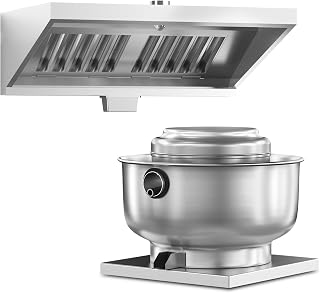
Best for kitchens needing a durable stainless steel build and a grease-rated exhaust with broad smoke capture coverage. Suitable for multi-stove layouts; avoid if you require extremely high CFM beyond the listed range.
Maxx Air Exhaust Fan

Best for budget-conscious buyers who want a reliable, no-frills exhaust solution with solid airflow. If you need precise CFM numbers, this option may require additional specification checks.
VEVOR Commercial Kitchen Exhaust Fan

Best for larger spaces or warehouses needing robust air movement and high-capacity ventilation with a focus on continuous operation. Consider space for duct routing and mounting weight.
Buying Guide
How do I choose the right exhaust fan for a commercial kitchen?
Assess required airflow (CFM) based on stove load, duct length, and local codes. Look for grease-rated housings, corrosion resistance, and electrical compatibility (voltage and single- or three-phase).
What features matter for grease-heavy environments?
Grease-rated seals, stainless steel construction, and a robust centrifugal or upblast design help resist buildup and simplify cleaning. Direct-drive motors reduce maintenance.
Should I prioritize mobile or fixed systems?
Mobile or low-profile hood systems fit food trucks or pop-up operations. Fixed installations suit cafes and full-size restaurants with dedicated ventilation ducts and ceilings.
What are common limitations to watch for?
Smaller CFMs may struggle with multiple-stove layouts. Some units may not list precise CFM—verify performance under your actual duct configuration. Noise and energy use are also practical considerations.
Installation considerations
Verify space for mounting, ensure proper duct routing, and confirm electrical supply matches motor requirements. Grease management and accessible access for cleaning are important for long-term performance.
FAQ
- What is a grease-rated exhaust fan? A fan designed to operate in kitchens where grease is present, with materials and seals that resist buildup and facilitate cleaning.
- Is stainless steel necessary for kitchen exhaust? Stainless steel offers corrosion resistance and durability, especially in high-heat, greasy environments, making it a preferred option in many commercial kitchens.
- How do I estimate the right CFM? Match CFM to the kitchen size, stove count, and the length/efficiency of the ductwork. Higher CFM provides stronger air removal but may increase noise and energy use.
- Can I install a hood system myself? Basic installations may be possible with electrical and ducting knowledge, but professional installation is recommended to meet code requirements and ensure safe operation.
- What maintenance is required? Regular grease filtration and periodic inspection of seals and fan housings help maintain performance and reduce fire risk.
- Are there limits to how much airflow I need? Yes. Oversized fans can create excessive noise and draft issues; undersized fans may fail to remove smoke effectively. Use manufacturer guidelines and, if possible, a ventilation professional.