Best Commercial Electric Air Compressors for Pro Workflows and Workshops
When selecting a commercial-grade electric air compressor, buyers typically prioritize capacity, duty cycle, noise level, and reliability. This guide highlights five top options designed for professional shop environments, automotive shops, and small industrial settings. Each model is evaluated for who benefits most, practical limitations, and how it compares to similar units. The result is a clear, research-based reference to help buyers choose the right compressor for frequent, demanding use.
Overview of selected products (at a glance):
| Product | Tank / Capacity | Best For | Key Advantage |
|---|---|---|---|
| Klutch 60-Gallon Single-Stage Vertical | 60 gal | Professional shops needing high airflow | High CFM at 90 PSI; rugged cast-iron pump |
| DEWALT 60-Gallon Stationary | 60 gal | Tradesmen and industrial users | High SCFM at multiple pressures; low noise |
| California Air Tools 20-Gallon Ultra Quiet | 20 gal | Quiet work environments | Ultra quiet, oil-free operation |
| DEWALT Pancake 6-Gallon | 6 gal | Mobile shops and on-site jobs | Lightweight, quick recovery, quiet |
| VEVOR 13-Gallon, 2HP | 13 gal | Small to medium tasks, garage setups | Quiet operation and portable |
Klutch 60-Gallon Single-Stage Vertical Air Compressor
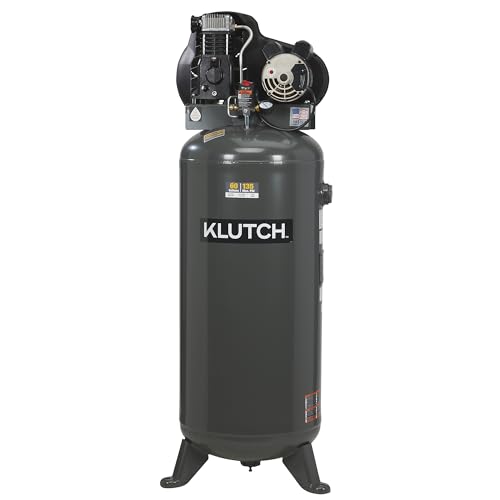
The Klutch 60-Gallon unit uses a 3.7 HP dual-induction motor and delivers 9.3 CFM at 90 PSI with a maximum of 135 PSI. Its oil-lubricated cast iron single-stage pump, stainless valves, and balanced crankshaft are designed to withstand heavy, continuous use in shop environments. This model is best for professional shops that require consistent airflow for automotive tools, spray painting, and mid-sized pneumatic equipment. A potential limitation is the heavier weight and larger footprint, which may require a dedicated space and adequate ventilation.
- Best for high-demand professional shops needing reliable airflow.
- Better for continuous use over long work sessions.
DEWALT 60 Gallon Stationary Vertical Air Compressor
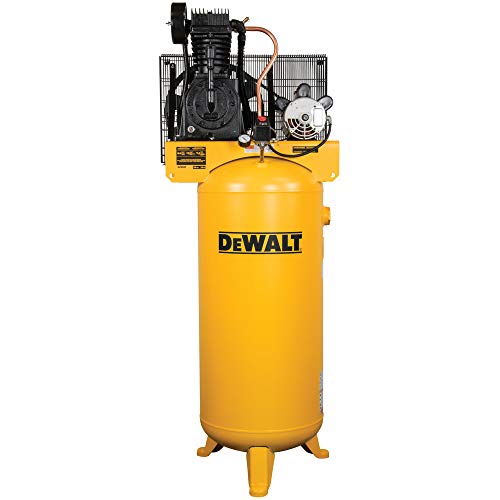
This DEWALT model offers 13.5 SCFM at 175 PSI and 15.3 SCFM at 100 PSI, with a 5 HP motor and oil-lubed operation. It includes thermal overload protection and a quiet 65 dB operation level, making it suitable for workshops that require robust output but still need a quieter environment. It’s a solid pick for tradespeople who run high-demand tools for extended periods. A possible limitation is its larger electrical demand, so ensure circuit capacity and space are suitable.
- Best for tradesmen needing strong high-pressure performance.
- Choose this if noise reduction is a priority alongside power.
California Air Tools 20020 20-Gallon Ultra Quiet

The California Air Tools 20020 emphasizes ultra-quiet operation at 70 dB with a 2.0 HP motor and a 20-gallon tank. Its oil-free dual-piston pump provides lower maintenance and a long service life. Best for quiet environments such as shared workshops or home garages that still need reliable air for finishing tools, spray work, or light automotive tasks. The trade-off is a smaller tank versus larger industrial units, which means more frequent cycling under heavy workloads.
- Best for noise-sensitive settings without sacrificing performance.
- Better for lighter commercial tasks or intermittent use.
AEOLUS A Ultra Quiet 2.4 Gallon Tank

Despite its compact size, AEOLUS A offers 115 PSI with a 2.4-gallon tank. It operates quietly at 65 dB and includes quick couplers for fast tool changes. This unit suits mobile operations, small garages, or jobsites that require portable, low-noise pneumatic power for nail guns or light air tools. A limitation is its small tank capacity, which can require frequent recharges under heavier workloads.
- Best for portable, low-noise tasks and light-duty work.
- Avoid this if you need extended tool runtimes for heavy air tools.
CARSUN AC/DC Tire Inflator Portable Air Compressor

The CARSUN unit offers dual power options (AC and 12V DC) and is portable for inflating tires and other inflatables. It features an auto-shutoff with preset pressure modes for cars, bikes, and balls. While ideal for quick, on-the-go tasks, it is not designed to replace a dedicated shop compressor for continuous, heavy-duty air demands.
- Best for on-site tire inflation and quick inflations away from a shop.
- Choose this if you need portability over full-time shop performance.
Bostitch 6-Gallon Pancake And Accessory Kit

The Bostitch package combines a 6-gallon pancake compressor with a 13-piece accessory kit. It delivers up to 150 PSI with 2.6 CFM at 90 PSI, featuring an oil-free pump and a high-flow regulator for better air tool performance. Best for finish carpentry, blow-drying, and portable shop tasks where light-to-moderate air needs are frequent. It may not sustain longer heavy-duty air runs compared to larger stationary units.
- Best for portable, versatile small-shop setups.
- Better for tasks where mobility and a broad accessory kit are valued; avoid for sustained heavy-duty tooling.
Buying Guide: Key Considerations For Commercial Electric Air Compressors
- Tank size and CFM: Match airflow (CFM at your typical operating PSI) to the tools you run. Larger tanks reduce cycling, but require more space.
- Duty cycle: Look for units rated for continuous or high-duty use in professional environments. Higher duty cycles translate to longer operation without overheating.
- Electrical requirements: Ensure outlet amperage and circuit capacity align with motor horsepower (e.g., 5 HP at 230V for steady performance without tripping breakers).
- Noise level: For shared workshops or noise-sensitive environments, prioritize units around 65 dB or lower when possible.
- Maintenance profile: Oil-lubed pumps have longer life but require oil checks; oil-free models reduce maintenance but may have different durability profiles.
- Portability vs. stationary use: Mobile units are convenient for small jobs; stationary units offer higher capacity and stability for shop workflows.
- Space and installation: Consider footprint, ventilation, and mounting needs for larger 60-gallon or bigger units.
Frequently Asked Questions
- What size compressor is best for a commercial workshop?
– For high-demand tools and longer runs, 60-gallon units with 9–14 CFM at typical working pressures are common; larger shops may need more than one unit or industrial compressors. - Is oil-lubricated always better than oil-free?
– Oil-lubed pumps typically offer greater durability for continuous use, while oil-free pumps require less maintenance but may have shorter lifespans under heavy workloads. - Should I choose a mobile pancake unit or a stationary vertical tank?
– Pancake units are ideal for portability and light-to-mid tasks; stationary vertical tanks suit continuous, heavy-duty shop work. - How important is noise level in a workshop?
– Very important in shared spaces or residential-adjacent shops; aim for 65 dB or lower if possible. - Can I run spray painting off a standard compressor?
– Yes, if the compressor provides steady CFM at the required PSI; ensure a suitable regulator and adequate duty cycle for spray tasks.