Best Combustible Gas Indicator (CGI) Options for Home and Work Safety
Answering the question, “Which combustible gas indicator should I choose?” this guide highlights five dependable CGIs that help detect natural gas, propane, methane, and other combustibles quickly and clearly. These devices are best for homeowners, handy professionals, RV owners, and anyone needing rapid leak localization in tight spaces. The top picks emphasize easy warm-up, clear alarms, and practical form factors for hard-to-reach areas.
| Product | Best For | Key Benefit | Limitations |
|---|---|---|---|
| TOPTES PT199 Natural Gas Leak Detector | Homeowners, renters, quick leak sniffing | Fast visual and audible alarms with red LCD on high readings | Requires 2x AAA batteries |
| UEi CD100A Combustible Gas Leak Detector | HVAC pros and DIYers needing flexible reach | 18″ flexible gooseneck for hard-to-reach spots | May be more suited to pro use due to features |
| TOPTES PT210S Gas Leak Detector | Probing narrow spaces, detailed readings | Percent LEL readout with 4″ probe and audible/visual alarms | Requires calibration and proper use to interpret readings |
| Aicevoos Natural Gas Detector | Indoors and outdoors with flexible access | Gas concentration display with flexible gooseneck | Warm-up time needed in some conditions |
| Inficon Combustible Gas Detector | Industrial or detailed testing scenarios | Established brand for gas detection instruments | Basic spec list; may require professional use context |
TOPTES PT199 Natural Gas Leak Detector
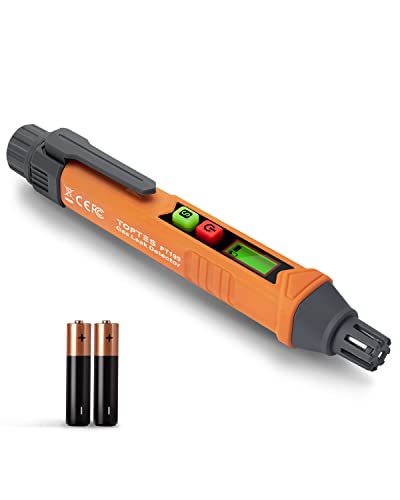
The PT199 detects natural gas, methane, propane, butane, LPG, and related combustibles. It pinpoints leaks to reduce explosion risk and protect property. Visual and audio alarms activate within 0.5 seconds, with a red LCD screen when readings rise. The device ships with two AAA batteries and has a 30-second warm-up. A low battery indicator signals when power is near depletion, and it auto-powers off after five minutes of inactivity.
Best for: households needing a simple, fast, and portable leak detector for everyday safety. It’s also suitable for quick on-the-spot checks around kitchen stoves, furnaces, and gas lines. Caution: the device relies on battery power; replace batteries as needed for reliable operation.
UEi CD100A Combustible Gas Leak Detector

The UEi CD100A offers broad gas detection including acetone, ammonia, butane, methane, natural gas, LPG, and jet fuel. It features a long 18″ flexible gooseneck to access tight spaces, and it provides audio and visual cues when a leak is detected. This tool is well-suited for homeowners performing HVAC checks or professionals needing reach into confined areas.
Best for: those who need a versatile detector with a long reach for challenging locations. Better for: use in more complex settings where precision and reach matter. Caution: ensure proper calibration and follow safety guidelines when interpreting readings in busy environments.
TOPTES PT210S Gas Leak Detector

The PT210S provides a four-inch probe and displays readings in Percent LEL (Lower Explosive Limit). It produces fast alarms and shows a red screen with rising bar graphs as gas concentration increases. Detection range spans 100 ppm to 5,000 ppm (1% LEL to 10% LEL). It’s designed for swift identification of leaks in hard-to-reach areas.
Best for: users needing quantified LEL readings and a compact probe for precise localization. Choose this if you require a single device to gauge leak severity over simple presence/absence. Caution: readings depend on ambient conditions and probe placement; interpret results with context.
Inficon Combustible Gas Detector

Inficon is a recognized name in gas detection. The Inficon detector listed here focuses on general combustible gas detection with basic specifications. It’s suitable for professionals and technicians who rely on established instrument brands for routine checks and calibrations in residential or light commercial settings.
Best for: users seeking a trusted brand with tested design for various gas types. Caution: product details are limited in this listing; verify specific sensor capabilities and calibration requirements before use in more demanding environments.
Buying Guide: How to Choose the Right Combustible Gas Indicator
What gas types will you monitor? If you mostly want natural gas, propane, or methane in a home setting, a detector with broad combustible gas sensing and quick alarms is ideal. For professional HVAC work or RV use, prioritize long reach, precise readings in Percent LEL, and a robust probe.
Key purchase considerations
- Gas detection range and units: Look for LEL-based readings when you need quantitative leak severity, or simple present/absent alarms for quick checks.
- Response time and alarms: A device that alarms within seconds helps you act fast and minimize risk.
- Probe length and accessibility: Long goosenecks or detachable probes improve access to tight spaces like behind appliances or in machinery.
- Power and battery life: Battery-powered detectors should offer clear indicators and a reliable auto-off feature to conserve power.
- Ease of use and maintenance: Choose models with straightforward operation, clear displays, and easy battery changes or calibration.
- Portability and form factor: Handheld units are convenient for quick checks; larger detectors may offer more features but are less portable.
- Brand and support: Reputable brands often provide clearer documentation and more reliable service options.
How to use a CGI safely and effectively
- Read the manual to understand sensor warm-up times and safe handling practices.
- Test detectors away from active gas sources to verify baseline readings.
- Scan from low to high areas, as gas may rise or pool near ceilings in certain environments.
- Replace batteries promptly when indicated and store detectors in a ready-to-use state.
- Keep detectors clean and free of dust or moisture that could affect sensor performance.
Frequently asked questions
- What is a combustible gas indicator? A CGI is a handheld device that detects the presence of flammable gases such as natural gas, propane, and methane and provides alarms to help prevent explosions.
- Can I use a CGI for every家庭 gas leak? Yes, for routine safety checks around kitchens, furnaces, grills, or RVs, CGIs offer quick leak localization and confirmation.
- What should I do if the detector indicates a leak? Evacuate if necessary, ventilate the space, and call your gas utility or emergency services according to local guidelines.
- Do CGIs require calibration? Some models may require periodic calibration or sensor replacement. Refer to the manual for maintenance guidance.
- Are there detectors with color-coded alarms? Many CGIs use audible alarms and LCD indicators that shift to red at higher concentrations for quick visual interpretation.
- Is a longer probe always better? Longer probes help reach difficult areas, but balance with portability and battery life for your use case.