Best Combination Arc Fault GFCI Breakers for Safer Home Electrical Systems
Answers to common buyer questions begin with choosing the right combination arc fault circuit interrupter (AFCI) and GFCI breaker. These units detect arc faults and ground faults while providing branch protection. The top picks below are best for different setups: homeowners seeking straightforward plug-on or plug-in installation, electricians prioritizing neutral handling and gutter space, and those needing dual-function protection for ongoing electrical safety. A quick summary table follows to compare essentials at a glance.
| Product | Amperage | Pole Type | Function | |
|---|---|---|---|---|
| Siemens QA120AFC | 20A | Single Pole | AFCI | Simple AFCI protection with LED trip indicators |
| Square D HOM120PDFC | 20A | Single Pole | CAFCI/GFCI | Plug-on-neutral design for faster installations |
| ABB THQL1120AFP2 | 20A | Single Pole | AFCI | Advanced arc fault protection, robust build |
| Murray MPA115AFC | 15A | Single Pole | AFCI | Budget-friendly AFCI option |
| ABB THQL1120DFP | 20A | Single Pole | AFCI/GFCI | Dual-function protection for fire and ground faults |
Siemens QA120AFC 20-Amp AFCI Breaker
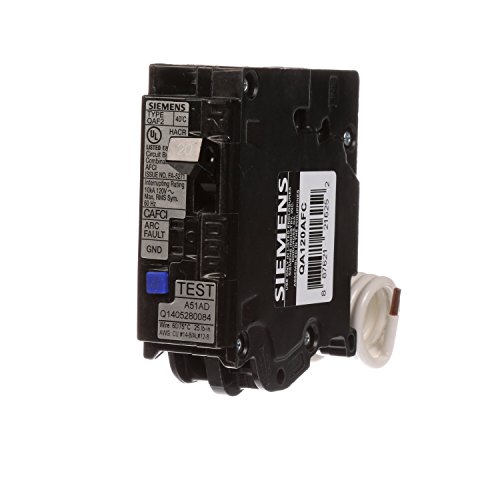
Best for straightforward AFCI protection in a standard panel. This single-pole, 20-amp unit uses a combination AFCI mechanism and includes LED trip indicators to clearly identify the last trip condition. It offers 1/4 inch more wire bend space than earlier designs, which can ease installation in tight panels. Choose this if you want a reliable AFCI that is easy to wire and read during trips. A potential limitation is its single-function focus if you need dual protection in one device.
Square D HOM120PDFC Homeline 20A CAFCI/GFCI

Better for applications needing both arc and ground fault protection in one device. This plug-on-neutral dual-function breaker reduces extra neutral connections and eliminates pigtails, potentially speeding up installation. Best for Homeline series 4 and newer load centers. Avoid this if your panel isn’t compatible or if you require non-neutral configurations, as compatibility is key for proper operation.
ABB THQL1120AFP2 20A AFCI Breaker
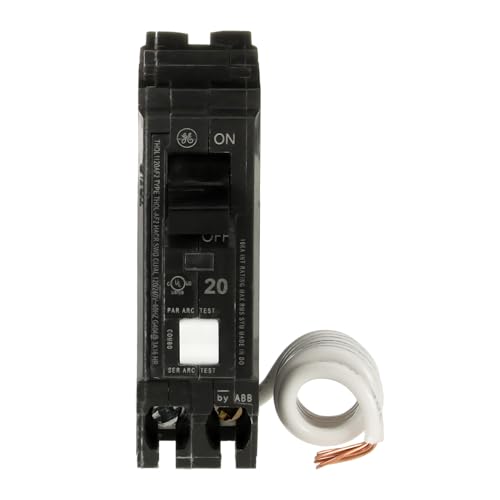
Best for high-safety needs with advanced arc fault protection. The THQL1120AFP2 is designed to mitigate arc faults with a robust build and straightforward installation, suitable for both residential and commercial systems. Best for users seeking durable protection and clear performance characteristics. Limitation to watch: ensure panel compatibility with ABB Q-Line styling and plug-in format for correct fit.
Schneider Electric HOM115PDFC 15A CAFCI/GFCI

Choose this if you need 15-amp dual-function protection in a Homeline setup. It features a neutral connection design aimed at reducing wiring complexity and speeding installation. Best for smaller branch circuits or load centers that require lighter protection. Limitations include lower amperage than 20A units, which may constrain larger branch circuits or higher-demand circuits.
Siemens Q120DF 20A AFCI/GFCI

Best for integrated protection with a plug-in load center style. Its combined AFCI and GFCI features help address both arc faults and ground faults, which is useful in spaces with increased moisture or where code requires dual protection. Consider this if your panel supports UL type QFGA2 breakers; if not, look for compatible Siemens models.
Square D QO 15A CAFCI/GFCI

Best for smaller circuits or limited-spaces where 15A protection is sufficient. This device provides arc fault and ground fault protection in a compact form factor suitable for QO style panels. Use this if your circuit demands 15A and you need quick-compatible replacement in a QO panel. A limitation is the lower amperage for larger loads.
Buying Guide
What to consider when selecting a combination AFCI/GFCI breaker:
- Panel compatibility: Verify that the breaker type matches your load center brand and series. Mismatched plug-in styles can prevent proper operation.
- Amperage needs: Match the breaker to the circuit wire size and load requirements. Higher-amp circuits may require 20A units.
- Function: Decide between AFCI only, CAFCI/GFCI, or AFCI/GFCI depending on branch protection needs and local code requirements.
- Neutral handling: Some models offer plug-on-neutral or no-pigtail designs that can simplify wiring in tight spaces.
- Installation ease: Neutral connections, labeling, and space for wire bends affect install time and reliability.
- Durability and build quality: Look for breakers with robust housings and clear indicators to aid maintenance and troubleshooting.
Frequently Asked Questions
- What is a CAFCI/GFCI breaker? A dual-function device that protects against arc faults (CAFCI) and ground faults (GFCI) on a single pole or multi-pole circuit.
- Which breaker should I choose for an older panel? Check compatibility with your panel’s model and the manufacturer’s recommendations for AFCI/GFCI breakers.
- Do all panels support plug-on-neutral breakers? Not all do; verify neutral connection design for your specific panel type.
- Is a 15A CAFCI/GFCI sufficient for most circuits? Many lighting and small appliance circuits use 15A; larger outlets and appliances may require 20A.
- Do I need both AFCI and GFCI in every room? It depends on local electrical codes and the room’s usage. Some spaces require both functions in a single device.
- What maintenance is needed for AFCI/GFCI breakers? Routine checks for trip history and visual inspection of wiring connections are advisable.