Best Cold Weather 100-Ft Extension Cords for Outdoor Use
Answer: When shopping for a 100-foot extension cord designed for cold weather, choose a model with 12 or 14 gauge conductors, ETL or cETL safety certification, IP65 weather resistance, and a visible, durable jacket. These features help ensure flexibility in freezing conditions, safer operation, and longer service life. This guide highlights five top options, each suited for outdoor projects, construction, or home improvement in colder climates.
Buyer profiles at a glance:
- Best overall: Balanced gauge, visibility, and weather resistance for professionals and serious DIYers.
- Best for outdoor heavy-duty use: Higher amp capacity with robust construction for tools and power equipment.
- Best for flexible storage and regular movement: Notable pliability and easy unwinding for frequent repositioning.
- Best value: Solid protection and safety features at a more affordable price point.
- Best for visibility and safety: Bright yellow jackets to reduce tripping and enhance line-of-sight.
| Product | |||
|---|---|---|---|
| HUANCHAIN 100 ft 14/3 | 14 AWG, 13A, 125V | IP65, -50°C cold resistant | Heavy-duty outdoor tasks |
| POWGRN 100 ft 12/3 | 12 AWG, 15A, 125V | IP65, -58°F flexible | Heavy equipment and long runs |
| Skrizcable 16/3 100 ft | 16 AWG, 10A, 125V | IP65, ETL Listed | Light to medium-duty outdoor use |
| HUANCHAIN 12/3 100 ft | 12 AWG, 15A, 125V | IP65, -50°C | Wide-range outdoor power needs |
| Deeklify 12 Gauge 100 ft Black | 12 AWG, 15A, 125V | IP65, ETL Listed | Budget-friendly heavy-duty use |
HUANCHAIN 100 ft 14/3 Gauge Heavy Duty Outdoor Cord

Best for: Professionals and DIYers needing a robust 14-gauge cord for heavy tools. Why: It handles up to 13A and 1625W, with ETL listing and a flame-resistant jacket. The yellow jacket improves visibility to reduce trips in dim work areas. Limitation: 14 AWG is less ideal for very high-current tools over long distances compared to 12 AWG options.
POWGRN 100 ft 12/3 Outdoor Extension Cord

Best for: Projects requiring longer runs and higher power. Why: 12/3 with 12 AWG supports up to 15A and 1875W, plus an LED end indicator for safety. It’s IP65 waterproof and remains flexible in cold weather. Caution: Heavier gauge cords can be tougher to coil and store in tight spaces.
Skrizcable 16/3 100 Ft Outdoor Cord

Best for: Lighter outdoor tasks or where storage flexibility matters. Why: 16 AWG is lighter and more flexible, suitable for string lights, small tools, or lawn equipment. Limitation: Lower current capacity (10A) means less headroom for power-hungry tools compared with heavier gauges.
HUANCHAIN 12/3 Gauge 100 ft Cord

Best for: Heavy outdoor power needs with a balance of flexibility and current capacity. Why: 12 AWG supports 15A and 1875W, with a bright yellow jacket for visibility and a protective design that withstands cold weather. Limitation: Slightly heavier than 16 AWG cords, which may affect portability for some users.
Deeklify 12 Gauge 100 Ft Black Cord
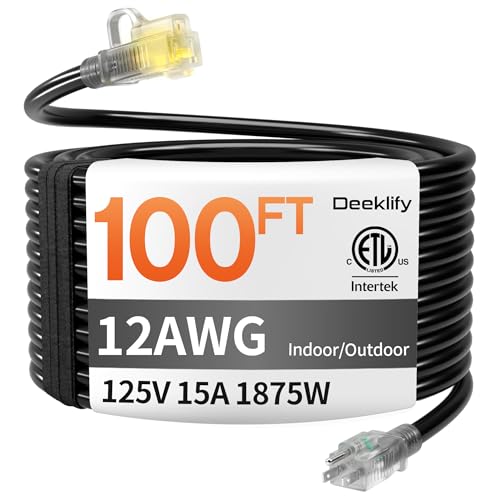
Best for: Budget-conscious buyers needing reliable outdoor power. Why: 12 AWG, 15A, 125V with ETL listing and IP65 protection, plus durable copper conductors. Practical limitation: Some listings note potential minor length tolerance due to manufacturing, so plan for slight variation in actual length.
Buying Guide
What to consider when choosing a 100-foot cold-weather extension cord:
- Gauge and capacity: Higher gauge (e.g., 12 AWG) supports more load over long distances, especially in cold temps where resistance increases.
- Certifications and safety: ETL or cETL listings indicate compliance with safety standards and consistent manufacturing quality.
- Weatherproof rating: Look for IP65 or higher, flame resistance, and cold resistance to ensure performance in snow, rain, and low temperatures.
- Visibility: Bright yellow jackets improve safety and reduce trip hazards in outdoor work zones.
- Flexibility in cold weather: Cords rated for low temperatures stay pliable, reducing kinking and tangling when deployed in winter.
- Durability and strain relief: A robust plug and socket design with strain relief extends service life in hard-working outdoor environments.
- Length and energy needs: 100 ft may require careful planning to minimize voltage drop for high-wattage tools; when in doubt, choose a heavier gauge.
FAQ
- Q: Is 12 AWG better than 14 AWG for 100 ft in cold weather? A: Yes, 12 AWG generally carries more current with less voltage drop over 100 ft, making it more suitable for high-wattage tools in cold conditions.
- Q: Do these cords work with standard outdoor tools? A: Yes, most have NEMA 5-15P connectors compatible with common household outlets and tools.
- Q: What does IP65 mean for outdoor cords? A: IP65 indicates protection against water jets and dust, useful for wet or dusty outdoor work.
- Q: How important is a lighted end? A: A lighted end helps confirm power status and improves safety when working in dim areas.
- Q: Can I coil and store these cords after use in winter? A: Yes, many cords are designed for easy re-coiling, but ensure they are fully dry before storage.
- Q: Are there any safety practices I should follow? A: Keep cords off hot surfaces, avoid pinching near plugs, and inspect for wear before each use.