Best Clamp on Energy Monitor Solutions for Smart Homes
Looking to track real-time electricity use with a clamp-on meter? This guide highlights five top clamp-on energy monitors that suit different households. Choose based on installation needs, privacy, solar integration, and smart-home compatibility. Whether you’re a DIYer upgrading a panel, a solar homeowner optimizing self-consumption, or a smart-home enthusiast seeking local control, these options offer reliable data and practical features. The table below compares core capabilities to help you decide quickly before reading detailed notes on each product.
| Product | Best For | Key Benefit |
|---|---|---|
| 2 Pieces AC Current Voltage Amperage Power Energy Panel Meter (MORNING GROUP) | DIY install in basic panels | Split-core CT for easy install; multifunction readouts |
| Refoss Smart Home Energy Monitor | Privacy-conscious smart-home users | Local control via web UI and MQTT; open API |
| Emporia Vue 3 Home Energy Monitor | UL-certified safety with scalable setups | Single/three-phase support; robust automation options |
| Shelly EM Gen3 + 50A Clamp | Compact, behind-socket installs | Wi-Fi, local data logging, and appliance-level insights |
| eMylo 2 Channel WiFi Power Meter | Budget-friendly dual-channel monitoring | Real-time power metrics with Tuya/Smart Life integration |
2 Pieces AC Current Voltage Amperage Power Energy Panel Meter

This meter uses a split-core current transformer for straightforward installation and displays voltage, current, active power, energy, frequency, and power factor simultaneously. It includes an overload alarm with backlight flashing when preset limits are exceeded, and it stores last test data after outages. Best for practical, budget-conscious users who want a multifunction display without cloud requirements. Limitations include the need for physical access to the panel for installation and a reliance on the included CT for accurate readings.
Refoss Smart Home Energy Monitor

Refoss emphasizes local control and privacy with a built-in Web UI, Open API, and MQTT that work without cloud services. It integrates with Home Assistant and OpenClaw AI for automation, and is designed to optimize solar usage and self-consumption. Best for households prioritizing data ownership and offline operation. A potential limitation is that advanced AI features may require familiarization with local-network setup and software components.
Emporia Vue 3 Home Energy Monitor
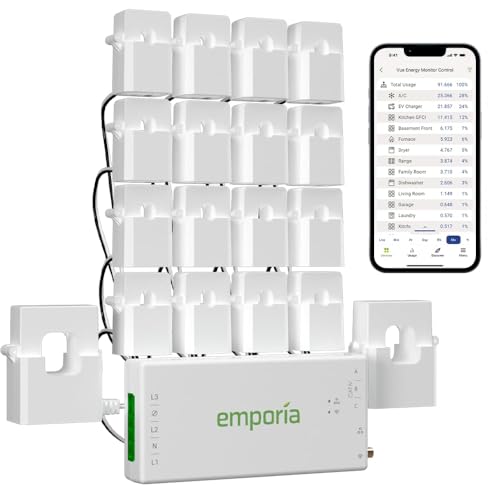
Emporia Vue 3 is UL Listed, offering strong safety assurance for U.S. and Canada installations. It supports single-phase, split-phase, and various 3-wire/3-phase configurations (with an optional 200A sensor). It provides continuous energy management and solar/net metering monitoring, with a 1-year warranty. Best for safety-conscious buyers who want scalable, long-term energy management in typical home panels. Limitations include the need for an additional sensor for full three-phase setups in larger homes.
Shelly EM Gen3 + 50A Clamp

Shelly EM Gen3 is a compact, Wi-Fi-enabled energy meter with two channels and a 50 A clamp included. It supports real-time energy tracking and can connect to Home Assistant, Alexa, and Google Home. It also features local data logging and a built-in relay for load control. Best for tight spaces and users who want direct cloud-free control when possible. A drawback is that some advanced automation may require additional Shelly devices for full functionality.
eMylo 2 Channel WiFi Power Meter

eMylo offers a budget-friendly two-channel monitor with 0.2 A to 80 A current range and 100–240 V AC compatibility. It provides real-time monitoring of voltage, current, power, and frequency, and supports Tuya/Smart Life app integration for automation. Best for cost-conscious buyers who want basic dual-channel monitoring and smart-home compatibility. A limitation is that it may offer fewer advanced features or professional-grade safety assurances compared with UL-listed models.
Buying Guide
What should you consider when choosing a clamp-on energy monitor? Here are practical questions to guide your decision:
- Do you need local control or cloud connectivity? If privacy and offline operation matter, prioritize models like Refoss with local UI and MQTT.
- How many circuits or phases must you monitor? For single-phase homes, most models work well; for larger or three-phase systems, look for additional sensors or higher current ratings.
- Is installation space a constraint? Compact units with detachable CTs or behind-socket designs are easier to fit into tight panels.
- Do you want solar optimization features? Look for monitors that support net metering or auto-load shifting to maximize solar self-consumption.
- What level of safety certification is needed? UL certification provides strong safety assurances for US/Canada installations.
- What kind of integrations do you require? If you use Home Assistant, MQTT, or Tuya/Smart Life ecosystems, verify compatibility and available APIs.
FAQ
- What is a clamp-on energy monitor? It measures electrical parameters by clamping a sensor around a conductor without breaking the circuit.
- Can these monitors work with solar power systems? Yes, several models support solar net metering and bi-directional energy tracking.
- Do these require internet access? Some offer local control only, while others provide cloud or app-based features; choose based on your privacy and access needs.
- Are these safe to install in a typical home panel? Most models are designed for standard residential panels, but ensure you follow installation instructions and safety guidelines.
- What is the difference between single-phase and three-phase monitoring? Single-phase monitors track one hot conductor; three-phase monitors require sensors and configurations to measure all phases.
- Will these replace a professional electrical audit? They provide continuous data but should not replace professional inspection when addressing complex or dangerous electrical issues.