Best Clamp-on Current Probes for Precise Electrical Measurements
This guide highlights five clamp-on current probes and related devices ideal for professionals and serious hobbyists. If you need accurate current readings in motor drives, power electronics, or industrial equipment, these options cover a wide range of currents, bandwidths, and interfacing with multimeters or oscilloscopes. The selections emphasize clear measurement ranges, practical output formats, and ease of use for targeted tasks, from DC to high-frequency AC signals.
Buyer intent summary table (selected products at a glance):
| Product | Best For | Key Benefit |
|---|---|---|
| Hantek CC-65 AC/DC Clamp Meter | DC and AC current measurement with BNC access | Wide DC/AC range up to 65 A with BNC output |
| Goupchn CC100 Clamp Probe | High-current and cascading measurements | Two ranges (10 A / 100 A) with cascade support |
| BTMETER BT-605A | High-current, DMM compatibility | 600 A clamp for deep current measurements |
| Hantek CC-650 Oscilloscope Clamp | Scope-based current waveform capture | AC/DC clamp with scope-friendly output |
| Fluke i410 Clamp | Reliable high-quality readings with DMM integration | Up to 200 A AC with simple generation of readings |
Hantek CC-65 AC/DC Multimeter Current Clamp Meter

The Hantek CC-65 is designed for power circuit measurements and malfunction analysis. It supports AC/DC measurements with a BNC connector for oscilloscope-based waveform analysis. It is best for professionals evaluating motor drives, frequency converters, and other electronics where quick access to current alongside waveform data is valuable. A potential limitation is the need for compatible BNC-equipped equipment to maximize waveform visibility. The device provides straightforward interpretation of current in standard test setups.
Hantek CC-65 AC/DC Current Clamp Meter Transducer

This oscilloscope-friendly current probe is ideal for digital multimeter users who need accurate circuit measurements and direct oscilloscope integration. It supports a frequency range up to 20 kHz and handles 20 mA to 65 A DC. Choose this if you’re coupling with a DSO for dynamic current analysis. A caveat is that performance is tied to the oscilloscope’s bandwidth and probe calibration, so ensure compatibility and proper setup for best results.
Goupchn CC100 Clamp Probe

The CC100 offers two switchable ranges: 10 A and 100 A, with voltage outputs aligned to 1 V per A and 0.1 V per A. This arrangement enables precise measurements across a wide span while maintaining simple signal interpretation. It supports cascading multiple units for synchronized measurements, which is helpful in motor drives and three-phase systems. Best for: scalable, higher-current testing with minimal cabling. Caution: cascading requires a common power source, and unit-to-unit synchronization should be verified before critical measurements.
BTMETER BT-605A AC/DC 600A Clamp-on Probe
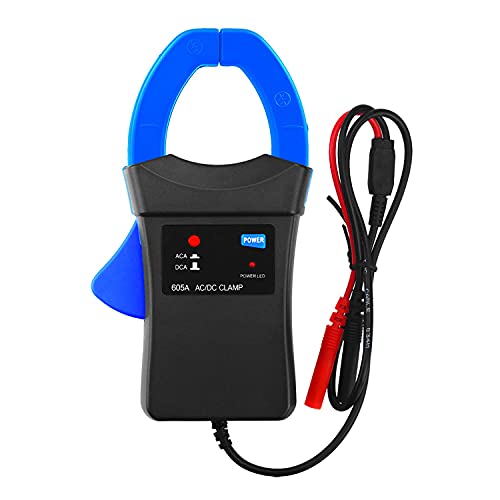
The BT-605A is designed for higher current measurement up to 600 A and is a strong companion for select BT- meter digital multimeters. It outputs a straightforward mV per amp signal, with an accuracy target around ±3.0% + 10. This probe is best for electricians and technicians working with heavy DC and AC circuits. Limitation: when used with non-BT meters, you’ll need to convert to the meter’s mV range to read current accurately, which adds a setup step.
Hantek CC-650 Oscilloscope Clamp

The CC-650 is a current clamp designed for oscilloscope use, offering a 400 Hz bandwidth and dual sensitivity settings (1 mV/A and 10 mV/A). It serves as a versatile transducer to enable both current measurements on meters and current waveform capture on oscilloscopes. Best for: users who need to observe dynamic current changes in low- to mid-frequency signals. A potential limitation is its lower bandwidth compared to high-speed probes, which may affect very fast transients.
Fluke i410 AC/DC Current Clamp

The Fluke i410 is a reliable clamp for measuring up to 200 A AC and delivering easy interpretation with a 1 mA per amp output suited for DMM integration. It’s designed to measure current while keeping the circuit intact, offering a safe and efficient workflow. Best for: users who prioritize dependable readings and quick DMM interfacing. Limitation: while robust, it may be priced higher than entry-level probes and could be overkill for very small current measurements.
Buying Guide: Key Considerations for Clamp-On Probes
- Current range and duty cycle: Choose a probe that covers your typical current range, with a safe margin above your maximum expected readings.
- Output interface: Decide between direct oscilloscope input, DMM-compatible mV outputs, or both. BNC outputs enable direct scope use, while mV outputs suit DMMs.
- Bandwidth and frequency response: Higher bandwidth captures fast transients; lower bandwidth suffices for steady-state measurements.
- Cascading and synchronization: If you monitor three-phase systems or motor drives, cascading units can simplify setup but verify power requirements and synchronization.
- Accuracy and calibration: Look for specified DC accuracy and linearity. Regular calibration improves long-term reliability.
- Physical design and usability: D-shaped jaws, easy clamping, and clear labeling reduce measurement errors in tight spaces.
- Compatibility with instruments: Confirm whether the probe is designed for use with your oscilloscope or DMM brand to avoid interface issues.
Frequently Asked Questions
- What is a clamp-on current probe and when is it useful?
A clamp-on current probe measures current without breaking the circuit, using a clamp around a conductor. It’s useful for diagnosing electrical loads, motor drives, and power electronics in live systems.
- Can clamp probes measure both AC and DC currents?
Many models support AC and DC measurements, but always check the current range and bandwidth for your specific use-case to ensure accuracy.
- How do I choose between a high-bandwidth probe and a high-current probe?
High-bandwidth probes excel at capturing fast transients, while high-current probes handle larger currents. For waveform analysis of motors or inverters, balance both needs.
- Is cascading multiple probes always beneficial?
Cascading can synchronize measurements across multiple channels, reducing wiring complexity. Ensure your setup supports cascading power and data sharing.
- What precautions ensure accurate readings?
Calibrate regularly, use proper jaw placement, and verify probe compatibility with your measurement instruments to avoid signal distortion.