Best Cheap Grid Tie Inverter Options for Solar Fans, DIYers, and Small Installations
If you’re searching for affordable grid-tie inverters, you want devices that reliably convert DC from solar panels into AC that can feed the grid or a home circuit. This guide highlights 5 budget-friendly grid tie inverters, focusing on size, MPPT efficiency, and suitability for common solar setups. Each option is chosen for value, stability, and clear data to help you compare. Ideal buyers include DIY homeowners installing a small solar array, hobbyists testing off-grid ideas, and apartment users looking to back up energy without hefty upfront costs.
Summary table of chosen products (quick reference):
- YINZINR 1000W Grid Tie Inverter, 10.8-32V DC Input, 110V AC Output — Best for small 12–24V solar builds
- YINZINR 1000W Grid Tie Inverter, 20-50V DC to 90-140V AC — Best for mid-range 36V panels
- Y&H 1000W Grid Tie Inverter Power Limiter — Best for constrained loads with limiter feature
- Lumicasaler 1000W Solar Micro Inverter Grid Tie — Best for compact spaces and IP65 outdoor use
- Aiwewin 800W Solar Grid Tie Micro Inverter — Best price-per-Watt with dual MPPT option
YINZINR 1000W Grid Tie Inverter, 10.8-32V DC Input

The YINZINR 1000W Grid Tie Inverter supports a broad DC input range of 10.8–32V and delivers 110V AC output. It emphasizes rugged construction with an aluminum alloy shell and imported components. Its MPPT approach aims for high efficiency and stable maximum power point locking. This model is well suited for small solar setups that use lower-voltage panels, such as 12–24V systems, where space and cost savings matter. A caution is that exact open-circuit voltages should stay within the specified range to maintain best performance.
Who it’s best for: Homeowners with compact, low-voltage solar arrays and DIY installers who want a straightforward grid-tie solution with robust physical construction. Why selected: It is purpose-built for low-voltage inputs and emphasizes efficiency and durability. Limitation: Its performance depends on maintaining panel voltage within the 10.8–32V range and consistent MPPT conditions.
YINZINR 1000W Grid Tie Inverter, 20-50V DC to 90V-140V AC

This model expands the input range to 20–50V DC with an AC output band of 90–140V, intended for 36V solar panels and 36V battery systems. It uses aluminum alloy construction and MPPT-assisted regulation to achieve claimed efficiency above 99%. The device targets users who have higher-voltage panels or a battery backup aspect. A practical note: ensure solar panel open-circuit voltage and module specs align to avoid triggering the limiter or reducing MPPT effectiveness.
Who it’s best for: Systems with 36V modules or higher and those who want to optimize MPPT with a broader input window. Why selected: It provides a higher input voltage capacity while retaining a pure sine wave output. Limitation: Requires careful battery/balance setup if used with a battery bank to avoid voltage mismatches.
Y&H 1000W Grid Tie Inverter Power Limiter
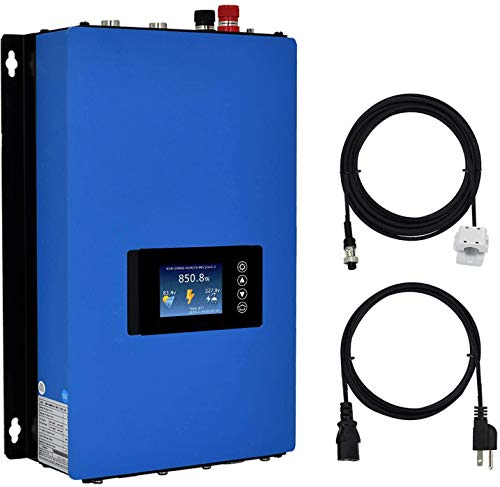
This Y&H unit emphasizes a built-in limiter sensor and an MPPT-based efficiency claim up to 99%. It supports DC inputs in a broad range and is suitable for 36–60V panel arrays with 110/240V AC outputs, making it a strong match for U.S. homes and panels around 200W or greater. The system also features a battery discharge mode for compatible setups. Best for: homes needing controlled power delivery and predictable load matching. Caution: verify the panel voltage and run-length of wiring to stay within recommended circuit limits to preserve performance.
Who it’s best for: Users who want a grid-tie inverter that actively throttles output to match load. Why selected: The limiting feature helps prevent overfeeding and reduces the risk of grid-related issues. Limitation: Requires correct matching of panel voltages and load to avoid underutilization of available sun.
Lumicasaler 1000W Solar Micro Inverter Grid Tie

The Lumicasaler micro inverter is designed for 36V solar panels or 36V batteries, delivering 1000W with IP65-rated protection for outdoor or harsh environments. It touts MPPT-driven efficiency above 99% and a pure sine wave output for compatibility with sensitive devices. A practical note: micro inverters are most cost-effective for smaller, modular installations or roof siting; large-scale deployments may benefit from centralized inverters. Best for: compact, weather-exposed installations where protection and reliability matter. Caution: integration with many panels may require planning for panel-level voltage and shading effects.
Aiwewin Solar Grid Tie Micro Inverter 800W

The Aiwewin 800W micro inverter offers 96% peak efficiency with dual MPPT tracking suited for two separate solar panels, aiming to maximize generation under shading. Its 120V AC output and compact footprint make it a practical choice for small residences or light commercial use. A caution is that lower wattage means you may need more units to scale up; ensure the app and monitoring features align with your install. Who it’s for: budget-conscious buyers needing straightforward, modular micro-inverter setup for a small system. Why selected: strong value with dual MPPT and reliable sine-wave output.
Buying Guide: Key Considerations for Cheap Grid Tie Inverters
- System voltage range and MPPT: Match the inverter’s input voltage range to your panel array. Higher MPPT efficiency helps maximize power harvest in variable sunlight.
- Output voltage compatibility: Ensure the inverter’s AC output is compatible with your grid or equipment (typical residential use is 110–120V or 220–240V).
- DC input range vs. panel configuration: Low-voltage inputs work well for small setups; higher-voltage inputs suit larger or multi-panel strings.
- Reliability vs. cost: Budget options may trade some durability; check aluminum housing, thermal design, and fanless vs. active cooling for long-term stability.
- Safety and protection features: Look for over-voltage, short-circuit, and grid-connection protections, plus proper isolation between input and output.
- Weather and installation: For outdoor use, IP-rated enclosures and robust connectors support longer life. Consider micro inverters for modular, weather-protected placements.
- Expansion and stacking: Some models support multiple units in parallel for higher total output; assess whether stacking aligns with your plans.
- Monitoring and ease of use: LCDs, apps, and remote monitoring can simplify maintenance and optimization of energy harvest.
Frequently Asked Questions
- What is a grid tie inverter? – It converts DC from solar panels to AC and synchronizes with the grid to feed power back to the electrical system.
- Do cheap grid tie inverters work with batteries? – Some can, especially models designed to work with battery banks and limiter features, but many grid-tie units do not require batteries.
- What size inverter do I need for my panel setup? – Choose an inverter that matches your panel voltage and total Wattage. For 1 kW systems, a 1 kW inverter is typical.
- Are micro inverters better for shading? – Yes, micro inverters track each panel individually, reducing losses from shading compared to central inverters.
- Is MPPT necessary in a grid tie inverter? – MPPT helps maximize energy harvest, particularly in fluctuating sunlight, making it a desirable feature in budget models.
- Can I mix different brands of grid tie inverters? – It is possible in a larger system with careful design, but in practice, matching voltage, current, and MPPT characteristics is important for safety and efficiency.