Best Cheap Flexible Solar Panels for Off-Grid Power
Yes, affordable flexible solar panels exist that fit curved surfaces on RVs, boats, campers, and trailers. This guide highlights five cost-conscious options designed for portability, easy mounting, and reliable performance on uneven or curved roofs. Each pick suits different off-grid buyers—from budget travelers to hobbyists seeking lightweight setups—without sacrificing essential flexibility or durability. Below, compare top picks, then read a practical buying guide and answers to common questions.
| Product | |||
|---|---|---|---|
| DOKIO 100W Semi-Flexible 18V | Monocrystalline flexible panel | Travelers and campers needing light weight | Up to 30° bend |
| Renogy 100W Flexible Panel | Ultra-flexible, monocrystalline | Boats, RVs, and curved surfaces | Up to 240° fold/bend |
| BougeRV Arch Pro 200W | N-Type, high-efficiency flex | Shaded or larger power needs | Highly bendable with shading resilience |
| ECO-WORTHY 130W (2-pack) | Flexible monocrystalline panels | Curved surfaces on RVs and boats | Up to 270° bend per panel |
| Topunive 100W 9BB | Flexible, high-efficiency cells | Versatile portable setups | Non-specific bend limit stated; multiple uses |
Below is a closer look at each option, including who it’s best for, why it’s a good fit, and a practical caveat to consider before buying.
DOKIO 100W Flexible Solar Panel

The DOKIO 100W model is a lightweight, semi-flexible option designed for travel, camping, and seasonal off-grid use. It weighs about 2.3 lb and remains only 0.03 inches thick, making it easy to mount on curved or irregular surfaces. Best for casual campers who need a portable solar boost without heavy setups.
Best for: Budget-conscious travelers needing a compact, carry-friendly panel for RVs, boats, or tents. Why selected: strong weight-to-output ratio and very thin profile support mobile applications where rigid panels won’t fit.
Caution: Over-bending or stepping on the panel can reduce performance; ensure ventilation and avoid mounting on combustible materials.
Renogy 100W Flexible Panel
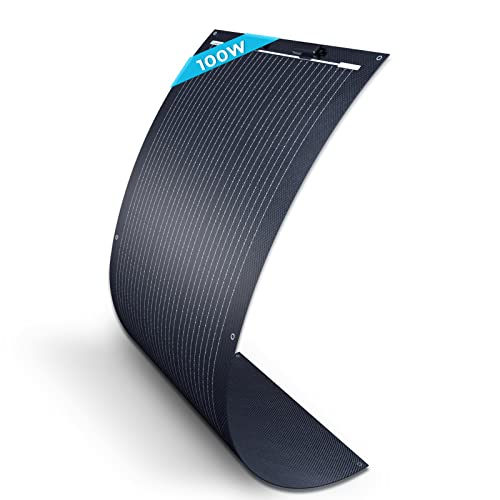
This panel uses advanced half-cut PERC cell technology to improve light capture and overall output. It’s lighter than rigid panels and is designed for curved surfaces on boats, RVs, and cabins. Best for buyers who want higher efficiency in a flexible form factor without sacrificing portability.
Best for: Those seeking higher efficiency on curved surfaces. Why selected: industry-leading tech can translate to better daily output under variable sun.
Caution: Confirm compatibility with power systems or inverters before wiring multiple panels in series; data indicates careful integration is needed for certain setups.
Renogy Flexible Panel 100W (Second Entry)

This Renogy model emphasizes extreme flexibility and a very thin laminated profile. It weighs substantially less than rigid panels and is designed to mount on uneven or curved surfaces, such as an RV roof or boat deck. Best for: Users prioritizing ultra-thin, stealthy installations where visibility matters less than discreet power delivery.
Limitation: While flexible, ensure the chosen mounting surface remains ventilated to avoid heat buildup, which can affect efficiency.
BougeRV Arch Pro 200W

BougeRV Arch Pro uses an advanced N-type 16BB cell design with high efficiency and a robust bending range. It is suited for larger off-grid needs and situations where shading might be a factor, such as tree-dappled sites. Best for: RVs or boats requiring higher wattage and strong performance in partial shade. Why selected: higher power density and improved shading resilience help maintain steady output under challenging conditions.
Caution: Open-circuit voltage ranges may differ from some power stations; check your equipment’s input specifications before purchase.
ECO-WORTHY 130W Flexible Panels (2-Pack)

Two flexible 130W panels provide a combined 260W option with excellent flexibility (up to 270° bend per panel). They’re lightweight at about 4.4 lb per pair and designed for curved surfaces on RVs, boats, cabins, or tents. Best for: Buyers needing more total power while maintaining a flexible, portable form. Why selected: higher output per panel and compact packaging make this a strong value for larger off-grid setups.
Caution: Ensure your mounting surface allows for venting to prevent heat buildup, and verify that the panels’ open-circuit voltage works with your power system.
Topunive 100W 9BB Flexible Panel

The Topunive 100W panel uses 9BB monocrystalline cells for higher conversion efficiency and flexibility. Its compact 0.11-inch thickness and light weight support versatile mounting on diverse surfaces, including trailers, boats, and tents. Best for: Those needing a balance of efficiency and flexibility in a portable package. Why selected: 9BB design can offer improved output consistency and durability in curved installations.
Caution: The minimum bend radius is specified; respect that limit to avoid micro-cracks and reduced longevity over time.
Buying Guide: Key Considerations For Cheap Flexible Solar Panels
- Flexibility vs. durability: Higher bendability often correlates with thinner laminates. Choose a product that matches your surface curvature and expected handling.
- Power needs: Estimate daily energy usage and sun hours. If you routinely run heavier loads, consider higher-wattage flexible panels or a pack (two panels) for more total energy.
- Weight and portability: Lightweight panels are ideal for temporary setups and frequent relocation. Heavier panels may provide more robust long-term performance but require sturdier mounting.
- Mounting surface and ventilation: Ensure the mounting area supports ventilation to prevent heat buildup, which can degrade efficiency and lifespan.
- Shading resilience: If the installation area experiences partial shading, panels with better bypass diode technology or higher shading tolerance can maintain output.
- Electrical compatibility: Check open-circuit voltage, wiring requirements, and compatibility with charge controllers and batteries in your system.
- Packaging and protection: Some sellers provide foam protection during shipping; this can influence how well panels arrive and install on your vehicle or boat.
FAQ: Quick Answers For Buyers
- What makes flexible solar panels cheap?
They typically use thinner laminates, lighter frames, and simplified builds designed for temporary or semi-permanent setups. - Are flexible panels as durable as rigid panels?
They are generally less resistant to impact and may be more prone to micro-cracks if bent beyond recommended limits, but modern designs improve resilience with flexible laminates. - Can flexible panels be mounted on a curved RV roof?
Yes. Look for panels advertised as bendable up to 240° or 270° for curved surfaces, and follow mounting guidance for cooling and ventilation. - Do I need a special controller for flexible panels?
You typically need a compatible solar charge controller rated for the panel’s voltage and current and a storage battery system sized to your load. - Is a two-panel setup better than a single panel?
For higher daily output or larger battery banks, two panels can provide more energy and flexibility in placement, especially on limited roof spaces. - How do I choose between brands?
Consider efficiency (PERC or advanced cells), stated bendability, weight, and how well the panel fits your vessel or vehicle’s surface and power demands.