Best Chargers for Marine Battery Systems
Choosing the right charger for a marine battery system ensures reliable starts, longer battery life, and safer operation at sea. This guide focuses on high-performance, waterproof onboard chargers from NOCO and trusted alternatives, highlighting multi-bank options, charging modes, and protection features for lead-acid and lithium batteries. Read on to compare top models and find the best fit for your vessel.
| Product | Brand | Bank Count & Output | Main Benefit |
|---|---|---|---|
| NOCO Genius GEN5X2 | NOCO | 2 Banks, 10A total (5A per bank) | Compact, versatile two-bank charger for 12V systems |
| 2 Bank Marine Battery Charger 5X2 | FirstPower Pro | 2 Banks, 10A total (5A per bank) | IP68 waterproof with independent mode selection |
| NOCO Genius GEN5X3 | NOCO | 3 Banks, 15A total (5A per bank) | Three-bank flexibility with advanced protections |
| NOCO Genius GEN5X1 | NOCO | 1 Bank, 5A | Single-bank compact option with robust modes |
| NOCO Genius GENPRO10X4 | NOCO | 4 Banks, 40A total (10A per bank) | High-capacity four-bank charger for larger fleets |
Note: This overview emphasizes capability, durability in marine environments, and compatibility with lead-acid, AGM, calcium, and lithium batteries. Each listed model provides temperature compensation and overcharge protection to safeguard electrical systems on boats, docks, and vessels.
NOCO Genius GEN5X2: 2-Bank Marine Charger

The GEN5X2 offers two independent charging banks with a combined 10A output, delivering 5A per bank. It is designed for 12V marine systems and supports lead-acid and lithium batteries. Modes include 12V, 12V AGM, 12V Lithium, and a Repair Mode to restore weak batteries. The charger is touted as compact relative to power, with temperature compensation and overcharge protection for safe operation in variable marine environments. Its two-bank configuration is suitable for boats with separate starting and deep-cycle batteries.
Key features include waterproof construction, independent bank control, and mode versatility, making it a practical centerpiece for mid-sized boats or vessels with multiple 12V battery banks. Installation should consider shore power access and ventilation to maximize longevity and performance.
2 Bank Marine Charger 5X2: FirstPower Pro

The 5X2 model from FirstPower Pro provides two independent 5A charging channels within a 12V waterproof enclosure. It supports 12V SLA/AGM, lithium, and calcium chemistries, with IP68 sealing suitable for on-deck or open-water installations. Each battery can be independently set to the appropriate charging mode via a simple interface, and a Force Mode allows charging from very low voltages (below 1V) to recover depleted cells. This makes it a strong option for boats with mixed battery chemistries and the need for 24/7 maintenance capability while at sea.
Practical considerations include ensuring proper mounting to prevent water intrusion, selecting suitable mode settings for each bank, and confirming compatible battery types prior to installation. It is designed to enable continuous charging and maintenance without frequent human intervention.
NOCO Genius GEN5X3: 3-Bank Marine Charger
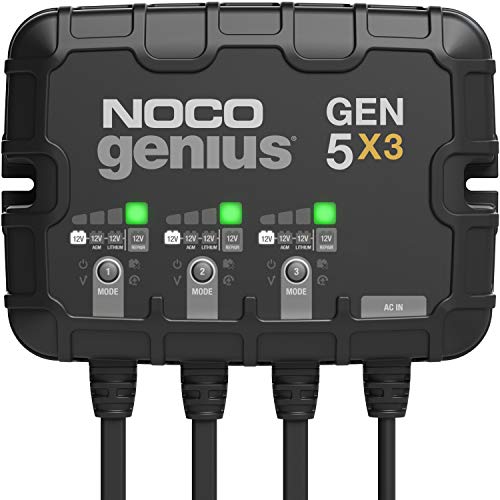
The GEN5X3 expands to three banks, offering a total of 15A (5A per bank) to efficiently manage separate 12V battery systems on larger boats. Each bank can be configured for 12V, 12V AGM, 12V Lithium, or a Repair Mode, enabling precise charging and maintenance for lead-acid and lithium chemistries. The GEN5X3 is described as compact and rugged, engineered for the toughest marine environments, with temperature compensation to adapt to changing conditions aboard.
When integrating a three-bank charger, considerations include space for installation, heat dissipation, and ensuring there is no interference with navigation or other critical electronics. The ability to independently manage each bank supports complex battery layouts common on coastal or offshore vessels.
NOCO Genius GEN5X1: 1-Bank 5A Charger
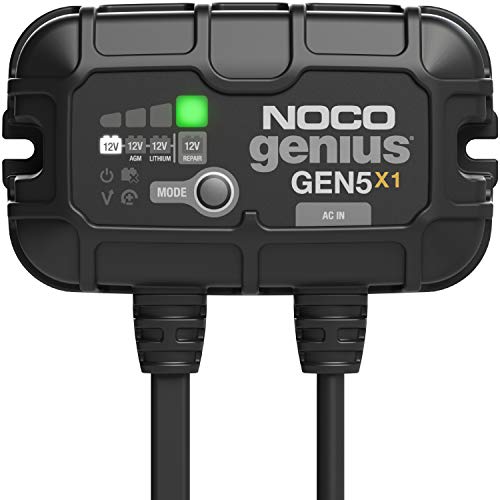
The GEN5X1 provides a single 5A bank, ideal for smaller boats or added charging capacity where only one battery bank needs dedicated charging. It supports 12V lead-acid, AGM, calcium, and lithium batteries, with multiple charging modes and a Repair Mode. Its compact size and straightforward interface make it a practical choice for vessels with limited space or as a supplementary charger for a secondary battery bank.
Key considerations include evaluating whether a lone 5A bank meets the vessel’s daily charging needs, and ensuring compatible battery types are selected to maximize charging efficiency and battery longevity in marine environments.
NOCO Genius GENPRO10X4: 4-Bank 40A Charger
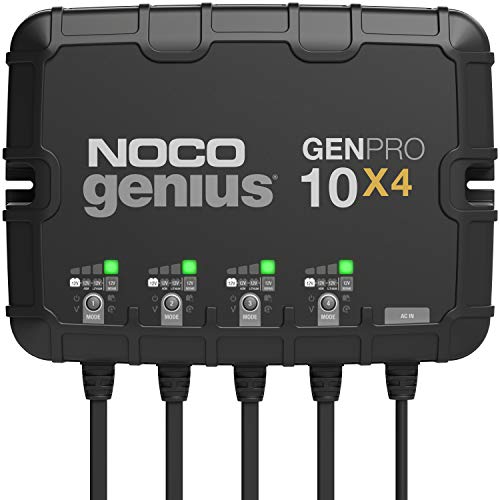
The GENPRO10X4 is a four-bank charger with a total 40A (10A per bank) capacity, designed for larger marine electrical setups that require robust simultaneous charging for multiple batteries. Each bank supports 12V, 12V AGM, 12V Lithium, and a Repair Mode. The unit is compact for its power level and emphasizes protection features, temperature compensation, and independent bank operation to ensure precise charging across four batteries or banked systems.
Assessing deployments for this model involves vessel size, the number of batteries, and whether the boat’s electrical load benefits from a four-bank independent charging arrangement. Adequate ventilation and secure installation are recommended to maintain performance in marine conditions.
Buying Guide
- Bank count and total output: Match the charger’s banks to your boat’s battery layout. More banks allow independent charging of multiple batteries without cross-interference.
- Battery chemistry support: Ensure the charger accommodates lead-acid, AGM, calcium, and lithium (LiFePO4) chemistry, if applicable to your fleet.
- Protection and efficiency: Look for overcharge protection, temperature compensation, and recovery modes that can help preserve battery life in varying climates.
- Waterproofing and ruggedness: Marine environments demand IP ratings (e.g., IP68) and solid housings to withstand spray, humidity, and vibration.
- Maintenance modes: Repair or desulfation features can extend the life of aging batteries by providing targeted charging cycles.
- Installation footprint: Consider space, mounting orientation, and cable routing to avoid interference with navigational gear and to minimize heat buildup.
- Future needs: If you anticipate expanding battery capacity or adding more banks later, choosing a higher-bank model may offer scalability without replacing hardware.
- Warranty and support: Prefer brands with robust support and longer warranties to protect your investment in harsh marine conditions.